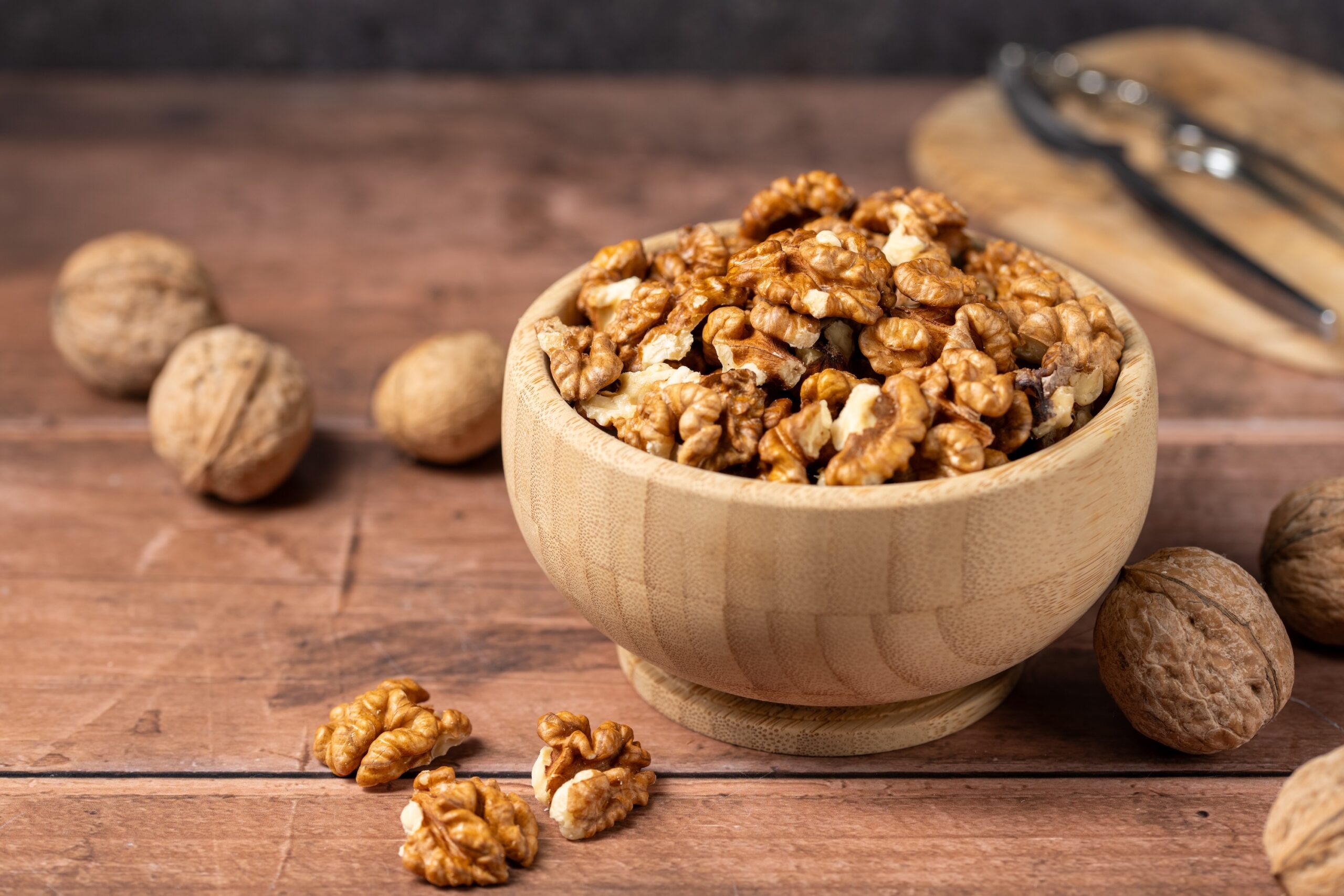
Walnuts have long been considered a healthy food. They’re a staple of heart-healthy eating patterns, often recommended as a plant-based source of omega-3 fats, and sometimes even nicknamed “brain food” thanks to both their nutrient profile and their distinctly brain-like shape.
But if you’re trying to lose weight, walnuts can seem a little harder to figure out. One ounce—about 14 walnut halves—has around 185 calories and 18 grams of fat. That’s a lot of calories packed into a small handful. At the same time, walnuts provide protein, fiber, and mostly unsaturated fats, nutrients that can help make meals and snacks more satisfying.
So, are walnuts actually a good choice for weight loss? Research suggests they can be. Eating nuts regularly doesn’t appear to promote the weight gain their calorie content might suggest, and walnuts may have some advantages when it comes to fullness and overall diet quality.
Here’s what to know about walnuts and weight loss, including what’s in them, what the research shows, and how to fit them into your diet without accidentally turning a handful into several.
✅ Quick answers
- How many calories are in walnuts? About 185 calories per ounce, which is roughly 14 walnut halves. A 100-gram serving has about 650 calories.
- Are walnuts good for weight loss? They can be. Walnuts are calorie-dense, but research shows that they can fit into a reduced-calorie diet without preventing weight loss.
- Do walnuts have protein? Yes. One ounce of walnuts provides about 4 grams of protein. They’re not as high in protein as some other nuts, such as almonds and pistachios.
- How many net carbs are in walnuts? One ounce has about 4 grams of total carbohydrates and 2 grams of fiber, for roughly 2 grams of net carbs.
- Do walnuts have omega-3s? Yes. One ounce provides about 2.5 grams of ALA, a plant-based omega-3 fatty acid. That’s more than other commonly eaten nuts.
🚀 Weight loss benefits of walnuts
- Walnuts may help you feel full. Walnuts contain fat, fiber, and protein, all of which can contribute to fullness. But walnut-specific research is mixed: Some studies find that eating them regularly increases feelings of fullness, while others find little difference after a single meal.
- Walnuts can fit into a weight-loss diet. In one study, people following a reduced-calorie diet that included walnuts lost about as much weight as those following a standard reduced-calorie diet. In other words, their higher calorie and fat content didn’t prevent weight loss.
- Walnuts can be a nutritious swap for other sources of fat. Using walnuts in place of foods like butter, cheese, or creamy dressings can add unsaturated fats, fiber, and other nutrients. Research suggests this type of swap can also improve measures like LDL cholesterol and blood pressure while you’re losing weight.
⚠️ 3 things to be mindful of
- Calorie density makes portions important. One ounce of walnuts—about 14 halves—has around 185 calories, so a relatively small handful can add up quickly. Studies showing that walnuts can fit into a weight-loss diet generally use defined portions, not unlimited amounts. Measuring out a serving instead of snacking straight from the bag can make it easier to enjoy walnuts while keeping calories in line with your goals.
- Tree nut allergies can be serious. Walnuts are a tree nut and can cause allergic reactions ranging from mild symptoms to severe, potentially life-threatening anaphylaxis. If you have a walnut or tree nut allergy, check with your allergist about which nuts and walnut-containing products you need to avoid.
- Walnuts can go rancid relatively quickly. Walnuts are rich in polyunsaturated fats, which are more prone to oxidation than some other types of fat. If they taste unusually bitter or have an off smell, it’s best to toss them. Storing walnuts in the refrigerator or freezer can help them stay fresh longer, especially if you buy them in larger quantities.
🥗 Nutrients in walnuts (per 1 ounce, about 14 halves)
| Nutrient | Amount | % RDA* |
|---|---|---|
| Calories | 185 calories | 9% |
| Protein | 4.3 g | 9% |
| Total carbs | 3.9 g | 1% |
| Fiber | 1.9 g | 7% |
| Sugars | 0.7 g | — |
| Total fat | 18.5 g | 24% |
| – Saturated fat | 1.7 g | 9% |
| – Monounsaturated fat | 2.5 g | — |
| – Polyunsaturated fat | 13.4 g | — |
| Omega-3 (ALA) | 2.5 g | — |
| Omega-6 (linoleic acid) | 10.7 g | — |
*Recommended dietary allowance (RDA) is defined as the average daily amount of nutrients needed to meet the requirements of nearly all healthy people in a specific group.
Noom’s Most Powerful Program
A dual-pathway GLP-1 and behavior change for lasting results.
Fat is the standout nutrient in walnuts, but the type of fat matters. Most of the 18 or so grams of fat is polyunsaturated, with only about 1.7 grams coming from saturated fat. Walnuts are particularly notable for alpha-linolenic acid (ALA), a plant-based omega-3 fatty acid. One ounce provides about 2.5 grams—more than any other commonly eaten nut.
Walnuts aren’t especially high in protein, though. Their 4.3 grams per ounce is less than you’ll get from the same amount of almonds, pistachios, or peanuts. If you’re eating walnuts as a snack, pairing them with a protein-rich food, like Greek yogurt, can make the combination more filling while still giving you the healthy fats walnuts are known for.
💊 Vitamins & minerals in walnuts (per 1 ounce, about 14 halves)
| Vitamin/Mineral | Amount | % RDA* |
|---|---|---|
| Copper | 0.44 mg | 49% |
| Manganese | 0.96 mg | 42% |
| Magnesium | 44 mg | 10% |
| Vitamin B6 | 0.15 mg | 9% |
| Phosphorus | 97 mg | 8% |
| Zinc | 0.87 mg | 8% |
| Folate | 27 mcg | 7% |
| Iron | 0.81 mg | 5% |
| Potassium | 123 mg | 3% |
Copper and manganese are the standout minerals in walnuts. One ounce provides nearly half of the recommended daily amount of copper and more than 40% of the recommended amount of manganese. Copper helps your body produce energy, form connective tissue, and maintain the nervous and immune systems, while manganese is involved in metabolism, bone formation, and antioxidant defenses.
One of the biggest nutritional benefits of walnuts is that they’re also rich in omega-3s. One ounce provides about 2.5 grams of alpha-linolenic acid (ALA), a plant-based omega-3 fatty acid—more than you’ll get from other commonly eaten nuts. ALA is an essential fat, meaning your body can’t make it and you need to get it from food. It has also been linked with cardiovascular benefits.
Walnuts provide smaller amounts of magnesium, vitamin B6, phosphorus, zinc, folate, iron, and potassium. They also contain polyphenols and other antioxidant compounds. No single nutrient makes walnuts a weight-loss food, but together, their unsaturated fats, omega-3s, minerals, and plant compounds make them a nutrient-dense choice.
🔍 Nutrient breakdown
Glycemic index (GI) of walnuts
Glycemic index: Very low/not typically rated
💡 Walnuts contain very little digestible carbohydrate—about 4 grams of total carbs and 2 grams of fiber per ounce—so they’re unlikely to cause a large rise in blood sugar when eaten on their own.
Are walnuts high in protein?
❌ No: Walnuts contain about 4 grams of protein per ounce, which is modest compared with some other nuts and protein-rich foods. They can contribute to your daily protein total, but they probably won’t provide enough on their own to make a meal particularly filling.
Higher-protein alternatives: Peanuts | Pistachios | Greek yogurt
Are walnuts high in fiber?
❌ No: Walnuts provide about 2 grams of fiber per ounce. That contributes to your daily total, but it’s not enough to consider them a particularly high-fiber food. 💡 Pair walnuts with fruit, vegetables, or another fiber-rich food to get more fiber from your meal or snack.
Noom’s Most Powerful Program
A dual-pathway GLP-1 and behavior change for lasting results.
Are walnuts low in carbs?
✔️ Yes: One ounce of walnuts contains about 4 grams of total carbohydrates, including about 2 grams of fiber. That leaves relatively little digestible carbohydrate. 💡 This can make walnuts easy to fit into a lower-carb eating pattern.
Are walnuts gluten-free?
✔️ Yes: Plain walnuts are naturally gluten-free. If you have celiac disease or need to strictly avoid gluten, check the package for potential cross-contact, especially with flavored or processed walnut products.
Are walnuts good for fat loss?
🤷 Maybe: Walnuts won’t directly make your body burn more fat, but they can fit into a calorie deficit—the key driver of fat loss. Their combination of fat, fiber, and some protein may also help with fullness, although studies specifically testing walnuts and appetite have had mixed results. The main thing to watch is portion size: At about 185 calories per ounce, walnuts can add calories quickly even though they’re nutritious.
🍽️ Diet compatibility: Which diets include walnuts?
| Diet | ✅ / ❌ | Why |
|---|---|---|
| Keto | ✅ | Walnuts’ fat-heavy, carb-light profile fits easily within a ketogenic macro split without pushing daily carb totals out of range. |
| Paleo | ✅ | As a whole, unprocessed food with no grains, dairy, or added sugar, walnuts fit the paleo framework cleanly. |
| Mediterranean | ✅ | Walnuts are a staple of the traditional Mediterranean diet and were used directly in the landmark PREDIMED cardiovascular trial. |
| Vegan | ✅ | Walnuts are entirely plant-based, with no animal-derived ingredients in their raw or dry-roasted form. |
| Gluten-Free | ✅ | Walnuts contain no gluten naturally; only cross-contact during processing is a concern for people with celiac disease. |
Walnuts fit cleanly into nearly every major eating pattern without modification, which is part of why they show up across so many different diet plans. The main adjustment for any of these diets is portion tracking, since the fit works nutritionally but the calorie math still needs attention regardless of which diet you’re following.
🌟 Are walnuts healthy? What are the health benefits?
Metabolic health: Are walnuts good for your metabolism?
- Boosts metabolism? ❌ No — There’s no good evidence that eating walnuts meaningfully increases your metabolic rate or causes you to burn significantly more calories. Their unsaturated fats may be metabolized somewhat differently from saturated fats, but that doesn’t make walnuts a metabolism-boosting food.
- Improves insulin sensitivity? 🤷 Maybe — Research on walnuts and blood sugar control is mixed. Some studies suggest that regularly eating walnuts may support insulin sensitivity or other markers of metabolic health, particularly when they replace foods higher in saturated fat, but walnuts haven’t consistently improved insulin resistance across trials.
- Effect on fat storage? ➖ Likely neutral — Eating walnuts hasn’t been shown to specifically prevent your body from storing fat. What research does suggest is that adding reasonable portions of walnuts to your diet doesn’t necessarily lead to weight or body-fat gain, despite their high calorie and fat content. For fat loss, your overall calorie intake still matters most.
Cholesterol impact: Do walnuts affect cholesterol levels?
- Does it lower LDL (“bad”) cholesterol? ✔️ Yes — An analysis of several studies found that diets that included walnuts lowered LDL cholesterol by about 5.5 mg/dL more than diets without walnuts. They also reduced total cholesterol without negatively affecting body weight.
- Does it raise HDL (“good”) cholesterol? ❌ No — The same analysis found no significant change in HDL cholesterol. That doesn’t cancel out the benefit: Lowering LDL is itself an important part of reducing cardiovascular risk.
- Overall impact on heart health? ❤️ Favorable — In a study of older adults, eating walnuts daily for two years lowered LDL cholesterol and reduced the number of small, dense LDL particles, which are associated with plaque buildup in the arteries. Regularly eating walnuts also didn’t lead to weight gain.
💡 Walnuts may be especially useful when they replace foods higher in saturated fat, such as butter or some cheeses, rather than simply being added on top of everything else you already eat.
Can you eat walnuts in a calorie deficit?
✔️ Yes. A study comparing two reduced-calorie diets found that people whose diet included walnuts lost about as much weight over six months as those following a standard reduced-calorie diet.
💡 Because walnuts are calorie-dense, try swapping them for another source of fat—such as cheese on a salad—rather than simply adding them to what you already eat.
Are walnuts rich in antioxidants?
✔️ Yes. Walnuts contain several antioxidant compounds, particularly polyphenols called ellagitannins. Many of these compounds are concentrated in the thin brown skin around the walnut, so there’s no nutritional reason to remove it.
Do walnuts support gut health?
🤷 Possibly. Early research suggests that eating walnuts may change the composition of gut bacteria in potentially beneficial ways. But research is still developing, and we don’t know whether these changes translate into meaningful differences in weight or overall health.
Do walnuts support digestion?
✔️ Yes, but they’re not especially high in fiber. An ounce of walnuts provides about 2 grams of fiber, which can contribute to regular digestion and support gut bacteria. Pairing walnuts with higher-fiber foods like fruit can give you more of a digestive benefit.
Do walnuts help you feel full and less hungry?
🤷 Maybe. Walnuts contain fat, fiber, and protein, all of which can contribute to fullness, but studies specifically testing walnuts have had mixed results. Some research suggests regularly eating walnuts may increase feelings of fullness, while other studies have found little or no difference compared with diets without walnuts.
💡 Your own response matters, too. If a measured serving of walnuts helps keep you satisfied between meals, they may be a useful addition to your weight-loss plan. If you can easily eat several servings without feeling much fuller, another snack with more protein or fiber might work better for you.
Do walnuts help reduce inflammation?
🤷 Possibly. Walnuts contain ALA omega-3 fats and polyphenols, both of which have been studied for their anti-inflammatory effects. Some studies have found improvements in certain markers of inflammation, but results aren’t consistent enough to consider walnuts an anti-inflammatory treatment.
Are walnuts beneficial for brain health?
🤷 Maybe, but the evidence is mixed. Walnuts contain nutrients associated with brain health, including ALA omega-3 fats and polyphenols. But in a large study that followed older adults for two years, eating walnuts every day didn’t improve cognitive outcomes overall. Researchers did see a possible benefit in one subgroup, but more research is needed.
Can walnuts improve skin and hair health?
🤷 There’s not enough evidence to say. Walnuts provide healthy fats and several vitamins and minerals involved in overall skin and hair health, but studies haven’t shown that eating walnuts specifically improves either one.
Can walnuts help balance hormones?
🤷 There’s no strong evidence that they can. Your body needs dietary fat for many functions, including hormone production, but that doesn’t mean walnuts specifically “balance” hormones. No single food has been shown to correct a hormonal imbalance.
🍽️ Best ways to eat walnuts for weight loss
National Walnut Day is May 17. Here are the best ways to include them in your diet:
- Pair them with protein and fiber. Add a measured serving of chopped walnuts to Greek yogurt and fruit, sprinkle them over oatmeal, or add them to a smoothie bowl. Walnuts provide healthy fats and some fiber, while foods like Greek yogurt can add the protein that walnuts are relatively low in.
- Toast them for more flavor. A few minutes in a dry skillet or the oven brings out walnuts’ nutty flavor and adds crunch without adding extra calories. Try toasted walnuts on salads, oatmeal, yogurt, or roasted vegetables.
- Use them as a swap, not just an add-on. Sprinkle walnuts over a salad in place of croutons or some of the cheese, or use them to replace some of the butter in baked goods. This lets you get the nutritional benefits of walnuts without simply adding more calories to your meal.
- Portion them before you start eating. One ounce is about 14 walnut halves and contains around 185 calories. Instead of eating straight from the bag, measure out a serving first. You still get a satisfying amount while making it much easier to keep track of how much you’re eating.
🍏 Walnuts vs. other nuts (per 1 ounce / 28 g)
| Nut | Calories | Carbs | Fiber | Protein | Fat |
|---|---|---|---|---|---|
| Walnuts | 185 | 4 g | 2 g | 4 g | 19 g |
| Cashews | 157 | 9 g | 1 g | 5 g | 12 g |
| Pistachios | 159 | 8 g | 3 g | 6 g | 13 g |
| Almonds | 164 | 6 g | 4 g | 6 g | 14 g |
| Pecans | 196 | 4 g | 3 g | 3 g | 20 g |
Walnuts are higher in calories than cashews, pistachios, and almonds, but they stand apart for their omega-3 content. They provide about 2.5 grams of ALA per ounce—far more than the other nuts in this comparison. Almonds and pistachios offer more protein and fiber for fewer calories, while pecans are slightly higher in calories and fat than walnuts.
There’s no single “best” nut for weight loss. If you’re looking for more protein and fiber, almonds or pistachios may have an edge. If getting more plant-based omega-3s is a priority, walnuts are the standout choice. Whichever you choose, keeping portions around an ounce can help you get the nutritional benefits without adding more calories than you intended.
Frequently asked questions about walnuts and weight loss
How many walnuts should I eat a day for weight loss?
There’s no specific number of walnuts you need to eat to lose weight. A standard serving is one ounce, or about 14 walnut halves, which has around 185 calories. That’s a useful starting point if you want the nutritional benefits of walnuts while keeping portions manageable. Depending on your calorie needs and the rest of your diet, you may eat more or less.
Access GLP-1 Weight Loss with Noom
Explore a wide range of prescription medications supported by Noom’s program.
Microdose GLP-1rx
Noom GLP-1rx
Noom GLP-1rx Plus
Wegovy®

Ozempic®

Metformin

Zepbound®

Mounjaro®
Liraglutide

Are walnuts or almonds better for weight loss?
Both can fit into a weight-loss diet, but they have different strengths. Almonds are lower in calories and provide more protein and fiber per ounce, which may make them a better choice if fullness is your main goal. Walnuts provide substantially more ALA omega-3 fat. You don’t have to choose just one—both can fit into a balanced diet.
What’s the best time to eat walnuts for weight loss?
There’s no evidence that eating walnuts at a particular time of day leads to greater weight loss. Instead, think about where they’re most useful in your day. Adding a measured portion to breakfast or lunch, or having them as part of a snack with fruit or another protein- or fiber-rich food, may help make that meal or snack more satisfying.
Can eating too many walnuts cause weight gain?
Yes. Walnuts are nutritious, but they’re also calorie-dense, with about 185 calories per ounce. Regularly eating several servings on top of your usual diet could make it harder to maintain the calorie deficit needed for weight loss. Portioning them before you eat can help prevent an unintended calorie surplus.
Is the omega-3 in walnuts the same as the omega-3 in salmon?
No. Walnuts contain alpha-linolenic acid (ALA), a plant-based form of omega-3 fat. Salmon contains mostly EPA and DHA, the forms of omega-3 that your body can use more directly.
Your body can convert ALA into EPA and DHA, but only a relatively small amount gets converted. That means walnuts are a great way to get more plant-based omega-3s, but they aren’t nutritionally equivalent to salmon or other fatty fish when it comes to EPA and DHA.
Are walnuts good for people with diabetes who are trying to lose weight?
They can be. Walnuts contain very little digestible carbohydrate and provide unsaturated fats, fiber, and protein, so they generally have little effect on blood sugar when eaten on their own. If you have diabetes, your overall eating pattern, medications, and individual blood sugar response matter more than any single food.
Do walnuts burn belly fat?
No. Walnuts haven’t been shown to specifically burn belly fat, and foods can’t determine where your body loses fat. Losing weight through a sustained calorie deficit can reduce abdominal fat along with fat stored elsewhere in the body. Walnuts can simply be one nutritious food that fits into that overall plan.
Are roasted walnuts as healthy as raw walnuts?
Yes, as long as you pay attention to how they’re prepared. Dry-roasted walnuts are nutritionally similar to raw walnuts and can be a flavorful option without adding extra calories. Oil-roasted, candied, or honey-roasted varieties may contain additional oil, sugar, or sodium, so check the nutrition label if those are things you’re watching.
🧠 The bottom line: Walnuts are good for weight loss in moderation
Walnuts won’t burn fat or dramatically boost your metabolism, but they can absolutely fit into a weight-loss plan. They provide unsaturated fats, some fiber and protein, and more plant-based omega-3 fat than other commonly eaten nuts. Those omega-3s aren’t likely to make you lose more weight, but they’re one reason walnuts can be a nutritious source of fat in a weight-loss diet. Research also shows that including measured portions of walnuts in a reduced-calorie diet doesn’t prevent weight loss and may help lower LDL cholesterol and blood pressure.
The key is portion size. One ounce, or about 14 walnut halves, has around 185 calories, so try using walnuts to replace another calorie-dense food rather than simply adding them to what you already eat. Pair them with protein- and fiber-rich foods like Greek yogurt and fruit to make a more balanced, satisfying meal or snack.
If you have a tree nut allergy, walnuts aren’t a safe choice. Otherwise, they can be a nutritious addition to a weight-loss diet. Measure out a serving first and let the scoop—not the bag—decide how much you eat.
Noom’s Most Powerful Program
A dual-pathway GLP-1 and behavior change for lasting results.
📖 Scientific evidence
- Walnuts may support weight loss while improving heart-health markers. (Nutrition Journal, 2017) Overweight and obese adults following a walnut-enriched reduced-calorie diet lost about as much weight as those on a standard reduced-calorie diet, while the walnut group had bigger reductions in LDL cholesterol and systolic blood pressure.
- Walnuts may help lower LDL cholesterol without causing weight gain. (American Journal of Clinical Nutrition, 2018) An analysis of 26 studies found that diets that included walnuts lowered LDL cholesterol by about 5.5 mg/dL more than diets without walnuts, with no significant change in body weight.
- Eating walnuts daily may improve cholesterol without causing weight gain. (Circulation, 2021) In a study of 708 healthy older adults, daily walnut consumption for two years reduced LDL cholesterol and the number of small, dense LDL particles associated with heart disease risk, without causing weight gain.
- Eating nuts doesn’t appear to increase body fat or waist size. (Obesity Reviews, 2021) An analysis of multiple studies found that eating nuts, including walnuts, generally wasn’t associated with increases in body fat or waist circumference compared with diets that didn’t include nuts.
- Eating nuts regularly may be linked to less weight gain over time. (Obesity, 2007) A study that followed nearly 9,000 adults for a little over two years found that people who ate nuts two or more times per week were less likely to have significant weight gain than those who rarely ate them.
- Eating walnuts regularly may help you feel fuller. (Obesity, 2010) In a four-day study of people with metabolic syndrome, a walnut-containing breakfast increased feelings of fullness compared with a breakfast without walnuts, but the difference didn’t appear until days three and four. Walnuts didn’t significantly change insulin resistance or resting energy expenditure.
- A single serving of walnuts may not make you feel fuller. (Appetite, 2017) In a study of overweight and obese adults, a walnut-containing meal didn’t significantly increase feelings of fullness or change most appetite-related hormones compared with a meal without nuts, although it did reduce the post-meal insulin response.
Editorial standards
At Noom, we’re committed to providing health information that’s grounded in reliable science and expert review. Our content is created with the support of qualified professionals and based on well-established research from trusted medical and scientific organizations. Learn more about the experts behind our content on our Health Expert Team page.