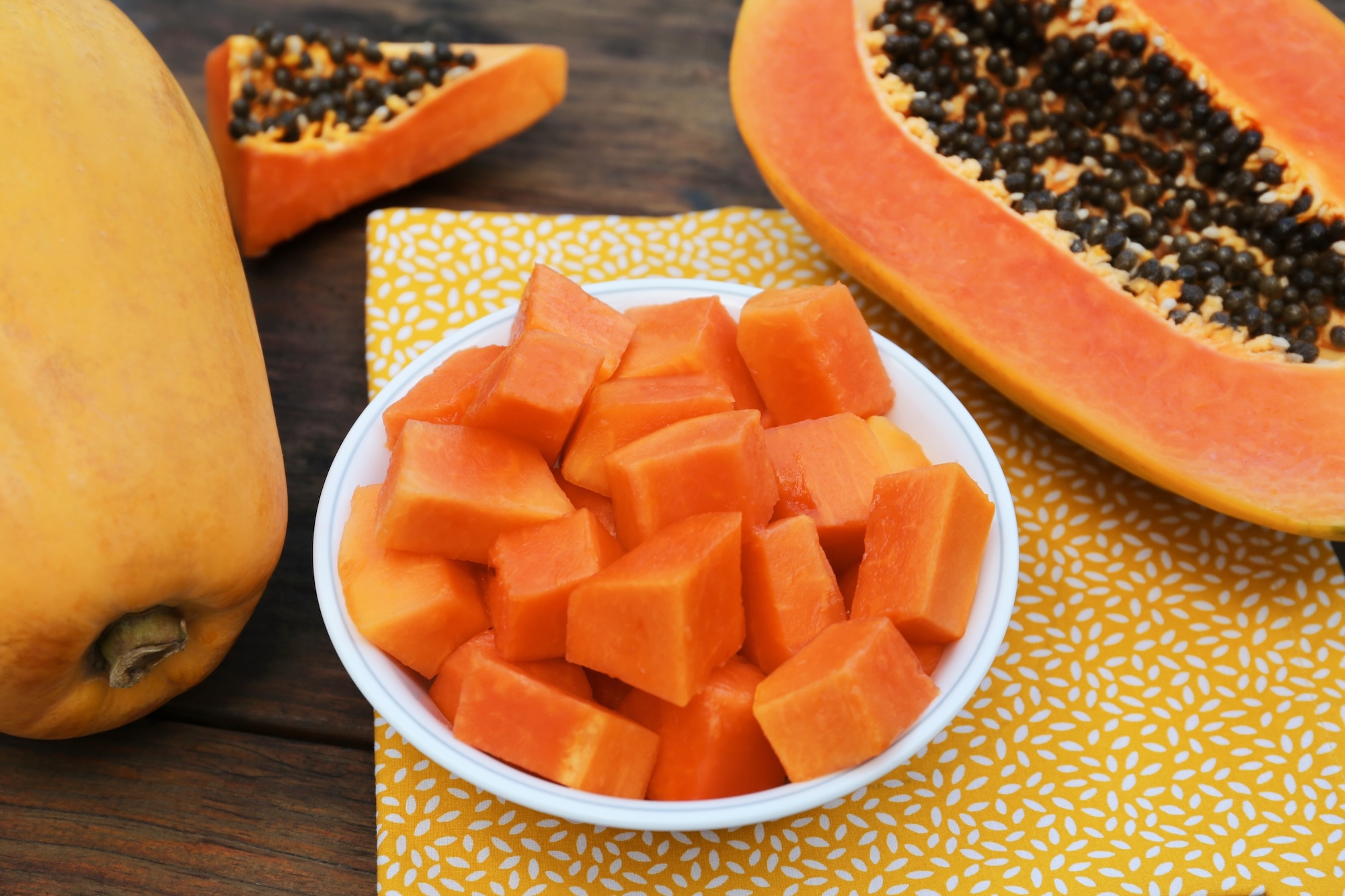
Papaya has become a favorite in gut-health circles, thanks largely to papain, an enzyme that helps break down protein and gives the fruit its reputation as a natural digestive aid. Online, that reputation has expanded into claims about everything from better digestion to weight loss—and, more dubiously, using raw papaya seeds as a natural parasite cleanse.
But you don’t need the more extreme claims to make a case for adding papaya to your diet. One cup of ripe papaya has just 62 calories, along with fiber, plenty of water, and nearly a full day’s worth of vitamin C. That makes it a relatively high-volume, low-calorie way to add something sweet to a meal or snack, which may be useful when you’re trying to lose weight.
Most people eat papaya ripe, when the flesh turns orange or salmon-pink and develops a mild sweetness often compared to melon and mango. Green papaya is firmer and starchier and is typically used in savory dishes like Thai som tam salad. Nutritionally, they’re a little different, so for this article, we’ll focus primarily on the ripe fruit.
So, is papaya actually good for weight loss? Here’s what its calories, fiber, nutrients, and the research on digestion and satiety can—and can’t—tell us.
✅ Quick answer: Is papaya good for weight loss?
Yes—papaya can be a good choice for weight loss as part of a calorie-conscious diet, mainly because it’s low in calories and high in water. A cup has just 62 calories and about 2.5 grams of fiber, which gives you a relatively large serving for few calories. But with less than a gram of protein, papaya probably won’t keep you full for hours on its own. Pair it with something more filling, like Greek yogurt, cottage cheese, or a handful of nuts, if you want it to hold you over longer.

The Easy Way
to lose weight and get healthy.
🚀 Weight-loss benefits of papaya
- You get a lot of fruit for very few calories. Papaya is about 88% water, so you can eat a fairly generous portion without adding many calories. A full cup has just 62 calories, compared with nearly 100 calories for the same amount of mango. That can be helpful for weight loss because lower-calorie-density foods let you eat satisfying portions while keeping your overall calorie intake lower.
- It gives you some filling fiber, too. A cup of papaya has about 2.5 grams of fiber. That’s not an especially high amount, but it does add some staying power and can help slow the absorption of the fruit’s natural sugars. Papaya probably won’t keep you full for hours on its own, but it can be a more satisfying choice than foods that pack a lot more calories into a smaller serving.
- Papain may give digestion a little help. Papaya contains papain, an enzyme that helps break down protein. That doesn’t mean papaya will help you lose weight directly, but it may help with digestion, particularly when you eat it alongside a protein-rich meal. Think papaya salsa with grilled chicken or fish, or papaya with Greek yogurt.
⚠️ Things to be mindful of with papaya
- Whole papaya will generally be more filling than papaya juice. Papaya’s high water content and fiber are part of what makes it a useful low-calorie food for weight loss. Juicing removes much of that fiber and makes it easier to drink a larger amount quickly, so stick with whole or blended papaya most of the time if fullness is your goal.
- Eating a lot at once may not agree with everyone. Papaya contains fiber as well as papain, an enzyme that helps break down protein. If you’re not used to eating much papaya, starting with a moderate portion can help you see how your digestive system responds.
- Some people should be more cautious with papaya. Papaya contains natural latex, particularly in the skin and unripe fruit, which may cause a reaction in people with a latex allergy. Unripe papaya also contains substantially more latex than ripe fruit and is generally avoided during pregnancy. If either applies to you, check with your healthcare provider about whether papaya is appropriate for you.
🥗 Nutrients in papaya (per 1 cup, cubed, 145 g)
| Nutrient | Amount | % RDA* |
|---|---|---|
| Calories | 62 calories | — |
| Protein | 0.7 g | 1% |
| Total carbs | 16 g | 6% |
| Fiber | 2.5 g | 9% |
| Sugars | 11 g | — |
| Total fat | 0.4 g | 1% |
| – Saturated fat | 0.1 g | 1% |
| – Monounsaturated fat | 0.1 g | — |
| – Polyunsaturated fat | 0.1 g | — |
| Omega-3 | 0 g | — |
| Omega-6 | 0.1 g | — |
*Recommended dietary allowance (RDA) is defined as the average daily amount of nutrients needed to meet the requirements of nearly all healthy people in a specific group.
Almost everything about papaya’s nutrition profile starts with its high water content. At just 62 calories per cup, you get a generous serving of fruit for relatively few calories. Most of its 16 grams of carbohydrates come from naturally occurring sugars, along with about 2.5 grams of fiber.
That fiber may not make papaya one of the highest-fiber fruits, but it still contributes to its overall volume and can help make it more satisfying. Combined with all that water, it’s one reason papaya can add plenty of food to your plate without adding many calories—something that can be especially useful when you’re trying to lose weight.
💊 Vitamins & minerals in papaya (per 1 cup, cubed, 145 g)
| Vitamin/Mineral | Amount | % RDA* |
|---|---|---|
| Vitamin C | 88 mg | 98% |
| Vitamin A | 276 mcg | 31% |
| Folate | 54 mcg | 14% |
| Vitamin E | 1.1 mg | 7% |
| Magnesium | 30 mg | 7% |
| Potassium | 264 mg | 6% |
| Pantothenic acid | 0.28 mg | 6% |
| Vitamin B6 | 0.06 mg | 4% |
| Niacin | 0.52 mg | 3% |
| Riboflavin | 0.04 mg | 3% |
Vitamin C is easily papaya’s standout nutrient. A single cup provides nearly a full day’s worth, along with vitamin A from carotenoids, including beta-carotene—the pigments that help give ripe papaya its orange color.
You’ll also get smaller amounts of folate, magnesium, potassium, vitamin E, and several B vitamins. None of those amounts are especially large on their own, but together they make papaya fairly nutrient-dense for a fruit with just 62 calories per cup.
That’s one of papaya’s biggest nutritional advantages if you’re trying to lose weight: You’re getting plenty of volume and a variety of vitamins and minerals without adding many calories to your day.
🔍 Papaya nutrient breakdown
Glycemic index (GI) of papaya
Glycemic index: 58 (Medium)
💡 Papaya falls in the medium-GI range, but GI only tells part of the story. A typical serving doesn’t contain a large amount of carbohydrate, and eating it whole gives you fiber and water along with its naturally occurring sugars.
Is papaya high in protein?
❌ No: Papaya has about 0.7 grams of protein per cup, which is typical for many fruits. If you want a more substantial snack, pair it with a protein-rich food like plain Greek yogurt or cottage cheese.
Is papaya high in fiber?
❌ No: A cup provides about 2.5 grams of fiber, or roughly 9% of the Daily Value. That’s a useful amount, although it’s less than you’ll get from higher-fiber fruits like pears or raspberries.
Noom’s Most Powerful Program
A dual-pathway GLP-1 and behavior change for lasting results.
💡 Add chia seeds or ground flax to papaya if you want to bump up the fiber in your snack.
Is papaya low in carbs?
❌ No: A cup has about 16 grams of carbohydrates, mostly from naturally occurring sugars. That’s a pretty typical amount for fruit, and those carbs come packaged with water, fiber, vitamins, and minerals.
Is papaya gluten-free?
✔️ Yes: Fresh papaya is naturally gluten-free. If you’re buying a packaged papaya product, check the ingredient list for anything added during processing.
Is papaya good for weight loss?
✔️ Yes: Papaya’s high water content and low calorie density make it a useful fruit for weight loss. A cup has just 62 calories, so you can eat a generous portion without adding many calories. It doesn’t burn fat or cause weight loss on its own, but it can be a satisfying alternative to more calorie-dense snacks.
🍽️ Diet compatibility: Which diets include papaya?
| Diet | ✅ / ❌ | Why |
|---|---|---|
| Keto | ❌ | A cup of ripe papaya has about 16 grams of carbs, which can take up a large share of the daily carb limit on a strict keto diet. Smaller portions may fit depending on your individual carb target. |
| Paleo | ✅ | Papaya is a whole, minimally processed fruit, so it fits comfortably within most paleo eating plans. |
| Mediterranean | ✅ | The Mediterranean diet encourages fruit as part of an overall plant-forward eating pattern. Papaya isn’t traditionally Mediterranean, but it can absolutely fit. |
| Vegan | ✅ | Papaya is a plant food with no animal-derived ingredients, making it naturally vegan. |
| Gluten-free | ✅ | Fresh papaya is naturally gluten-free. For packaged papaya products, check the label for added ingredients if you need to strictly avoid gluten. |
Papaya fits easily into most whole-food eating patterns. Paleo, Mediterranean, vegan, and gluten-free eaters can all include it without any special adjustments. The main exception is strict keto, where its carb content can make it harder to fit in compared with lower-carb fruits like berries or avocado.
If you follow a more moderate low-carb approach, papaya can still fit depending on your overall carb target. For most people, though, there’s no special reason to limit papaya—it can simply be enjoyed like any other whole fruit.
🌟 Is papaya healthy? What are the health benefits?
Metabolic health: Is papaya good for your metabolism?
- Boosts metabolism? ❌ No – There’s no evidence that eating papaya speeds up your metabolism or makes you burn more calories. Its potential advantage for weight loss comes from being a low-calorie, high-water food, not from a metabolism-boosting effect.
- Improves insulin sensitivity? 🤷 We don’t know yet – Animal studies have found improvements in insulin-related markers after consuming papaya, but researchers haven’t shown the same effect in people. For now, there isn’t enough evidence to say that eating papaya improves insulin sensitivity.
- Reduces fat storage? 🤷 We don’t know yet – Some animal research has found changes in fat cells associated with papaya consumption, but that doesn’t mean eating papaya prevents fat storage or reduces body fat in humans. Human studies are needed before we can draw that conclusion.
Cholesterol impact: Does papaya affect cholesterol levels?
- Does it lower LDL (“bad”) cholesterol? 🤷 We don’t know yet – Animal research has found lower LDL cholesterol in rats given papaya juice, but we don’t yet have good human studies showing that eating papaya lowers LDL.
- Does it raise HDL (“good”) cholesterol? ❌ Not proven – The same animal study found a small increase in HDL cholesterol, but the difference wasn’t statistically significant. There’s currently no good evidence that eating papaya raises HDL in people.
- Overall impact on heart health? ❤️ It can fit into a heart-healthy diet – Papaya provides fiber, potassium, vitamin C, and other plant compounds, all in a naturally low-calorie fruit. But that’s different from saying papaya itself lowers cholesterol or prevents heart disease, which hasn’t been established.
💡 Pair papaya with a few walnuts if heart health is the goal—the fat helps you absorb its carotenoids.
Can I eat papaya for a calorie deficit?
✔️ Yes: At just 62 calories per cup, papaya is easy to fit into a calorie deficit. Its high water content also gives you a relatively generous portion for few calories, making it a good option when you want something sweet.
💡 Try papaya in place of a more calorie-dense snack or dessert when you want to reduce calories without dramatically shrinking your portion.
Is papaya rich in antioxidants?
✔️ Yes: Papaya provides vitamin C and carotenoids, including beta-carotene and lycopene. These compounds act as antioxidants, helping protect cells from damage caused by oxidative stress.
Does papaya support gut health?
🔬 Possibly: Laboratory research suggests that fiber from papaya can be fermented by gut bacteria and may support beneficial microbes. But we still need human studies to know how much eating papaya actually changes the gut microbiome.
Does papaya support digestion?
✔️ Possibly: Papaya contains papain, an enzyme that helps break down protein. One small placebo-controlled study also found that a concentrated papaya preparation improved some digestive symptoms, including constipation and bloating. However, that study tested a papaya preparation rather than simply eating fresh papaya, so we can’t assume the effects are identical.
Does papaya help you feel full?
✔️ It can: Papaya is mostly water and provides about 2.5 grams of fiber per cup, so you get plenty of volume for just 62 calories. That can make it a satisfying snack, although how long it keeps you full will depend on the rest of your meal and your individual appetite.
💡 If you want a more substantial snack, pair papaya with Greek yogurt, cottage cheese, nuts, or seeds.
Does papaya help with nighttime cravings?
🤷 Not specifically: There’s no evidence that papaya has a special effect on nighttime cravings. But if you want something sweet in the evening, its low calorie density makes it an easy fruit to work into your day.
Does papaya help reduce inflammation?
🔬 Possibly, but the evidence is limited: Papaya contains vitamin C, carotenoids, and other plant compounds with antioxidant properties. Animal and laboratory studies have also found effects on inflammatory markers, but there isn’t enough human research to say that eating papaya reduces inflammation.
Is papaya beneficial for brain health?
🤷 We don’t know: Papaya contains antioxidants and other nutrients that are part of an overall nutritious diet, but there’s little evidence that papaya itself improves memory, cognition, or other brain-health outcomes.
Can papaya support skin and hair health?
✔️ It provides nutrients they need: Papaya is especially rich in vitamin C, which your body needs to make collagen, and it provides beta-carotene, which the body can convert to vitamin A. Both nutrients play roles in maintaining healthy skin, but eating papaya isn’t a treatment for skin or hair concerns.
Can papaya help balance hormones?
❌ Not proven: There isn’t good evidence that eating papaya “balances” hormones. Papaya can absolutely be part of a nutritious diet, but claims that it can correct hormonal imbalances go beyond what the research currently shows.
🍽️ Best ways to eat papaya for weight loss
- Eat it fresh when you want something sweet. A cup of cubed papaya has just 62 calories, so it makes an easy snack or naturally sweet addition to breakfast. Eat it on its own, or add it to Greek yogurt, cottage cheese, or oatmeal for a more substantial meal.
- Use it to add volume and sweetness without many calories. Papaya works well in fruit salads, yogurt bowls, overnight oats, and chia pudding. You can also blend frozen papaya into smoothies for sweetness and a creamy texture without needing much added sugar.
- Try green papaya in savory meals. Unripe papaya is firm rather than sweet, making it a completely different way to use the fruit. Shred it into salads, slaws, or other savory dishes to add crunch and volume.
- Choose whole or blended papaya more often than juice. Whole papaya retains its fiber and gives you something to chew, which can make it more satisfying than drinking papaya juice. A smoothie made with the whole fruit keeps the fiber, too, although it can be easier to consume larger portions when fruit is blended.
🍏 Best papaya alternatives & comparisons (per 1 cup)
| Food (1 cup) | Calories | Carbs | Fiber | Protein | Fat |
|---|---|---|---|---|---|
| Papaya (145 g) | 62 | 16 g | 3 g | 1 g | 0 g |
| Cantaloupe (160 g) | 54 | 13 g | 1 g | 1 g | 0 g |
| Watermelon (152 g) | 46 | 12 g | 1 g | 1 g | 0 g |
| Honeydew (177 g) | 64 | 16 g | 1 g | 1 g | 0 g |
| Strawberries (152 g) | 49 | 12 g | 3 g | 1 g | 0 g |
| Mango (165 g) | 99 | 25 g | 3 g | 1 g | 1 g |
| Guava (165 g) | 112 | 24 g | 9 g | 4 g | 2 g |
Papaya falls toward the lower-calorie end of the group, alongside watermelon, strawberries, cantaloupe, and honeydew. All give you a full cup of fruit for roughly 45 to 65 calories, making them easy options when you want plenty of volume without adding many calories.
Access GLP-1 Weight Loss with Noom
Explore a wide range of prescription medications supported by Noom’s program.
Microdose GLP-1rx
Noom GLP-1rx
Noom GLP-1rx Plus
Wegovy®

Ozempic®

Metformin

Zepbound®
Mounjaro®
Liraglutide

There are some nutritional differences, though. Strawberries give you about the same amount of fiber as papaya for slightly fewer calories, while guava is the clear fiber standout at about 9 grams per cup. Mango is more calorie-dense, but that doesn’t make it a poor choice for weight loss—it simply packs more calories into the same one-cup serving.
Papaya’s biggest nutritional standout is vitamin C: one cup provides nearly a full day’s worth. So there’s no single “best” fruit for weight loss. Watermelon and cantaloupe give you slightly more volume for fewer calories, guava offers considerably more fiber, and papaya lands somewhere in between while delivering an especially large dose of vitamin C.
Frequently asked questions about papaya and weight loss
How much papaya should I eat per day for weight loss?
There’s no specific amount of papaya you need to eat to lose weight. One cup, which has about 62 calories, is an easy serving to work into most eating plans and provides nearly a full day’s worth of vitamin C. But you don’t need to eat papaya every day to get its benefits—variety matters, too.
Can I eat papaya at night?
Yes. There’s no special cutoff time for eating papaya, and eating fruit at night doesn’t inherently cause weight gain. If papaya satisfies your craving for something sweet in the evening, a cup has just 62 calories and can easily fit into a calorie-controlled diet.
Is papaya better than mango for weight loss?
Not necessarily, but papaya is lower in calories per cup. One cup of papaya has about 62 calories compared with about 100 calories in a cup of mango. Both provide fiber, vitamins, minerals, and plenty of flavor, so either can fit into a weight-loss plan. If getting more volume for fewer calories is your priority, papaya has the edge.
Can you eat papaya seeds?
Yes, papaya seeds are edible, although their sharp, peppery flavor isn’t for everyone. You can eat a small amount on their own or use them as a garnish, but there’s no evidence that eating papaya seeds helps you lose weight.
Papaya seeds are also sometimes promoted online as a natural parasite cleanse. While researchers have studied compounds in the seeds for potential antimicrobial and antiparasitic effects, the evidence isn’t strong enough to recommend eating papaya seeds to treat a parasitic infection. If you think you have one, talk to a healthcare provider rather than trying to treat it with papaya seeds.
Do papaya seeds help you lose weight?
No evidence shows that papaya seeds burn fat, block fat absorption, or cause meaningful weight loss. If you enjoy their peppery flavor, you can eat them, but there’s no need to include the seeds to get the nutritional benefits of papaya.
Can you eat papaya skin?
Papaya skin generally isn’t eaten. While it isn’t the part of the fruit people typically consume, the bigger issue is that the skin and unripe fruit contain more latex than the ripe flesh. The simplest way to eat papaya is to peel it, scoop out the seeds, and eat the ripe flesh.
Does papaya make you poop?
It might help. Papaya contains water and fiber, both of which support normal bowel movements. One cup provides about 2.5 grams of fiber, so it can contribute to your daily intake, although it isn’t an especially high-fiber fruit. If constipation is an issue, your overall fiber and fluid intake matter much more than eating any one fruit.
Can pregnant women eat papaya?
Ripe papaya is generally considered safe to eat during pregnancy in normal food amounts. Unripe or semi-ripe papaya contains substantially more latex, which has raised concerns based largely on animal research. If you’re pregnant, stick with fully ripe papaya and ask your healthcare provider if you have questions about how much is appropriate for you.
Does green papaya help you lose weight faster than ripe papaya?
There’s no evidence that green papaya causes faster weight loss or burns more fat than ripe papaya. Green and ripe papaya also have different culinary uses: ripe papaya is soft and sweet, while green papaya is firm and works well shredded into salads and other savory dishes. Choose whichever you prefer rather than expecting one to have a special weight-loss effect.
Is papaya good for belly fat specifically?
No. Papaya can’t target belly fat, and no food can tell your body where to lose fat. What papaya can do is give you a filling amount of food for relatively few calories, which can make maintaining the calorie deficit needed for weight loss easier.
How many calories are in a whole papaya?
It depends on the size—and papayas can vary a lot. A small papaya may have fewer than 100 calories, while a very large one can contain several hundred. If you want a more useful number for tracking, measure out a cup of cubed papaya, which has about 62 calories, rather than counting an entire fruit as one serving.
🧠 The bottom line: Papaya is an excellent choice for weight loss
Yes, papaya can be a great fruit to include when you’re trying to lose weight. A cup has just 62 calories, is about 88% water, and gives you plenty of natural sweetness for relatively few calories. It’s also especially rich in vitamin C and provides fiber, vitamin A, folate, magnesium, potassium, and other nutrients.
But papaya doesn’t have any special fat-burning or metabolism-boosting powers. While early research has explored potential effects on inflammation, cholesterol, insulin sensitivity, and fat storage, much of that evidence comes from animal or laboratory studies. We don’t yet have good evidence that eating papaya produces those same effects in people.
Where papaya really shines is much simpler: It gives you a generous portion for relatively few calories, and it’s surprisingly versatile. Ripe papaya works as a naturally sweet snack, breakfast topping, or smoothie ingredient, while firm green papaya can be shredded into salads, slaws, and other savory dishes. If you enjoy it, either version can be an easy way to add more fruit, nutrients, and volume to your diet while working toward your weight-loss goals.
Noom’s Most Powerful Program
A dual-pathway GLP-1 and behavior change for lasting results.
📖 Scientific evidence on papaya and weight loss
- Papaya may help ease some digestive symptoms. (Neuroendocrinology Letters, 2013) In a small placebo-controlled study, people who took a concentrated papaya preparation daily for 40 days reported improvements in constipation and bloating. The study used a papaya preparation rather than fresh papaya, though, so we can’t assume eating the fruit will have the same effect.
- Papaya showed potential weight-related benefits in animal studies. (Biomedical Reports, 2020) In rats fed a high-fat diet, papaya juice was linked to smaller fat cells, less oxidative stress, and improvements in cholesterol compared with the high-fat diet alone. It’s interesting early research, but we don’t know whether eating papaya would have the same effects on weight or metabolic health in people.
- Papaya juice lowered LDL cholesterol in animal studies. (Journal of Nutritional Science, 2023) Rats fed a high-fat, high-sugar diet had lower LDL cholesterol and improvements in other heart-health markers when given papaya juice, with larger amounts generally producing stronger effects. It’s promising early research, but we don’t know whether eating papaya has the same effect on cholesterol in people.
- Papaya fiber may support beneficial gut bacteria. (International Journal of Biological Macromolecules, 2021) In a lab study designed to mimic digestion, gut bacteria fermented fiber from papaya pulp in ways that encouraged the growth of beneficial bacteria. Researchers also found differences between ripe and unripe papaya fiber. Because the study was done in a lab rather than in people, we don’t yet know how much eating papaya changes the gut microbiome.
- Papaya juice reduced liver fat and inflammation in animal studies. (World Journal of Hepatology, 2021) Obese rats given papaya juice had less fat buildup in the liver, lower inflammation, and improved antioxidant activity compared with rats that didn’t receive it. These results are promising, but we don’t yet know whether eating papaya has similar effects on liver health in people.
Editorial standards
At Noom, we’re committed to providing health information that’s grounded in reliable science and expert review. Our content is created with the support of qualified professionals and based on well-established research from trusted medical and scientific organizations. Learn more about the experts behind our content on our Health Expert Team page.