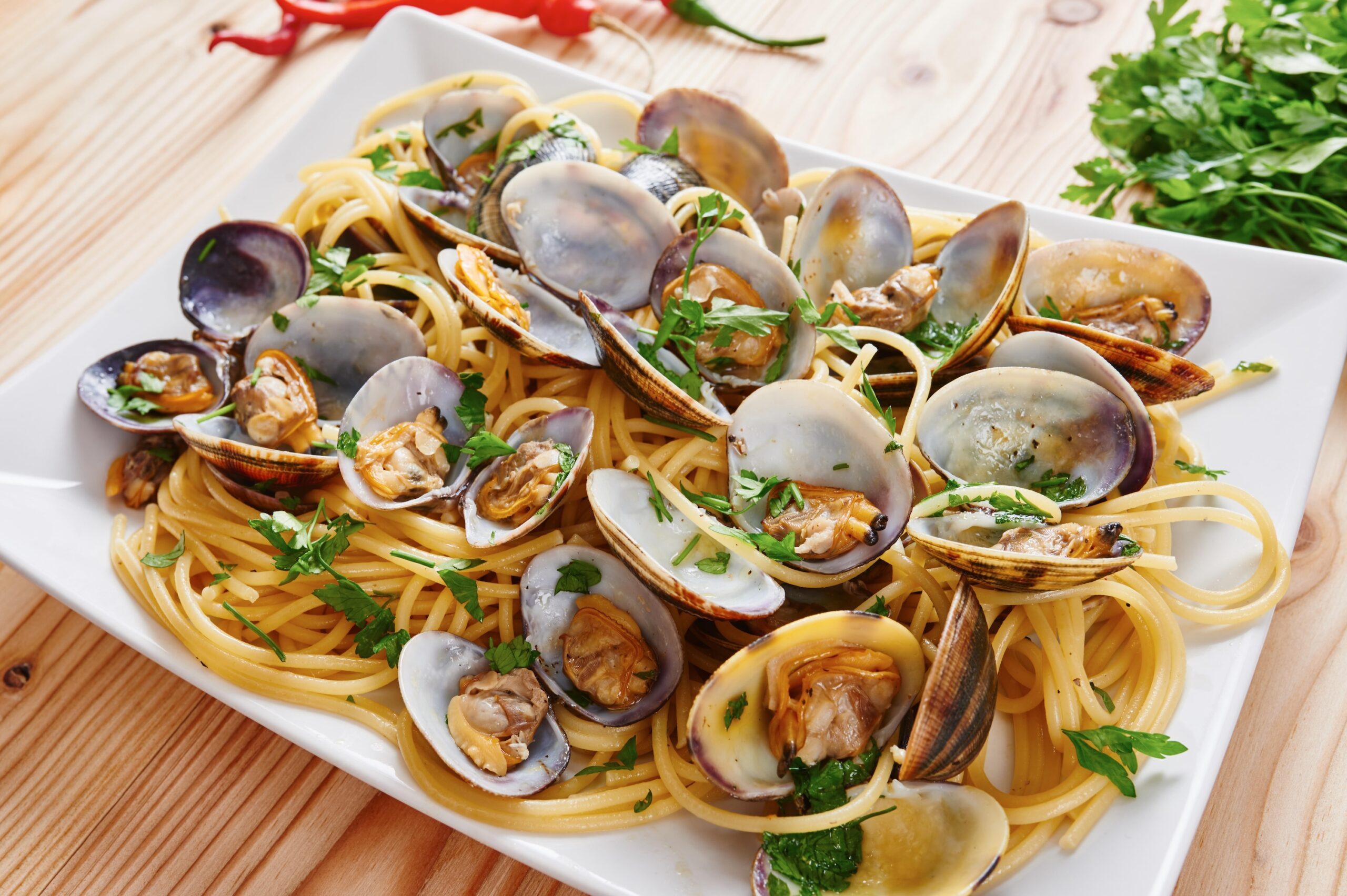
Clams are finding their way into some of today’s biggest food trends. Seafood boards and tinned fish have become social-media favorites, while high-protein eating continues to dominate nutrition conversations. Clams fit right in: They’re high in protein, relatively low in calories, and packed with nutrients, making them worth a closer look if weight loss is your goal.
Here’s why: A 3-ounce serving of cooked clams has around 22 grams of protein for only about 126 calories. They’re also exceptionally rich in iron and vitamin B12, along with selenium, copper, and other important nutrients. That’s an impressive nutritional package for a relatively small serving.
Of course, how you order or cook them matters. Steamed clams with lemon have a very different nutritional profile from a bowl of cream-based clam chowder or a plate of fried clam strips. So, are clams actually good for weight loss? Let’s take a closer look at the benefits—and what to keep in mind.
Download Noom on iOS or Android for tools and support that make healthy habits feel more realistic.
✅ Quick answer: Are clams good for weight loss?
Yes—clams are an excellent food for weight loss. With 22 grams of protein in 3 ounces, they help you feel full and help preserve muscle while you’re in a calorie deficit. The one thing to watch is preparation: canned clams and clam chowder can add a lot of sodium and, in the case of chowder, cream and butter, so plain steamed or boiled clams are the better everyday choice.
New from Noom
Microdose GLP-1Rx Plus
An affordable way to start your GLP-1 journey with Compounded Tirzepatide.

*Initial 3 week subscription and 4 weeks of medication from $79 plus tax and $199 per month plus tax for 12 week subscription thereafter. Final pricing depends on program selection. Noom GLP-1Rx Plus Microdose Program involves medication (when appropriate), healthy diet, exercise and support. Individual results vary. Meds & personalization based on need as determined by a third-party clinician. Medications are not reviewed by FDA for safety, efficacy, or quality. No affiliation with Eli Lilly and Company, the only US source of FDA-approved tirzepatide. Not available in all 50 US states.
🚀 Weight-loss benefits
- Clams pack a lot of protein into relatively few calories. A 3-ounce serving has about 22 grams of protein for just 126 calories. That high protein-to-calorie ratio puts clams among lean protein options that can help you get plenty of protein without adding a lot of calories.
- Clams are rich in selenium, which supports thyroid hormone metabolism. A 3-ounce serving covers nearly all of your daily selenium need, and selenium is required for the enzyme that converts inactive thyroid hormone into its active form, which plays a role in keeping metabolic rate running normally.
- Clams are naturally low in fat, making them easy to build a calorie deficit around. Because clams are close to fat-free, swapping them in for fattier proteins lets you eat a similar portion size for meaningfully fewer calories, which can make a deficit feel less restrictive.
⚠️ Things to be mindful of
- Clams can be high in sodium, especially in canned and prepared dishes. Canned clams and dishes like clam chowder can contain considerably more sodium than fresh clams, depending on how they’re prepared. Check the label on canned varieties, and keep an eye on salty additions like broth, bacon, and added salt.
- Clams are exceptionally high in iron. A 3-ounce serving of cooked clams can provide more iron than the average person needs in a day. That’s generally a nutritional plus, but people with hemochromatosis or another condition that causes excess iron accumulation may need to limit iron-rich foods based on guidance from their healthcare provider.
- Clams can pose allergy and food-safety risks. Clams are molluscan shellfish and can trigger allergic reactions in people with shellfish allergies. Raw or undercooked clams can also carry harmful bacteria, including Vibrio. People who are pregnant, older, immunocompromised, or have certain medical conditions are at greater risk of serious illness from raw or undercooked shellfish, so thoroughly cooked clams are the safer choice.
🥗 Nutrients in clams (per 3 oz / 85 g, cooked)
| Nutrient | Amount | % RDA* |
|---|---|---|
| Calories | 126 calories | — |
| Protein | 22 g | 44% |
| Total carbs | 4 g | 1% |
| Fiber | 0 g | 0% |
| Sugars | 0 g | — |
| Total fat | 1.7 g | 2% |
| – Saturated fat | 0.2 g | 1% |
| – Monounsaturated fat | 0.2 g | — |
| – Polyunsaturated fat | 0.4 g | — |
| Omega-3 | 0.3 g | — |
| Omega-6 | Less than 0.1 g | — |
*Recommended dietary allowance (RDA) is defined as the average daily amount of nutrients needed to meet the requirements of nearly all healthy people in a specific group.
The standout nutrient in clams is protein. A 3-ounce serving of cooked clams has about 22 grams of protein for just 126 calories, along with only about 2 grams of fat and 4 grams of carbs. That makes them a lean, protein-rich seafood option that delivers a lot of protein for relatively few calories.
Clams are also naturally low in fat and contain virtually no sugar and no fiber. Most of their small amount of fat is unsaturated, including about 0.3 grams of omega-3 fatty acids. That’s less omega-3 than you’d get from a fatty fish like salmon, but it still adds to the overall nutrient profile of clams.
💊 Vitamins & minerals in clams (per 3 oz / 85 g, cooked)
| Vitamin/Mineral | Amount | % RDA* |
|---|---|---|
| Vitamin B12 | 84 mcg | 3500% |
| Iron | 23.8 mg | 132% |
| Selenium | 54 mcg | 99% |
| Copper | 0.6 mg | 65% |
| Manganese | 0.85 mg | 37% |
| Phosphorus | 287 mg | 23% |
| Zinc | 2.3 mg | 21% |
| Vitamin C | 19 mg | 21% |
| Vitamin A | 145 mcg | 16% |
| Potassium | 534 mg | 11% |
*Recommended dietary allowance (RDA) is defined as the average daily amount of nutrients needed to meet the requirements of nearly all healthy people in a specific group.
Clams are especially rich in vitamin B12 and iron. A 3-ounce serving provides several times the recommended daily amount of vitamin B12 and more than a full day’s worth of iron. That 3,500% figure for B12 may look like a lot, but there’s no established upper intake limit for vitamin B12 because it has a low potential for toxicity. Your body also absorbs only a portion of the B12 you consume. B12 helps make healthy red blood cells and supports normal nerve function, while iron helps carry oxygen through your blood to your muscles and organs.
Clams also provide plenty of selenium and copper, along with manganese, phosphorus, zinc, vitamin C, vitamin A, and potassium. Together, these vitamins and minerals support everything from immune and bone health to normal muscle and nerve function.
🔍 Nutrient breakdown
Glycemic index (GI) of clams
Glycemic index: Very low
💡 Tip: Clams contain very little carbohydrate, so they’re unlikely to have much effect on blood sugar on their own.
Are clams high in protein?
✔️ Yes: Clams contain about 22 grams of protein per 3-ounce serving, making them a protein-rich choice for relatively few calories. Other lean, protein-rich options include shrimp, cod, and chicken breast.
Are clams high in fiber?
❌ No: Clams contain 0 grams of fiber per serving. Like other meat and seafood, they aren’t a source of dietary fiber.

The Easy Way
to lose weight and get healthy.
See if you qualify
Are clams low in carbs?
✔️ Yes: Clams have about 4 grams of carbs per 3-ounce serving. That makes them easy to include in many lower-carb eating patterns.
Are clams gluten-free?
✔️ Yes: Clams are naturally gluten-free. Prepared clam dishes may not be, though. Breaded clam strips, clam cakes, and some clam chowders can contain wheat, so check the label or ask how a dish is prepared if you need to avoid gluten.
Are clams good for fat loss?
✔️ They can be: Clams provide plenty of protein for relatively few calories and very little fat. Protein can also help with fullness and maintaining muscle while losing weight, making clams a useful protein choice if fat loss is your goal. Ultimately, though, fat loss depends on your overall eating pattern and maintaining a calorie deficit over time.
🍽️ Diet compatibility: Which diets include clams?
| Diet | ✅ Yes / ❌ No | Why |
|---|---|---|
| Keto | ✅ | With only 4 grams of carbs and virtually no sugar per serving, clams fit easily into a ketogenic macro split without interfering with ketosis. |
| Paleo | ✅ | Clams are an unprocessed whole food that predates modern agriculture, fitting the paleo framework of eating what could be hunted, fished, or gathered. |
| Mediterranean | ✅ | Shellfish is a core protein source in the Mediterranean pattern, and clams’ low saturated fat and omega-3 content align with the diet’s emphasis on seafood over red meat. |
| Vegan | ❌ | Clams are animals, so they fall outside standard vegan and vegetarian definitions. A small number of self-described “bivalvegans” eat clams and mussels because these mollusks lack a centralized nervous system, but this remains a minority position. |
| Gluten-free | ✅ | Plain steamed, boiled, or canned clams contain no gluten. Breaded, fried, or roux-thickened clam dishes are the exception and should be checked individually. |
Clams work with more restrictive eating patterns than most animal proteins because they’re naturally low in carbs, free of gluten, and easy to prepare without added flour or breading. The one diet they don’t fit is any plant-exclusive pattern, since they’re still animals regardless of how simple their nervous system is.
In practice, most of these compatibility checks come down to preparation rather than the clams themselves. Steamed or boiled clams with garlic, lemon, and herbs keep every checkmark intact, while breaded or cream-sauce versions can quietly disqualify a dish from keto, paleo, or gluten-free eating.
🌟 Are clams healthy? What are the health benefits
Metabolic health: Are clams good for your metabolism?
- Boosts metabolism? Neutral – Clams don’t directly speed up your metabolism. Protein does require more energy to digest and process than carbohydrates or fat, so the high protein content of clams gives them a higher thermic effect than foods with less protein. The effect is relatively small, though, and shouldn’t be thought of as a metabolism boost.
- Improves insulin sensitivity? Unclear – There isn’t good evidence that eating clams specifically improves insulin sensitivity. Their high protein and low carbohydrate content can make them a useful part of a balanced eating pattern, but improving insulin sensitivity depends on your overall diet, activity, weight, sleep, and other health factors.
- Effect on fat storage? Neutral – Eating clams doesn’t directly prevent or promote body-fat storage. Because they provide plenty of protein for relatively few calories, they can make it easier to get the protein you need while staying within your calorie goals. Over time, whether you gain or lose body fat depends largely on your overall energy balance.
Cholesterol impact: Does eating clams affect cholesterol levels?
- Does it lower LDL (bad) cholesterol? Maybe – Some small feeding studies have found that diets containing clams lowered LDL and total cholesterol or reduced the amount of cholesterol absorbed in the gut. Clams contain marine sterols that may interfere with cholesterol absorption, but the research is limited and doesn’t show that simply adding clams to your diet will lower LDL.
- Does it raise HDL (good) cholesterol? Unclear – One small study found that an oyster-and-clam diet increased the ratio of HDL2 to HDL3 compared with a chicken diet, but overall HDL cholesterol didn’t significantly change. There isn’t enough evidence to say that eating clams raises HDL.
- Overall impact on heart health? Clams can be a heart-friendly protein choice. They’re naturally low in saturated fat and provide some omega-3 fatty acids, along with marine sterols that may reduce cholesterol absorption. How you prepare them matters, too: Steaming or boiling keeps saturated fat low, while frying or adding lots of butter can change the overall nutritional profile.
Can I eat clams for a calorie deficit?
✔️ Yes: A 3-ounce serving of cooked clams has about 126 calories and 22 grams of protein, giving you plenty of protein for relatively few calories. That can make clams a useful choice when you’re trying to meet your protein needs while staying within a calorie deficit.
💡 Tip: Preparation can make a big difference in the total calories of your meal. Steamed clams or clams in a broth- or tomato-based dish will generally have fewer calories than fried clams or clams served with lots of butter or cream.
Are clams rich in antioxidants?
Not exactly: Clams aren’t a major source of antioxidant compounds in the way berries or colorful vegetables are, but they are rich in nutrients involved in your body’s antioxidant defenses. Selenium is needed to make antioxidant enzymes that help protect cells from oxidative damage, and copper also plays a role in antioxidant enzyme activity.
Does eating clams support gut health?
Neutral: Clams contain no fiber, so they don’t directly feed beneficial gut bacteria the way fiber-rich plant foods do. There’s also little research showing that clams have a specific benefit for the gut microbiome.
Does eating clams support digestion?
Neutral: There isn’t good evidence that clams improve digestion. They provide protein and several important nutrients, but they don’t contain fiber, probiotics, or other components typically associated with digestive health.
Does eating clams help you feel satiated and less hungry?
✔️ Yes: Protein generally helps promote fullness, and clams provide about 22 grams in a relatively low-calorie serving. That can make them a satisfying protein choice, although how full you feel will also depend on the rest of your meal. Satiety level: High
Does eating clams help with nighttime cravings?
Possibly: There’s no evidence that clams specifically reduce nighttime cravings. However, including enough protein at dinner may help you feel satisfied for longer, which could make later snacking less tempting. Your overall meal—and your eating pattern throughout the day—matters more than any single food.
Does eating clams help reduce inflammation?
Unclear: Clams provide some omega-3 fatty acids, but considerably less than fatty fish like salmon or sardines. There’s not enough evidence to say that eating clams specifically reduces inflammation.
Are clams beneficial for brain health?
✔️ They provide important brain-supporting nutrients: Clams are exceptionally rich in vitamin B12, which is essential for normal nerve function and neurological health. They also provide some omega-3 fatty acids, although much less than fatty fish. Eating enough B12 is especially important because a deficiency can cause neurological problems.
Can clams improve skin and hair health?
Unclear: Clams provide zinc, copper, iron, protein, and other nutrients your body uses to maintain healthy skin and hair. But there’s no evidence that eating clams specifically will improve their appearance unless you’re correcting a nutrient deficiency.
Can clams help balance hormones?
Limited evidence: Selenium plays an important role in normal thyroid function, including the conversion of thyroid hormones into their active forms, and clams provide nearly a full day’s recommended amount. But there’s no evidence that eating clams will “balance” hormones or correct a hormonal disorder.
💡 Tip: If you suspect a thyroid or other hormonal issue, talk with your healthcare provider rather than relying on a particular food or nutrient to treat it.
🍽️ Best ways to eat clams for weight loss
- Steam clams with plenty of flavor. Garlic, lemon, fresh herbs, broth, or a splash of white wine can add lots of flavor without dramatically increasing calories. Butter can absolutely fit, too, but using a smaller amount keeps the overall dish lighter.
- Try clams with a tomato-based sauce. Clams pair naturally with tomatoes, garlic, herbs, and vegetables for a flavorful meal that stays relatively low in calories. You can serve them with pasta, vegetables, or a combination of both depending on what fits your goals and what sounds satisfying.
- Keep preparation in mind. Clams themselves are lean and relatively low in calories, but breading, deep-frying, butter, and cream-based sauces can quickly increase a dish’s calorie and saturated-fat content. That doesn’t mean fried clams or clam chowder are off-limits—just that steamed, baked, or broth- and tomato-based preparations make it easier to take advantage of clams’ naturally lean nutrition profile.
🍏 How do clams compare to other seafood? (per 3 oz / 85 g)
| Food | Calories | Protein | Fat | Carbs |
|---|---|---|---|---|
| Clams | 126 | 22 g | 1.7 g | 4 g |
| Shrimp | 84 | 20 g | 0.8 g | 0.2 g |
| Cod | 89 | 20 g | 0.8 g | 0 g |
| Tuna | 109 | 24 g | 0.5 g | 0 g |
| Scallops | 116 | 20 g | 1 g | 6 g |
| Mussels | 146 | 20 g | 4 g | 6 g |
| Oysters | 139 | 14 g | 4 g | 8 g |
| Squid | 156 | 26 g | 2 g | 3 g |
| Salmon | 177 | 17 g | 11 g | 0 g |
Clams fall somewhere in the middle of the seafood pack when it comes to calories, while still providing an impressive 22 grams of protein per serving. Shrimp, cod, tuna, and scallops are a little more calorie-efficient, while mussels, oysters, squid, and salmon generally provide more calories per serving.
Where clams really shine is their micronutrient content. They’re exceptionally rich in vitamin B12 and iron and also provide selenium, copper, and other important minerals. Mussels offer many of the same nutritional strengths, while oysters are particularly rich in zinc. Salmon contains more fat and calories but provides considerably more omega-3s.
Access GLP-1 Weight Loss with Noom
Explore a wide range of prescription medications supported by Noom’s program.Microdose GLP-1rx
Noom GLP-1rx
Noom GLP-1rx Plus
Wegovy®

Ozempic®

Metformin

Zepbound®
Mounjaro®
Liraglutide

There isn’t one seafood that’s nutritionally “best.” If you’re prioritizing lean protein, shrimp, cod, tuna, scallops, and clams are all strong choices. Clams and mussels are particularly good sources of B12 and iron, while salmon is a better choice when omega-3s are the priority.
Frequently asked questions about clams and weight loss
How many clams should you eat for weight loss?
There’s no specific number of clams you need to eat to lose weight. A standard serving is about 3 ounces of cooked clam meat, which provides around 126 calories and 22 grams of protein. The number of whole clams that equals 3 ounces will vary depending on their size. What matters most for weight loss is how clams fit into your overall calorie intake and eating pattern.
Is clam chowder good for weight loss?
It can fit into a weight-loss plan, but preparation makes a difference. New England clam chowder is traditionally made with milk or cream and can be higher in calories and saturated fat, while Manhattan clam chowder uses a tomato-based broth and is generally lighter. You don’t have to avoid either one to lose weight—portion size and what you eat throughout the rest of the day matter, too.
Are clams healthy?
Yes. Clams provide about 22 grams of protein for just 126 calories per 3-ounce serving and are naturally low in fat. They’re also exceptionally rich in vitamin B12 and iron and provide selenium, copper, zinc, potassium, and some omega-3 fatty acids. How they’re prepared can change the nutritional profile, particularly when it comes to added sodium, saturated fat, and calories.
Are clams high in cholesterol?
Clams contain dietary cholesterol, but they’re very low in saturated fat. For most people, saturated fat has a greater effect on LDL cholesterol than dietary cholesterol does. Some small studies have also found that marine sterols in mollusks may reduce cholesterol absorption, although there isn’t enough evidence to say that eating clams will lower your cholesterol.
Are clams high in sodium?
Clams naturally contain sodium, and the amount can climb considerably depending on how they’re prepared. Canned clams, clam chowder, and restaurant dishes may contain added salt, while sauces, broths, and other ingredients can contribute even more. If you’re watching your sodium intake, check nutrition labels on canned products and consider the sodium content of the entire dish rather than the clams alone.
Are canned clams as healthy as fresh clams?
Both can be nutritious choices. Canned clams still provide plenty of protein and important nutrients such as vitamin B12 and iron, but they may contain more sodium depending on the product and packing liquid. Check the nutrition label to compare options, and draining canned clams can remove some of the sodium-containing liquid.
Can you eat clams every day?
For most healthy people, clams can be eaten regularly as part of a balanced diet, but there’s no need to eat them every day to get their benefits. Eating a variety of seafood and other protein sources gives you a broader range of nutrients. Because clams are exceptionally high in iron, people with hemochromatosis or another iron-overload condition should follow their healthcare provider’s guidance about how often to eat high-iron foods.
🧠 The bottom line: Clams are a good choice for weight loss
Clams pack a lot of nutrition into relatively few calories. A 3-ounce serving has about 22 grams of protein for 126 calories, plus an impressive amount of vitamin B12, iron, selenium, and other essential nutrients. Their high protein content can also help with fullness and support muscle maintenance during weight loss.
But you don’t need to eat clams—or any particular food—to lose weight. What matters most is finding an eating pattern that helps you maintain a calorie deficit while still giving your body the protein, fiber, vitamins, and minerals it needs. If you enjoy clams, their combination of lean protein and relatively few calories makes them an easy food to work into that pattern.
Preparation matters, too. Steamed, boiled, or baked clams keep added calories relatively low, while fried clams and dishes made with lots of butter or cream will be more calorie-dense. Fresh and canned clams can both work, though it’s worth checking sodium on canned and prepared versions. The bottom line: Clams aren’t a weight-loss superfood, but they’re a nutrient-rich, satisfying protein that can absolutely earn a place on your plate.

See if your insurance
covers GLP-1s.
The form only takes 2 minutes to answer. We’ll handle the rest.
GET STARTED📖 Scientific evidence
- Clams may be lower in cholesterol than you’d expect from shellfish. (Food & Nutrition Research, 2012) Researchers analyzed the sterol content of several types of commonly eaten shellfish and found that clams and scallops had among the lowest cholesterol concentrations of those tested. Clams also contained non-cholesterol marine sterols, supporting the idea that looking at total dietary cholesterol alone may not capture the full sterol profile of mollusks. This was a food-composition study rather than a human trial, so it can tell us what clams contain but not how eating them affects blood cholesterol.
- Clams may not affect cholesterol the way their dietary cholesterol content suggests. (Metabolism, 1987) In a small, older study, men who ate a diet containing oysters and clams absorbed less dietary cholesterol than when they ate diets containing chicken or crab. Researchers suggested that marine sterols in mollusks might interfere with cholesterol absorption, but the study was published in 1987 and more recent research is needed to confirm the effect.
- Clams may have a favorable effect on blood cholesterol, but the research is limited. (American Journal of Clinical Nutrition, 1990) In a small, older controlled feeding study, men who ate a diet featuring clams experienced improvements in some measures of blood cholesterol. Similar effects were seen with oysters, mussels, and crab, while shrimp and squid didn’t produce the same results. Because the study was published in 1990 and involved a small group of participants, more recent research is needed to understand whether eating clams has a meaningful effect on cholesterol levels.
- The amount of iron you get from clams can vary considerably. (Journal of Food Composition and Analysis, 2012) Researchers compared the iron content and estimated bioavailability of iron in live Manila clams and several processed clam products and found substantial differences between them. Some clam products were very high in iron, while others contained much less, and total iron content didn’t necessarily reflect how bioavailable that iron was. The study used a laboratory model rather than measuring iron absorption in people, but it suggests that clam species and processing can make a big difference in their iron content and availability.
Editorial standards
At Noom, we’re committed to providing health information that’s grounded in reliable science and expert review. Our content is created with the support of qualified professionals and based on well-established research from trusted medical and scientific organizations. Learn more about the experts behind our content on our Health Expert Team page.