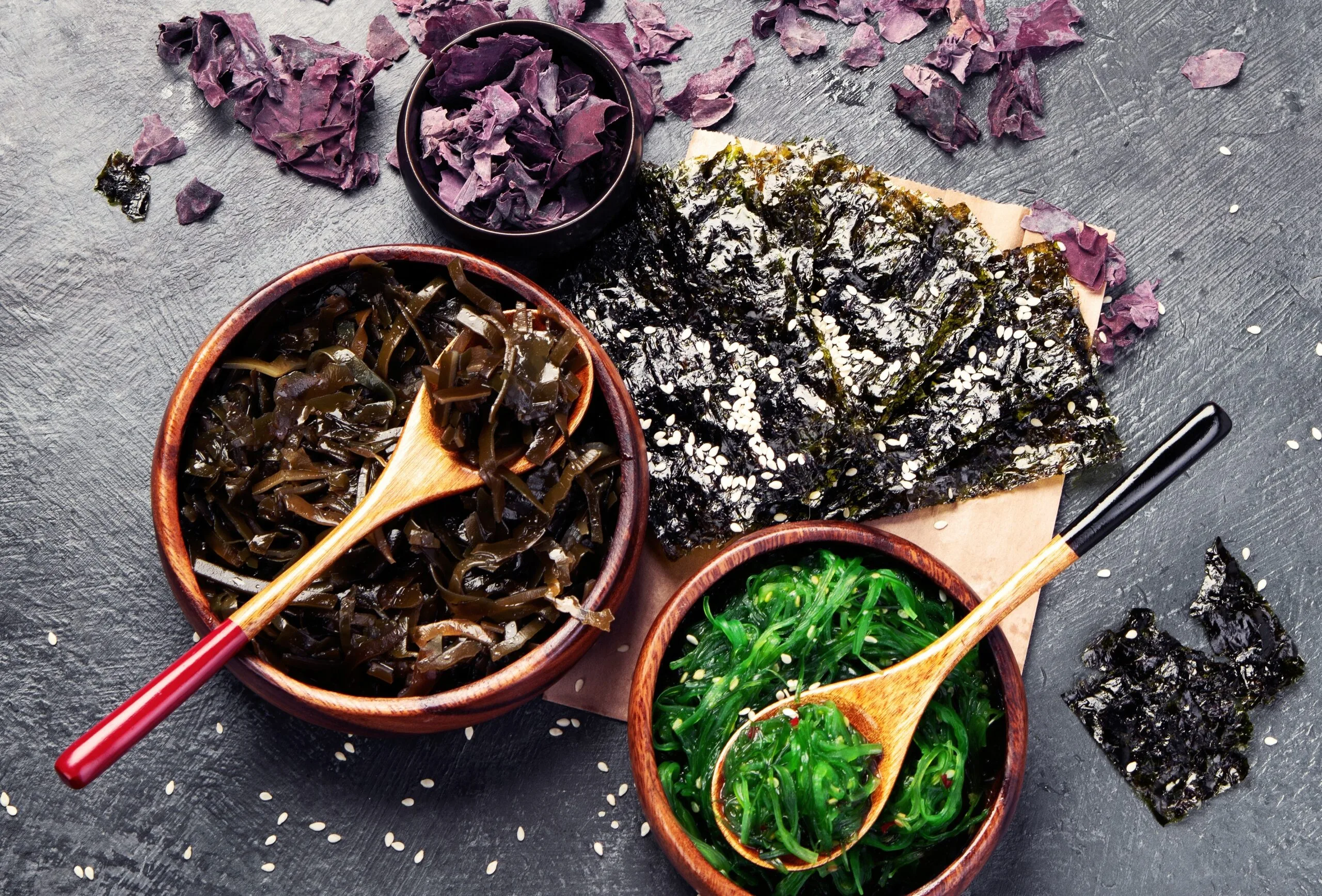
Long before roasted seaweed snacks landed in supermarket checkout aisles, seaweed was already a staple ingredient in many traditional cuisines, particularly across East Asia. Today, it’s just as likely to show up wrapped around sushi, floating in miso soup, tossed into a salad, or packaged as a crunchy snack. Its popularity isn’t just about the taste. A typical pack of roasted seaweed snacks has just 20 to 30 calories, while a cup of plain prepared seaweed has about 34 calories. Along with being low in calories, seaweed supplies vitamin K, folate, magnesium, and iodine—a mineral your thyroid needs but that can become too much with certain types of seaweed.
Seaweed comes in a few main forms. Dried nori sheets are used for sushi and make easy snacks. Wakame is commonly added to miso soup and seaweed salad. Kombu and kelp are often used to flavor broths. While all are low in calories, their iodine content differs dramatically: nori and wakame are relatively moderate sources, while kombu and some kelp varieties contain much higher amounts.
Seaweed is clearly nutrient-dense and low in calories. The bigger question is whether those qualities translate into meaningful weight loss—or whether it’s simply an easy way to make meals more filling without adding many calories. Here’s what the research says.
✅ Quick answer: Can seaweed help you lose weight?
Yes — seaweed can be part of a weight-loss-friendly eating pattern because it’s low in calories while adding fiber, volume, and flavor to meals. A cup of prepared seaweed salad has well under 50 calories, and studies suggest that alginate, a soluble fiber found in brown seaweeds, may help increase fullness and slightly reduce how much people eat at a meal. So far, though, the evidence doesn’t show that seaweed leads to meaningful weight loss on its own. Its biggest advantage is that it can make meals more satisfying without adding many calories. Because iodine levels vary dramatically between types of seaweed, it’s also best to avoid eating large amounts of high-iodine varieties—especially kombu—on a regular basis.
🚀 Weight-loss benefits
- Seaweed is low in calories but adds volume. A cup of prepared seaweed salad has about 34 calories, making it an easy way to bulk up soups, salads, and grain bowls while keeping calories relatively low.
- Seaweed may help you feel fuller. Brown seaweeds contain a soluble fiber called alginate that may increase fullness and, in some studies, slightly reduce how much people eat at a meal. The effects have generally been modest.
- Seaweed isn’t a fat-burning food. While a pigment in brown seaweed called fucoxanthin has shown promise in laboratory and animal studies, the human research used concentrated supplements—not seaweed itself. There’s no good evidence that eating seaweed alone meaningfully increases fat burning or causes weight loss.
⚠️ Things to be mindful of
- Seaweed can be very high in iodine. The amount varies widely depending on the type. Nori and wakame are generally lower, while kombu and some kelp varieties can contain several times the daily upper limit in a small serving. Eating high-iodine seaweed regularly may affect thyroid function, so it’s best to enjoy those varieties in moderation.
- Some seaweed products are high in sodium. Restaurant seaweed salad, seasoned seaweed snacks, and flavored nori often contain much more sodium than plain seaweed. If you’re limiting salt, check the nutrition label or choose lightly seasoned options.
- Seaweed isn’t a high-protein food. Most servings provide only 1 to 2 grams of protein, so it won’t keep you full on its own. Pair it with a protein-rich food like fish, tofu, eggs, or edamame to build a more satisfying meal.
🥗 Nutrients in plain prepared seaweed (per ½ cup prepared, about 40 g)
| Nutrient | Amount | % RDA* |
|---|---|---|
| Calories | 17 calories | 1% |
| Protein | 0.7 g | 1% |
| Total carbohydrates | 4 g | 1% |
| Fiber | 0.5 g | 2% |
| Sugars | <0.5 g | — |
| Total fat | 0.2 g | <1% |
| – Saturated fat | <0.1 g | <1% |
| – Monounsaturated fat | Trace | — |
| – Polyunsaturated fat | Trace | — |
| Omega-3 | Trace | — |
| Omega-6 | Trace | — |
*Recommended dietary allowance (RDA) is defined as the average daily amount of nutrients needed to meet the requirements of nearly all healthy people in a specific group.

The Easy Way
to lose weight and get healthy.
See if you qualify
Plain prepared seaweed packs a surprising amount of nutrition into a small serving. It provides vitamins and minerals like vitamin K, folate, magnesium, and iodine while contributing very few calories.
What it doesn’t provide is much protein or fat. With less than 1 gram of protein per serving, seaweed is best thought of as a flavorful, nutrient-rich vegetable rather than a significant source of macronutrients. Pairing it with protein-rich foods like fish, tofu, eggs, or edamame makes for a more balanced, satisfying meal.
Keep in mind that nutrition varies by the type of seaweed and how it’s prepared. Restaurant seaweed salad often contains added oil, sugar, and sodium, so its nutrition facts can look quite different from plain prepared seaweed.
💊 Vitamins & minerals in plain prepared seaweed (per ½ cup prepared, about 40 g)
| Vitamin/Mineral | Amount | % RDA* |
|---|---|---|
| Vitamin K | 27 µg | 22% |
| Folate | 72 µg | 18% |
| Magnesium | 49 mg | 12% |
| Iron | 1.2 mg | 7% |
| Copper | 0.05 mg | 6% |
| Calcium | 67 mg | 5% |
| Sodium | 93 mg | 4% |
| Zinc | 0.5 mg | 5% |
| Manganese | 0.08 mg | 4% |
| Vitamin C | 1.2 mg | 2% |
| Potassium | 36 mg | 1% |
*Iodine isn’t listed above because the amount in seaweed varies too widely by species, growing region, and processing to give one reliable figure.
Even in a modest serving, plain prepared seaweed supplies several vitamins and minerals for very few calories. Vitamin K, folate, and magnesium stand out the most, while smaller amounts of iron, calcium, copper, and zinc add to its overall nutrient density.
The biggest nutritional wildcard is iodine. Depending on the type of seaweed, the amount can range from relatively modest to well above the daily upper limit, which is why it’s more helpful to think about iodine by seaweed variety rather than by an average nutrition label.
🔍 Nutrient breakdown of seaweed
Glycemic index (GI) of seaweed
Glycemic index: estimated below 15 (Low)
💡 Seaweed’s carbohydrate is mostly non-digestible fiber, so it has little to no measurable effect on blood sugar.
Is seaweed high in protein?
❌ No. A typical serving of seaweed provides less than 1 gram of protein, so it won’t contribute much toward your daily protein needs. It’s best used as a flavorful, low-calorie addition to protein-rich foods rather than as a protein source itself.
Better protein alternatives: Edamame | Greek yogurt | Salmon
Is seaweed high in fiber?
❌ Not really. A typical serving of plain prepared seaweed contains less than 1 gram of fiber. While brown seaweeds contain a soluble fiber called alginate, seaweed isn’t a major source of fiber unless you’re eating much larger amounts.
💡 Pair it with: Beans, lentils, or whole grains to build a more fiber-rich meal.
Is seaweed low in carbs?
✔️ Yes. Seaweed is naturally low in carbohydrates, with about 4 grams per typical serving. Many of those carbs come from fiber and other complex carbohydrates rather than sugar.
💡 Good to know: If you’re eating sushi, the rice—not the nori—is responsible for most of the carbohydrates.
Is seaweed gluten-free?
✔️ Yes. Plain seaweed is naturally gluten-free because it’s an algae, not a grain. Just check the label on seasoned seaweed snacks or restaurant seaweed salads, which may contain soy sauce or other ingredients that include wheat.
Is seaweed good for fat loss?
✔️ It can support a fat-loss-friendly eating pattern. Seaweed is very low in calories and adds flavor and volume to meals, which can help make a calorie-controlled diet more satisfying. Just don’t expect it to burn fat on its own—the evidence doesn’t support that.
🍽️ Diet compatibility: Which diets include seaweed?
| Diet | ✅ / ❌ | Why |
|---|---|---|
| Keto | ✅ | Naturally low in carbohydrates, making it an easy fit for most ketogenic eating patterns. |
| Paleo | ✅ | Many people following a Paleo diet include plain seaweed as a minimally processed whole food, though interpretations vary. |
| Mediterranean | ✅ | While not a traditional Mediterranean ingredient, seaweed fits the diet’s emphasis on plant foods and minimally processed ingredients. |
| Vegan | ✅ | Seaweed is a marine algae, making it naturally vegan. |
| Gluten-free | ✅ | Plain seaweed is naturally gluten-free, but flavored snacks and prepared seaweed salads may contain wheat-based ingredients like soy sauce. |
Seaweed fits into most popular eating patterns because it’s a minimally processed, nutrient-rich food that’s naturally low in calories. The bigger consideration is how it’s prepared. Plain nori, wakame, or kelp can fit almost any diet, while restaurant seaweed salads and flavored seaweed snacks may contain added sodium, sugar, or wheat that changes their nutritional profile.
🌟 Is seaweed healthy? What are the health benefits?
Metabolic health: Is seaweed good for your metabolism?
- Boosts metabolism? ❌ Not likely. There’s no good evidence that eating seaweed increases metabolic rate. Studies suggesting a metabolism boost used concentrated fucoxanthin extracts—not whole seaweed.
- Improves blood sugar control? ⚠️ Maybe. Some research suggests the soluble fiber in brown seaweed may help blunt post-meal blood sugar spikes, but it’s too early to say whether eating seaweed improves insulin sensitivity over the long term.
- Reduces fat storage? ❌ Not proven. While laboratory and animal studies have linked compounds in seaweed to reduced fat storage, those findings haven’t translated into meaningful weight-loss or fat-loss benefits from eating seaweed itself.
Cholesterol impact: Does seaweed affect cholesterol levels?
- Lowers LDL (“bad”) cholesterol? ⚠️ Maybe. Some early research suggests compounds in seaweed may support cholesterol metabolism, but there isn’t strong evidence that eating seaweed consistently lowers LDL cholesterol.
- Raises HDL (“good”) cholesterol? ❌ Not proven. Human studies haven’t shown a consistent effect of seaweed on HDL cholesterol.
- Supports heart health? ✔️ Yes. Seaweed is low in saturated fat and adds fiber and nutrients to meals, making it a heart-friendly food. Just be mindful of prepared seaweed salads and seasoned snacks, which can be high in sodium.
Can you eat seaweed in a calorie deficit?
✔️ Yes. Seaweed is very low in calories, making it an easy way to add flavor and volume to meals without adding many calories. Just pair it with a protein-rich food, since seaweed on its own isn’t very filling.
Is seaweed rich in antioxidants?
✔️ Yes. Seaweed contains antioxidant compounds like carotenoids and polyphenols. While these have shown promising effects in laboratory studies, it’s still unclear how much they benefit health when seaweed is eaten as part of a typical diet.
Does seaweed support gut health?
⚠️ Maybe. Seaweed contains fibers that can be fermented by beneficial gut bacteria, but most of the research is still in animals or small human studies.
Does seaweed support digestion?
✔️ It can. The soluble fiber in seaweed may help slow digestion and promote fullness. Eating very large amounts, however, may cause bloating or digestive discomfort in some people.
Does seaweed help you feel fuller?
⚠️ Maybe. Brown seaweeds contain a soluble fiber called alginate that may increase fullness and slightly reduce appetite. So far, the effects in human studies have been modest.
Does seaweed help with nighttime cravings?
❌ Not specifically. Seaweed can be a low-calorie snack, but there’s no evidence it reduces cravings. If you’re genuinely hungry, pairing it with protein is likely to be more satisfying.
Does seaweed reduce inflammation?
⚠️ Maybe. Compounds in seaweed have shown anti-inflammatory effects in laboratory and animal studies, but human research is still limited.
Is seaweed good for brain health?
⚠️ Maybe. Seaweed provides iodine, which is essential for normal thyroid function and brain health. Beyond correcting iodine deficiency, there’s no strong evidence that eating seaweed boosts brain function.
Can seaweed improve skin or hair health?
❌ Not proven. Seaweed contains nutrients that support overall health, but there’s no good evidence that eating seaweed specifically improves skin or hair.
Can seaweed help balance hormones?
⚠️ It depends. Seaweed is one of the richest dietary sources of iodine, which your body needs to make thyroid hormones. For people who are deficient, that can be beneficial. But regularly eating large amounts of high-iodine seaweed—especially kombu—may disrupt thyroid function instead. If you have a thyroid condition, talk with your healthcare provider before making seaweed a daily habit.
🍽️ Best ways to eat seaweed for weight loss
- Add seaweed to soups, salads, and grain bowls. Dried wakame or nori flakes add flavor, texture, and nutrients for very few calories.
- Use nori as a wrap. Fill nori sheets with vegetables, fish, tofu, or chicken for a light meal or snack. If you’re making sushi, using less rice can also help reduce calories.
- Choose plain or lightly seasoned seaweed. Some packaged seaweed snacks and restaurant seaweed salads are high in added oil, sodium, or sugar. Check the nutrition label if you’re eating them regularly.
🍏 Best alternatives & comparisons (per ½ cup prepared seaweed or ½ cup raw vegetables)
| Food | Calories | Carbs | Fiber | Protein | Fat |
|---|---|---|---|---|---|
| Seaweed (kelp/wakame), prepared | 17 | 4 g | 1 g* | 1 g | 0 g |
| Spinach, raw | 9 | 2 g | 1 g | 1 g | 0 g |
| Kale, raw | 20 | 4 g | 1 g | 2 g | 0 g |
| Broccoli, raw | 15 | 3 g | 1 g | 1 g | 0 g |
| White mushrooms, raw | 9 | 1 g | 0 g | 1 g | 0 g |
Seaweed is very low in calories, but it isn’t the standout for fiber or protein. Vegetables like spinach, kale, broccoli, and mushrooms provide similar or fewer calories while offering as much or more fiber and protein. Where seaweed stands out is its unique flavor and nutrients—particularly iodine (depending on the variety) and vitamin K.
Think of seaweed as a complement rather than a replacement for other vegetables. Adding it to soups, salads, or grain bowls is an easy way to boost flavor and variety, while leafy greens and other vegetables do more of the heavy lifting for fiber and protein.
Seaweed and weight loss: FAQs
How much seaweed should I eat per day for weight loss?
There’s no recommended amount for weight loss. A serving of plain seaweed a few times a week—or small daily amounts of lower-iodine varieties like nori or wakame—is reasonable for most people. The biggest reason to avoid overdoing it is excess iodine, not calories.
Access GLP-1 Weight Loss with Noom
Explore a wide range of prescription medications supported by Noom’s program.Microdose GLP-1rx
Noom GLP-1rx
Noom GLP-1rx Plus
Wegovy®

Ozempic®

Metformin

Zepbound®
Mounjaro®
Liraglutide

Can I eat seaweed every day?
Yes, in moderation. Small amounts of nori or wakame are generally fine for most people. High-iodine varieties like kombu and some kelp are best eaten less often because regular large amounts can lead to excess iodine intake.
Is seaweed safe during pregnancy?
Yes, but choose the type carefully. Seaweed can be part of a healthy pregnancy diet, but because iodine levels vary so much, it’s best to avoid regularly eating large amounts of high-iodine seaweeds like kombu unless your healthcare provider recommends it.
Does seaweed help with bloating?
Probably not. Seaweed isn’t a proven remedy for bloating. While most people tolerate moderate amounts well, eating large amounts may cause gas or bloating because of its fiber.
Is seaweed better for weight loss than kelp supplements?
No. There’s no good evidence that eating seaweed leads to meaningful weight loss, and studies of kelp or fucoxanthin supplements don’t apply to eating whole seaweed. Whole seaweed is best viewed as a nutritious, low-calorie food rather than a weight-loss supplement.
Can seaweed cause thyroid problems?
Yes, if you eat too much. Some types of seaweed—especially kombu and certain kelp varieties—contain very high amounts of iodine. Regularly eating large amounts may affect thyroid function, particularly if you already have a thyroid condition.
🧠 The bottom line: Seaweed is good for weight loss in moderation
Seaweed can absolutely have a place in a weight-loss-friendly eating pattern, but not because it speeds up your metabolism or burns fat. Its biggest strengths are much simpler: it’s low in calories, adds flavor and variety to meals, and may help increase fullness thanks to its fiber.
The research doesn’t support seaweed as a weight-loss food on its own. While compounds like fucoxanthin have shown promise in laboratory and supplement studies, those findings don’t translate to eating a few sheets of nori or a serving of wakame. Think of seaweed as a nutritious ingredient—not a shortcut to fat loss.
The best approach is also the simplest. Enjoy seaweed the way it’s traditionally eaten: in soups, salads, sushi, and other meals, alongside protein-rich foods and plenty of vegetables. Just be mindful of high-iodine varieties like kombu, and choose plain or lightly seasoned seaweed most of the time. Used that way, seaweed is an easy, flavorful addition to a healthy eating pattern you can stick with over the long term.
📖 Scientific evidence
- Seaweed may help you feel fuller. (Obesity, 2012) In a small study, people who drank a beverage containing alginate—a soluble fiber found in brown seaweeds like wakame and kelp—felt fuller and less hungry before lunch than those who drank a placebo. They didn’t consistently eat much less afterward, though, suggesting seaweed may have a bigger effect on appetite than on calorie intake.
- Seaweed’s fiber doesn’t always increase fullness. (Obesity, 2010) In another small study, overweight adults who took an alginate supplement for 10 days didn’t experience meaningful changes in how quickly their stomach emptied, how full they felt, or the hormones involved in appetite regulation. The findings suggest alginate’s effects on fullness may be modest and not consistent across studies.
- Seaweed fiber may support modest weight loss. (Clinical Nutrition ESPEN, 2023) In a 14-week study, adults with overweight who took a daily alginate supplement lost slightly more weight than those taking a placebo. Researchers think the benefit may have been related to changes in the gut microbiome and how the body processes bile acids. Because the study used a concentrated alginate supplement—not whole seaweed—it’s not clear whether eating seaweed would produce the same effect.
- A compound in seaweed has shown promise—but not in the form most people eat. (Functional Foods in Health and Disease, 2017) In a small study, adults taking a daily fucoxanthin supplement lost more weight and visceral fat than those taking a placebo. Fucoxanthin is a natural pigment found in brown seaweeds, but the study used a purified supplement rather than whole seaweed, so the results don’t mean eating seaweed itself will produce the same effect.
- Seaweed can affect thyroid function when iodine intake gets too high. (Endocrine Journal, 2008) Healthy adults who ate large amounts of kombu—a type of brown seaweed very high in iodine—for as little as 7 to 10 days developed temporary changes in thyroid function, including higher TSH levels, a sign the thyroid was working harder. The changes reversed after they stopped eating the kombu, highlighting why high-iodine seaweeds are best enjoyed in moderation.
- Not all seaweeds carry the same thyroid risk. (Iodine, Seaweed, and the Thyroid, 2021) A review concluded that eating seaweed occasionally is unlikely to cause problems for most healthy adults, but regularly eating iodine-rich varieties such as kombu and some kelps may increase the risk of thyroid dysfunction—especially in people with existing thyroid disease, during pregnancy, or in children.
Editorial standards
At Noom, we’re committed to providing health information that’s grounded in reliable science and expert review. Our content is created with the support of qualified professionals and based on well-established research from trusted medical and scientific organizations. Learn more about the experts behind our content on our Health Expert Team page.