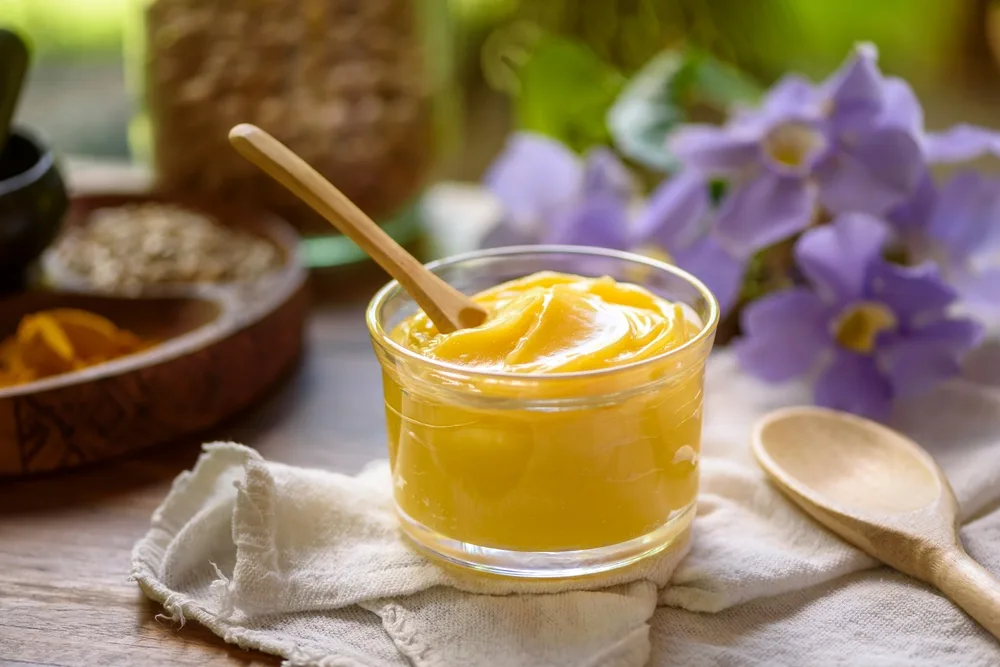
Ghee is a cooking fat made from butter that’s long been a staple in Indian cooking. Because it takes some effort to make—butter must be simmered and strained to remove the milk solids and water—it remained more of a specialty ingredient in Western markets for years. That changed as keto and paleo diets embraced it, and growing questions about seed oils led more people to look for alternative cooking fats.
Its long history in Ayurvedic medicine has also given ghee a place in wellness conversations. But is it actually healthier than butter? Would olive oil or another cooking fat be a better choice? And when it comes to weight loss, can ghee help you feel fuller, or is it simply another calorie-dense fat to use in moderation?
Ghee does have some practical advantages: it’s nearly lactose-free, shelf-stable, and has a smoke point of about 485°F, making it well suited for high-heat cooking. It also contains small amounts of butyrate, a short-chain fatty acid that’s important for gut health, along with modest amounts of fat-soluble vitamins.
But at about 112 calories per tablespoon, it’s still a calorie-dense cooking fat. A teaspoon to roast vegetables or sear chicken? Totally workable. A generous pour over everything on your plate? That’s where things get tricky. Here’s what the research says about ghee, health, and weight loss.
✅ Quick answer
In moderation, ghee can be part of a calorie-conscious diet. The catch is its calorie density—a single tablespoon packs about 112 calories, so it’s easy to underestimate how much you’re using. If you’re mindful of portions, ghee can be a flavorful, functional cooking fat. But if you’re pouring or drizzling it freely, those calories can quietly add up and contribute to a calorie surplus over time.

The Easy Way
to lose weight and get healthy.
See if you qualify
🚀 Potential benefits
- Ghee has a high smoke point, making it a stable cooking fat.
Ghee’s smoke point is around 485°F (250°C)—about 150°F higher than butter and well above most unrefined oils. It resists breaking down at high temperatures, making it a practical choice for sautéing, roasting, and stir-frying. - Ghee contains butyrate, a short-chain fatty acid that may support gut and metabolic health.
Butyrate is the primary fuel for colon cells and has been linked to reduced inflammation, improved insulin sensitivity, and better gut barrier function. While ghee contains preformed butyrate, the amount in a typical serving is relatively small, so it shouldn’t be relied on as a major source. - Ghee is naturally very low in lactose and casein.
Because the milk solids are removed during clarification, most people with lactose intolerance or mild dairy sensitivities can tolerate ghee. For people who experience digestive discomfort with butter, ghee may be a better option.
⚠️ Things to be mindful of
- Ghee is calorie-dense. At around 112 calories per tablespoon, ghee packs a lot of calories into a small serving. It’s easy to pour, drizzle, or scoop more than you realize, especially when cooking. If weight loss is your goal, measuring ghee instead of eyeballing it can help keep portions in check.
- Ghee is high in saturated fat. About 60% of ghee’s fat is saturated—roughly four times the proportion in olive oil. While the science on saturated fat is more nuanced than it once was, diets high in saturated fat can still raise LDL (“bad”) cholesterol in some people. If you have cardiovascular risk factors, talk to your healthcare provider about how much is appropriate for you.
- Ghee isn’t a significant source of protein, fiber, or most vitamins and minerals. While it contains small amounts of fat-soluble vitamins—particularly vitamin A, and to a lesser extent vitamins E and K—those amounts are modest in a typical one-tablespoon serving. Think of ghee as a flavorful cooking fat rather than a nutrient-dense food.
🥗 Nutrients in ghee (per 1 tablespoon)
| Nutrient | Amount |
|---|---|
| Calories | 112 |
| Protein | 0 g |
| Total carbohydrate | 0 g |
| Fiber | 0 g |
| Total sugars | 0 g |
| Total fat | 12.7 g |
| – Saturated fat | 8.0 g |
| – Monounsaturated fat | 3.7 g |
| – Polyunsaturated fat | 0.5 g |
| Omega-3 | 0.1 g |
| Omega-6 | 0.3 g |
Ghee’s nutritional profile is almost entirely fat—it contains no carbohydrates, protein, or fiber. Saturated fat is the dominant type at 8 grams per tablespoon, meaning a single serving provides nearly 40% of the recommended daily limit for saturated fat. That’s one reason portion size matters. Ghee also contains about 3.7 grams of monounsaturated fat, an unsaturated fat also found in foods like olive oil.
What ghee lacks is just as important as what it contains. It doesn’t provide the protein or fiber that help make meals more satisfying, and while it contains small amounts of fat-soluble vitamins like vitamins A, E, and K, the amounts in a typical serving are modest. Think of ghee as a cooking fat that adds flavor rather than a significant source of nutrition. Pair it with foods like vegetables, whole grains, or lean protein to create a more balanced meal.
💊 Vitamins & minerals in ghee (per 1 tablespoon / 0.49 oz)
| Vitamin/Mineral | Amount | % RDA* |
|---|---|---|
| Vitamin A | 108 µg | 12% |
| Vitamin E | 0.4 mg | 3% |
| Vitamin K2 | 1.1 µg | About 1% |
*Recommended dietary allowance (RDA) is defined as the average daily amount of nutrients needed to meet the requirements of nearly all healthy people in a specific group.
Ghee isn’t a major source of vitamins and minerals. It contains some vitamin A—about 12% of your daily needs per tablespoon—but you can get much larger amounts from foods like sweet potatoes and carrots, along with fiber and far less saturated fat. Ghee also provides small amounts of vitamins E and K2, especially if it’s made from the milk of grass-fed cows, but the amounts in a typical serving are modest.
🔍 Nutrient breakdown
Glycemic index (GI) of ghee
Glycemic index: 0 (None)
💡 Because ghee contains no carbohydrates, it has a glycemic index of 0 and won’t raise blood sugar on its own. When eaten as part of a meal that contains carbohydrates, fat can help slow digestion and blunt the rise in blood sugar somewhat, but the effect is modest. Portion size still matters because ghee is calorie-dense.
Is ghee high in protein?
❌ No: Ghee contains 0 grams of protein per serving. All milk proteins are removed during the clarification process, leaving pure fat.
Is ghee high in fiber?
❌ No: Ghee provides 0 grams of fiber per serving.
💡 Add fiber to the meal you’re cooking with ghee—roasted vegetables, legumes, or whole grains pair well
Is ghee low in carbs?
✔️ Yes: Ghee contains 0 grams of carbohydrates per serving, making it compatible with ketogenic and very low-carb diets.
💡 While ghee fits low-carb macros, its calorie density means it still requires portion awareness—zero carbs doesn’t mean zero calories.
Is ghee gluten-free?
✔️ Yes: Ghee is naturally gluten-free. Since it’s made from butter and the milk solids are removed, there’s no gluten present. If you’re buying commercially produced ghee, check the label for cross-contamination warnings from shared manufacturing equipment.
Is ghee good for fat loss?
✔️ Maybe: Ghee can fit into a fat loss plan, but it isn’t a weight loss food. At 112 calories per tablespoon, it’s easy to add more than you realize while cooking. Used in small, measured amounts, ghee can add flavor to vegetables, lean proteins, and other nutritious foods, making a healthy eating pattern easier to stick with. But because it’s calorie-dense, portion size is key.
🍽️ Diet compatibility: Which diets include ghee?
| Diet | ✅ / ❌ | Why |
|---|---|---|
| Keto | ✅ | Ghee has zero carbs, it’s high in fat, and has a great flavor profile for cooking meats and vegetables. It’s frequently used in keto coffee. Just account for calories if weight loss is your goal. |
| Paleo | ✅ | Most paleo frameworks permit ghee because the milk solids—the dairy proteins some paleo followers avoid—have been removed. It’s considered a more ancestrally appropriate fat than processed oils, and its high smoke point suits paleo-style cooking methods like roasting and grilling. |
| Mediterranean | ⚠️ | Ghee isn’t a traditional Mediterranean ingredient—olive oil is the foundation fat of that dietary pattern. Ghee can be used sparingly without conflicting with Mediterranean principles, but its high saturated fat content means it shouldn’t replace olive oil as a daily cooking fat. |
| Vegan | ❌ | Ghee is an animal product made from butter, which is derived from cow’s milk, and is not suitable for vegans. Refined coconut oil is the closest vegan substitute for high-heat cooking, while extra-virgin olive oil suits lower-heat applications. |
| Gluten-free | ✅ | Ghee is inherently gluten-free and safe for people with celiac disease or non-celiac gluten sensitivity. It’s a versatile cooking fat that doesn’t introduce any gluten risk—just check for cross-contamination notices on the label to be certain. |
Ghee works across popular diet plans, with the exception of vegan diets. It’s a particularly strong fit for keto and paleo, where high-fat, animal-derived foods are explicitly encouraged. For these eating patterns, ghee can serve as both a cooking fat and a flavor booster without raising dietary red flags.
For Mediterranean-style eaters, ghee works as an occasional addition rather than a daily staple. The more closely your diet centers on plant-based fats and whole foods, the less frequently ghee should appear. Either way, portion size remains the most important variable regardless of which dietary pattern you follow.
🌟 Is ghee healthy? What are the health benefits?
Metabolic health: Is ghee good for your metabolism?
- Boosts metabolism? ❌ There’s no good evidence that ghee boosts metabolism. Ghee contains butyrate, a short-chain fatty acid that has been linked to improved mitochondrial function and energy metabolism in laboratory and animal studies. However, it’s unclear whether the small amount of butyrate in a typical serving of ghee has a meaningful effect on human metabolism.
- Improves insulin sensitivity? ✔️ Possibly, but the evidence is limited. Some research suggests butyrate may support gut health and insulin sensitivity, but most studies have looked at butyrate supplements or the butyrate produced by gut bacteria—not ghee itself. Eating fiber-rich foods that promote your body’s own butyrate production is likely to have a greater impact.
- Effect on fat storage? Mixed. Grass-fed ghee contains small amounts of conjugated linoleic acid (CLA), which has been linked to modest changes in body fat in some studies. However, the evidence is inconsistent, and ghee’s calorie density means that eating more of it than your body needs can contribute to weight gain over time.
Cholesterol impact: Does ghee affect cholesterol levels?
- Does it lower LDL (bad) cholesterol? ❌ No. Ghee is high in saturated fat, which can raise LDL cholesterol in some people. How much it affects cholesterol depends on genetics, how much you eat, and the rest of your diet, but replacing unsaturated fats with ghee isn’t generally recommended for heart health.
- Does it raise HDL (good) cholesterol? ✔️ Possibly. Some studies suggest diets higher in saturated fat can modestly raise HDL cholesterol, including when ghee is used. However, raising HDL alone doesn’t necessarily reduce the risk of heart disease, so this isn’t considered a reason to eat more ghee.
- Overall impact on heart health? Mixed. Small amounts of ghee can fit into an overall healthy diet, but it’s still a concentrated source of saturated fat. If you have high LDL cholesterol, heart disease, or a family history of cardiovascular disease, it’s best to use ghee sparingly and emphasize unsaturated fats—such as olive oil, nuts, seeds, and avocados—as your primary fat sources.
💡 Balance ghee with olive oil, fatty fish, and plant-based foods to maintain a heart-healthy overall fat profile.
Can you eat ghee in a calorie deficit?
✔️ Yes: Ghee can fit into a calorie deficit as long as you account for it. Because it’s calorie-dense, it’s best used as a measured cooking fat rather than poured freely. Even a small amount can add rich flavor, making it easier to enjoy vegetables, lean proteins, and other nutritious foods while staying within your calorie budget.
💡 Measure with a teaspoon rather than a tablespoon—most people overestimate how little is needed to get great flavor.
Is ghee rich in antioxidants?
✔️ A little: Ghee contains small amounts of antioxidant nutrients, including vitamin E. Grass-fed ghee may also contain more beta-carotene, which gives it a deeper yellow color and has antioxidant properties. While these compounds can help protect cells from oxidative stress, ghee isn’t a significant source of antioxidants compared with foods like fruits, vegetables, nuts, and seeds.
Does ghee support gut health?
✔️ Possibly: Ghee contains small amounts of butyrate, a short-chain fatty acid that serves as a primary fuel source for the cells lining the colon. Butyrate helps support the gut barrier and plays a role in digestive health, but it’s unclear whether the amount found in a typical serving of ghee provides meaningful benefits. Most of the butyrate in your body is produced when gut bacteria ferment fiber, making fiber-rich foods a much more important source.
Does ghee support digestion?
✔️ Possibly: Ghee has long been used in Ayurvedic medicine to support digestion, although modern evidence is limited. It contains small amounts of butyrate, a short-chain fatty acid that helps maintain the gut lining and supports normal digestive function. Because ghee has most of its lactose and casein removed during processing, it’s also often better tolerated than butter by people with lactose intolerance or mild dairy sensitivities. While ghee may be easier to digest for some people, there’s little evidence that it improves digestion in otherwise healthy adults.
Does ghee help you feel satiated and less hungry?
✔️ Somewhat: Ghee may help make meals more satisfying because fat slows digestion and gastric emptying. However, ghee doesn’t provide protein or fiber—the nutrients most strongly linked to fullness—so it’s unlikely to curb hunger on its own. For the greatest satiety, pair a small amount of ghee with protein-rich foods and fiber-rich vegetables, legumes, or whole grains.
Satiety level: Moderate (as a fat in a mixed meal)
💡 Combine ghee with a protein source like eggs or chicken and a fiber-rich vegetable to maximize fullness at your meal.
Does ghee help with nighttime cravings?
✔️ Possibly: Adding a small amount of fat to an evening meal can slow digestion and help stabilize blood sugar through the night, which may reduce late-night hunger.
💡 If nighttime hunger is an issue, focus primarily on protein and fiber at dinner—ghee is a complement to that strategy, not a solution on its own.
Does ghee help reduce inflammation?
✔️ Possibly: Ghee contains small amounts of butyrate and conjugated linoleic acid (CLA), two compounds that have shown anti-inflammatory effects in laboratory and some animal studies. However, it’s unclear whether the amounts found in a typical serving of ghee are enough to meaningfully reduce inflammation in humans. Overall, there’s little evidence that eating ghee itself has a significant anti-inflammatory effect.
Is ghee beneficial for brain health?
✔️ Possibly, but the evidence is limited: Ghee contains small amounts of vitamins A and E, which play important roles in normal brain and nervous system function. It also contains butyrate, a compound that has shown neuroprotective effects in laboratory and animal studies. However, there’s little evidence that eating typical amounts of ghee improves brain health or cognitive function in humans.
Can ghee improve skin and hair health?
✔️ Possibly, but the effect is likely small: Ghee contains vitamin A, which is important for healthy skin and normal cell growth. It also provides dietary fat, which helps your body absorb fat-soluble vitamins from other foods. However, ghee isn’t a major source of skin-supporting nutrients, and there’s little evidence that eating it improves skin or hair health in people who aren’t deficient in vitamin A.
Can ghee help balance hormones?
✔️ Possibly, but there’s little direct evidence: Dietary fat is essential for the production of steroid hormones, including estrogen, progesterone, and testosterone, and ghee can contribute to your overall fat intake. However, there’s no good evidence that eating ghee specifically helps balance hormones or improves hormone-related conditions. While ghee has traditionally been used in Ayurvedic medicine for hormonal support, these uses haven’t been confirmed in high-quality clinical studies.
Access GLP-1 Weight Loss with Noom
Explore a wide range of prescription medications supported by Noom’s program.Microdose GLP-1rx
Noom GLP-1rx
Noom GLP-1rx Plus
Wegovy®

Ozempic®

Metformin

Zepbound®
Mounjaro®
Liraglutide

💡 Hormonal balance depends on your overall diet pattern, sleep, stress, and exercise—ghee can be one contributing factor, but it isn’t a standalone hormone fix.
🍽️ Best ways to eat ghee for weight loss
- Use ghee as a measured cooking fat. Ghee’s high smoke point makes it a good choice for roasting vegetables, sautéing, or searing proteins. Because it’s calorie-dense, measure it instead of pouring freely. One teaspoon contains about 42 calories and is often enough to lightly coat a pan or add flavor to a meal.
- Use a small amount to finish a dish. Stirring ½ to 1 teaspoon of ghee into dishes like lentil soup, dal, roasted vegetables, or cooked grains just before serving adds richness and depth of flavor, making healthy meals feel more satisfying without adding many calories.
- Use it where a little goes a long way. Instead of adding ghee to everything, use it where its rich, buttery flavor shines. A teaspoon can transform air-popped popcorn, roasted vegetables, or a bowl of lentils, especially when paired with spices like garlic, cumin, curry powder, or smoked paprika. The more flavor you get from a small amount, the easier it is to keep portions in check.
Recipes to try:
- Tempered Lentil Dal (In Tomato Broth) – The Kitchn
- The Best Chicken Tikka Masala – Food Network
- Ghee-Roasted Vegetables – Insanely Good Recipes
🍏 Best alternatives & comparisons (per 1 tablespoon)
| Food | Calories | Total fat | Saturated fat | Monounsaturated fat | Polyunsaturated fat |
|---|---|---|---|---|---|
| Ghee | 112 | 13 g | 8 g | 4 g | 0.5 g |
| Butter | 102 | 12 g | 7 g | 3 g | 0.4 g |
| Extra-virgin olive oil | 119 | 14 g | 2 g | 10 g | 1.5 g |
| Coconut oil | 121 | 14 g | 12 g | 1 g | 0.2 g |
| Avocado oil | 124 | 14 g | 2 g | 10 g | 2 g |
| Light spray oil (per spray) | 7 | 1 g | 0 g | 1 g | 0 g |
The biggest difference between these cooking fats isn’t calories—it’s the type of fat they contain. Ghee, butter, and coconut oil are predominantly saturated fat, while olive oil and avocado oil are rich in monounsaturated fat, the type most consistently associated with heart health. If you have high LDL cholesterol or other cardiovascular risk factors, choosing oils higher in unsaturated fats more often may be a better option.
From a weight loss perspective, portion size matters more than the type of cooking fat you choose. Most oils and fats provide roughly 100 to 125 calories per tablespoon, so switching from one to another won’t make a meaningful difference in calorie intake. Light spray oil is the exception, providing just a few calories per spray for lightly coating a pan. Otherwise, choose the fat that best fits your cooking method and taste preferences while keeping portions in check.
Frequently asked questions about ghee and weight loss
How much ghee per day is okay for weight loss?
There’s no recommended daily amount of ghee for weight loss. Because it’s calorie-dense, many people find that 1 to 2 teaspoons per day (about 40 to 85 calories) fits comfortably into a calorie-controlled eating plan, though the right amount depends on your overall calorie needs and the other fats in your diet. Rather than aiming for a specific daily target, think of ghee as a flavorful cooking fat to use in measured amounts while staying within your calorie budget.
Is ghee better than butter for weight loss?
Not really. Ghee and butter are very similar in calories and fat, so choosing one over the other is unlikely to affect weight loss. Ghee’s main advantages are its higher smoke point and the fact that it contains very little lactose and casein, making it a better choice for many people with lactose intolerance or mild dairy sensitivities. If weight loss is your goal, the amount you use matters far more than whether you choose ghee or butter.
Can you eat ghee every day on a weight loss diet?
Yes. Ghee can be part of a healthy weight loss diet if it fits within your calorie goals. One teaspoon contains about 42 calories, making it easy to incorporate in small, measured amounts. Because it’s calorie-dense, the key is keeping portions consistent—using a little for flavor rather than letting it become a major source of calories.
Is grass-fed ghee worth it for weight loss?
Not really. Grass-fed ghee contains slightly more vitamin A, vitamin K2, conjugated linoleic acid (CLA), and omega-3 fats than conventional ghee, but the differences are relatively small—especially at the 1 to 2 teaspoons most people use. If you prefer grass-fed dairy or enjoy the flavor, it can be a good choice. But when it comes to weight loss, portion size and total calorie intake matter far more than whether your ghee is grass-fed.
Should I cook with ghee or olive oil for weight loss?
Both can fit into a weight loss plan—the better choice depends on how you’re cooking. Ghee’s high smoke point makes it a good option for high-heat cooking, such as searing or roasting, while extra-virgin olive oil is an excellent choice for most everyday cooking, including sautéing, roasting, and salad dressings. Olive oil is also richer in heart-healthy monounsaturated fats and antioxidant polyphenols. For weight loss, however, the type of fat matters less than the amount you use, since both provide about 100 to 120 calories per tablespoon.
Is ghee inflammatory or anti-inflammatory?
Neither, really—it depends on the overall diet. Ghee contains small amounts of compounds like butyrate and conjugated linoleic acid (CLA) that have shown anti-inflammatory effects in some studies. At the same time, it’s high in saturated fat, which may promote inflammation in some people when consumed in excess as part of an overall unhealthy diet. For most healthy adults, using small amounts of ghee as part of a balanced eating pattern is unlikely to have a meaningful effect on inflammation one way or the other.
🧠 The bottom line: Ghee can be used in most weight loss plans in moderation
Ghee can be part of a successful weight loss diet, but like any cooking fat, portion size is what matters most. Its high smoke point makes it a practical choice for high-heat cooking, and because it contains very little lactose or casein, it may be a good option for many people with lactose intolerance or mild dairy sensitivities. While ghee also contains small amounts of butyrate, CLA, and fat-soluble vitamins, there’s little evidence that these nutrients meaningfully affect weight loss at the amounts most people consume.
The practical rule is simple: measure your portions. One teaspoon of ghee contains about 42 calories and is often enough to add rich, buttery flavor to vegetables, proteins, soups, or grains. The challenge isn’t ghee itself—it’s how easy it is to use more than you intended.
Ghee isn’t the right choice for everyone. If you have high LDL cholesterol or other cardiovascular risk factors, oils rich in unsaturated fats, such as olive or avocado oil, may be better everyday options. But if you enjoy the flavor and use it in small, measured amounts, ghee can absolutely fit into a balanced, calorie-conscious eating pattern.
📖 Scientific evidence
1. Butyrate improved insulin sensitivity and increased energy expenditure in animal studies. (Diabetes, 2009) Mice given butyrate alongside a high-fat diet burned more energy and maintained better insulin sensitivity than those that didn’t receive it. But researchers studied butyrate supplements rather than ghee, so we don’t know whether the small amount of butyrate naturally found in ghee has the same effect in people.
2. CLA supplementation reduced body fat mass over one year in overweight adults. (American Journal of Clinical Nutrition, 2004) In this one-year study, people taking CLA supplements lost more body fat than those taking a placebo. However, researchers studied 3.4 to 3.6 grams of CLA per day—much more than you’d get from a typical serving of grass-fed ghee—so it’s unclear whether eating ghee would have the same effect.
3. A large review found no clear link between saturated fat intake and cardiovascular events. (Annals of Internal Medicine, 2014) This analysis found that saturated fat intake alone wasn’t significantly associated with coronary heart disease or cardiovascular events. But, the authors also noted that what replaces saturated fat in the diet matters—replacing it with unsaturated fats may improve heart health, while replacing it with refined carbohydrates may not. The findings suggest that the overall dietary pattern is more important than focusing on saturated fat in isolation.
4. Butyrate helps maintain gut barrier integrity and reduce gut inflammation. (Nutrients, 2018) This review found that butyrate plays a key role in maintaining the intestinal barrier and reducing inflammation in the gut. Most butyrate is produced when gut bacteria ferment dietary fiber, though foods like ghee contain small amounts of preformed butyrate.
5. Dietary ghee didn’t raise total cholesterol in a genetically susceptible rat model. (AYU, 2010) In this four-week study, Fischer inbred rats fed a diet containing 10% ghee showed no significant change in total cholesterol, although triglyceride levels increased. Because the study was conducted in a genetically susceptible rat strain rather than people, the findings don’t necessarily reflect the effects of typical ghee consumption in humans.
Editorial standards
At Noom, we’re committed to providing health information that’s grounded in reliable science and expert review. Our content is created with the support of qualified professionals and based on well-established research from trusted medical and scientific organizations. Learn more about the experts behind our content on our Health Expert Team page.