What you’ll learn:
- Almost every red light belt on the market uses LEDs, but the studies behind red light therapy weight-loss claims almost all used lasers.
- Red light laser studies show modest inch loss in some trials, but body weight and BMI barely moved, and no LED belt has been tested the same way.
- Red light therapy is low-risk for most people, but darker skin tones, certain medications, and eye exposure call for extra caution
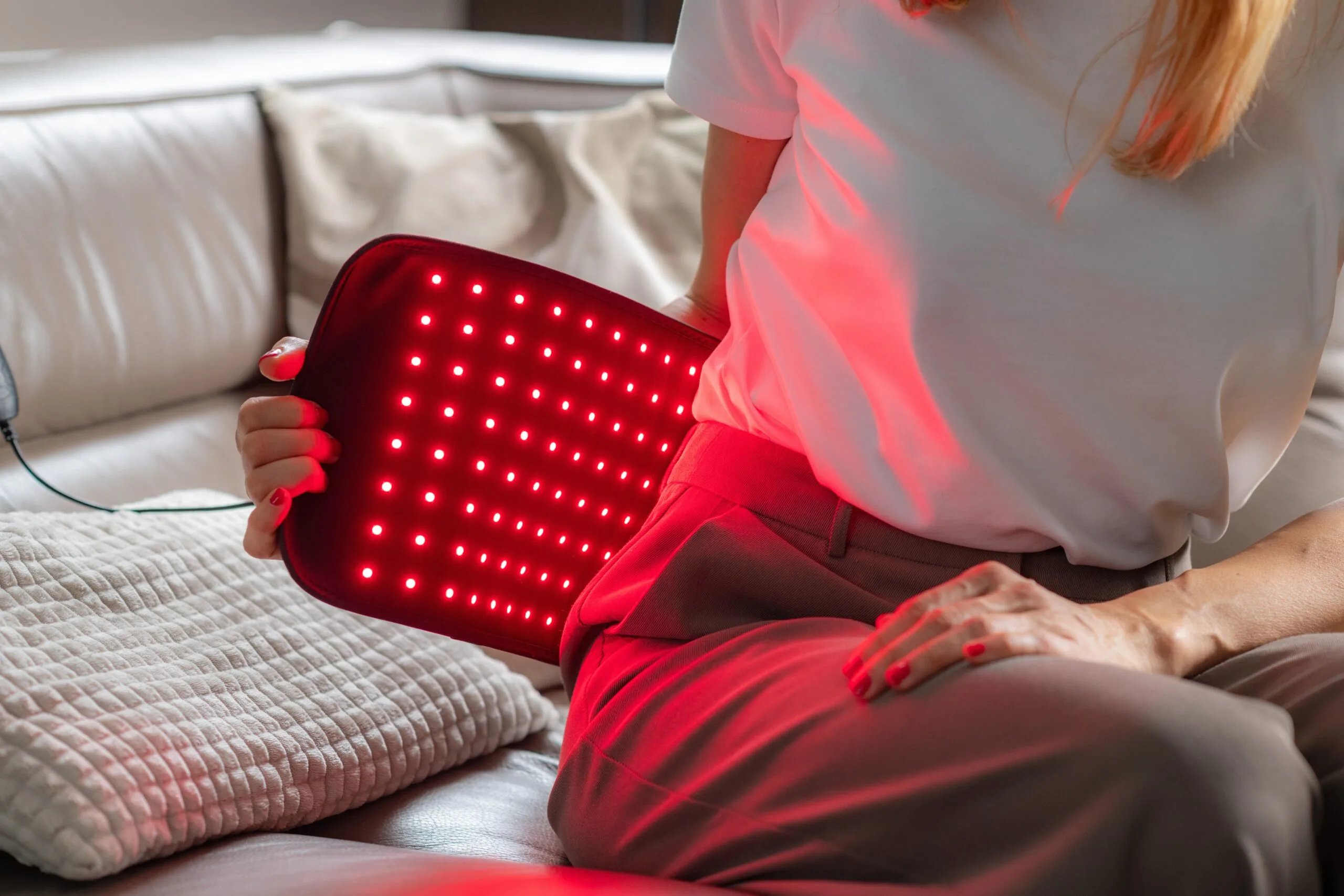
Red light therapy belts promise something simple: wrap a glowing belt around your waist for 10 to 30 minutes a day and lose inches and weight. As these belts show up more on social media and in ads, people want to know if they actually work, or if they’re another gadget with big promises, like fat-burning shorts.
Here’s the short version: red light belts might shrink your measurements a little, but the evidence is thin. They haven’t been shown to cause real weight loss on their own. Most of the promising research used clinic-grade lasers, not the LED belts sold to consumers, so it’s not clear the results carry over to what you’d actually buy.
That doesn’t mean red light therapy has no value. Red light therapy has real uses in skin care, treating acne, hair loss, and some kinds of pain. Using it for fat loss is a different claim, and one with much less evidence behind it.
Here’s what these belts are, how they’re supposed to work, and what the research actually shows about weight loss.
How does red light therapy work?
Red light therapy uses red and near-infrared light to trigger changes in your cells. Instead of heat, like a sauna, the light gets absorbed by proteins inside mitochondria—the part of your cells that makes energy. Researchers think this may help cells work more efficiently, though the full process is still being studied.
This is well established in skin care: red light can improve texture, fade fine lines, treat acne, help hair grow, and speed wound healing. Whether a device actually delivers enough light to trigger this effect depends on its wavelength accuracy and power, which vary a lot between products. What’s less clear is whether these cell-level effects add up to real changes in body fat. That’s where the evidence gets shaky.
This basic mitochondria effect doesn’t care whether the light source is an LED or a laser—both can trigger it, as long as the wavelength and power are strong enough. But for weight loss specifically, device type turns out to matter a lot. That’s what the next section gets into.
What is a red light therapy belt?
A red light therapy belt is a wearable strap that wraps around your waist, hips, or thighs. You wear it for 10 to 30 minutes, directly against your skin.
There are two ways to produce this kind of light: LEDs or lasers. An LED (light-emitting diode) is the same basic tech as a flashlight or a string of holiday lights—a small chip that gives off a spread of light in one color. A laser works differently. It produces a single, tightly focused beam of light at one exact wavelength, strong enough to stay a narrow beam instead of spreading out.
Almost every belt sold online uses LEDs. The lasers, on the other hand, are what almost all of the clinical studies below used. That mismatch matters: even though both get marketed as “red light therapy,” a study on a laser doesn’t tell you much about how an LED belt performs.
Here’s how some popular devices break down:
| Device | Light type |
|---|---|
| Maysama LED Light Therapy Silicone Belt | LED |
| Hooga Red Light Therapy Belt | LED |
| Megelin LED Contour Belt | LED |
| Infraredi Body Wrap | LED |
| KingPavonini Red Light Therapy Belt | LED |
| iRESTORE Sculpt LED Belt | LED |
| MitoQUAD Wavelength Belt | LED |
| Kineon MOVE+ Pro | Laser + LED hybrid |
Kineon’s MOVE+ Pro is the one real exception on this list—a modular device with an actual laser alongside its LEDs. Every other belt here is LED-only.
Even within that LED group, they’re not identical. Belts differ a lot in power and light accuracy—a bargain belt like the KingPavonini can spread a weaker, less consistent beam than a more expensive one, even though both are technically “LED.” That’s on top of the bigger laser-versus-LED gap: quality varies within LEDs, and LEDs as a category differ from the lasers used in the studies below.
Cost is a big reason for that pattern. Laser diodes are expensive to make and expensive to build into a device, which is part of why clinic-grade laser treatments can cost thousands of dollars. LEDs are cheap by comparison, so a company can pack a belt with hundreds of them and still sell it for under $200. That price gap is a big part of the technology gap: the belt you’d actually buy is built to a different budget than the devices tested in the studies below.
It’s also worth being clear about where those lasers are used. The lasers in studies are only found in dermatology offices or medspas, run by trained staff. Part of the reason is safety: the lasers used in these studies require protective eyewear and professional supervision, since a laser at that power is a bigger eye-injury risk than an LED. So when you see “red light therapy belt” advertised online, you’re almost always looking at an LED product, not a smaller version of the medspa laser.
What does the research say about red light therapy for weight loss?
Red light therapy’s skin-care uses have made it easier for companies to stretch the claim to weight loss. But a biological effect on skin cells isn’t the same as real fat loss. That’s a bigger leap than the marketing suggests. And almost all of the studies below were done with medspa-grade lasers, not the LED belts sold online. Here’s what the evidence shows, and what we still don’t know.
Laser therapy may modestly shrink inches—but LED belts haven’t been tested.
The most-cited trial here is a study that treated 67 people with a 635nm red laser, administered at a clinic three times a week for two weeks. The treatment group lost about 3.5 inches combined across the waist, hips, and thighs. A later, independent test of the same type of device found a similar result: close to 3 inches lost across the same areas.
635nm is the wavelength close to what most LED belts use too (mostly 630–660nm). What’s different is that this is a laser, which produces one concentrated beam—an LED belt spreads that same red light out instead, at lower intensity.
And even laser studies don’t all agree. A smaller, 4-week study using a different 635nm laser found a much smaller result: less than an inch off the waist, with no real change in weight or BMI.
None of these trials tested an LED belt, the kind you’d actually buy online. That’s a separate problem from the studies disagreeing with each other. Applying a laser result to an LED product isn’t a lower dose of the same thing. It’s evidence for one light source being used to justify a different one.
Red light may release fat from cells—but the mechanism isn’t settled.
One theory is that laser light opens tiny, temporary holes in fat cell walls, letting some stored fat leak out. Lab testing behind this idea found that laser-treated fat cells released more stored fat than untreated cells, without breaking that fat down the way your body normally would. In other words, the fat leaked out through weakened cell walls rather than being burned off. A separate study disagreed, suggesting any inch loss comes from a shift in how your whole body handles fat, not direct damage to fat cells in the treated area.
Researchers still don’t agree on what’s actually happening at the cellular level. A broad review of the low-level laser research found that after more than a decade of small trials, there still isn’t enough evidence that this therapy works on its own.
These studies used red light—but it’s medspa laser light, not the LED light in most belts.
The studies above all used the same 635nm red light, which is close to what an LED product uses. What’s different is where that light comes from and how strong it is: a laser at a medspa, run by trained staff, versus an LED belt you’d wear alone on your couch.
A laser is a small number of diodes shooting one tight, focused beam at a set strength. An LED belt is the opposite: a wide, soft spread of light from lots of small diodes, at lower strength per point. Devices vary a lot in light source and power, and that’s exactly the laser-versus-LED gap: same color, two very different ways of delivering it.
That gap matters. The theory is that light triggers tiny pores in fat cells, or pushes mitochondria to release stored fat—and both depend on how much light energy actually reaches the tissue. The laser studies show what a strong, focused beam can do in a clinical setting. None of them tested whether a weaker LED belt delivers enough of that same red light to do anything similar. That’s not a small gap. It’s the difference between “this worked at a medspa” and “this belt will do the same thing on your couch.”
Is a red light therapy belt safe?
For most people, red and near-infrared light doesn’t carry much risk. There’s no cancer risk like from the sun’s UV rays or tanning beds, and the American Academy of Dermatology notes research hasn’t linked red light devices to skin cancer. The most common side effect is mild—a little redness or irritation where the device touches your skin.
That doesn’t mean it’s right for everyone. A few groups should use caution:
- You’re being treated for cancer, or have a history of it. Talk to your doctor first. It isn’t well understood how light might affect cell growth in or near a cancer-affected area.
- You have a darker skin tone. You may be more sensitive to visible light, including red light, which can leave dark spots that last longer than a typical sunburn mark.
- You have a light-sensitive condition, like lupus, or take a medication that increases light sensitivity. Check with a doctor before starting.
- You’re using a device near your eyes—a face mask or panel, not a body belt. Keep your eyes closed or wear the eye protection provided. Bright light that close can be uncomfortable, and the stronger lasers used at medspas (not the LEDs in belts) can cause lasting harm, which is why those sessions require protective eyewear.
FAQs about red light therapy belts
Do red light therapy belts work?
Some clinic-grade laser devices have shown small reductions in waist and hip size in trials—typically half an inch to a few inches over several weeks. But those trials tested lasers, not the LED belts sold online. No LED belt has been tested the same way, so there’s no direct evidence a belt does the same thing.
Will a red light therapy belt reduce belly fat?
Maybe a little, based on the laser trials—but that’s a change in size, not proof of real fat loss or a change in body composition. Several studies found no change in weight or BMI even when waist size went down. And those results come from lasers at a clinic, not the LED belts you’d actually buy.
What are the side effects of a red light therapy belt?
Side effects are usually mild, like temporary redness or irritation. People with darker skin tones, light-sensitive conditions, or anyone on a light-sensitizing medication should talk to a doctor first—red light can cause dark spots that last longer than a typical sunburn mark.
What are the negatives of red light therapy?
The biggest issue isn’t safety; it’s uncertainty. The studies are small, use different devices and schedules, and don’t agree on why any effect happens. Clinic laser treatments can cost thousands of dollars, while LED belts are much cheaper—but cheaper because they’re a different, less-tested technology, not a smaller dose of the same one. Either way, you’d need consistent, correctly timed sessions to see even the modest results reported in trials.
Can red light therapy cause fat loss?
Some research suggests laser light may cause fat cells to leak a small amount of their contents, leading to measurable inch loss in a few studies. This isn’t the same as losing fat through a calorie deficit, and the effect seems to fade without ongoing treatment. This evidence comes from laser studies, not the LED belts marketed as at-home versions.

The Easy Way
to lose weight and get healthy.
See if you qualify
The bottom line: Red light therapy belts aren’t a proven weight loss shortcut
Red light therapy may help with some skin conditions, but that doesn’t automatically extend to reshaping the fat underneath. Skin and fat tissue are different targets, backed by very different levels of evidence—and a belt borrowing credibility from red light’s track record in dermatology doesn’t change that.
A few studies showing a positive effect is still a long way from knowing this will reshape your body, especially since almost all of that evidence comes from lasers at a clinic, not the LED belts sold online. The research is inconsistent between devices, the results are often small, researchers don’t agree on the mechanism, and body weight and BMI mostly didn’t change even in the trials that found a smaller waist.
If you like how your skin looks or how your muscles feel after a session, that’s a reasonable reason to use one. If you’re expecting it to replace the basics—a sustainable balanced diet, regular movement, and consistent sleep—there’s no evidence that it can do that.
Access GLP-1 Weight Loss with Noom
Explore a wide range of prescription medications supported by Noom’s program.Microdose GLP-1rx
Noom GLP-1rx
Noom GLP-1rx Plus
Wegovy®
Ozempic®
Metformin
Zepbound®
Mounjaro®
Liraglutide
Need help building the habits that help you lose weight comfortably and sustainably? Download Noom on iOS & Android for food logging, progress tracking, and psychology-based lessons built around healthy changes you can maintain.
Editorial standards
At Noom, we’re committed to providing health information that’s grounded in reliable science and expert review. Our content is created with the support of qualified professionals and based on well-established research from trusted medical and scientific organizations. Learn more about the experts behind our content on our Health Expert Team page.