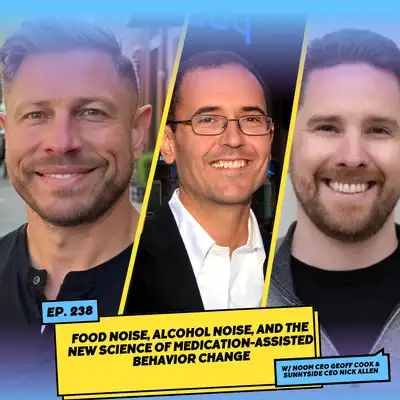
Noom CEO Geoff Cook joined Sunnyside CEO Nick Allen and Mike Hardenbrook on Journey to the Sunnyside Podcast to talk about food noise, alcohol noise, and the new science of medication-assisted behavior change.
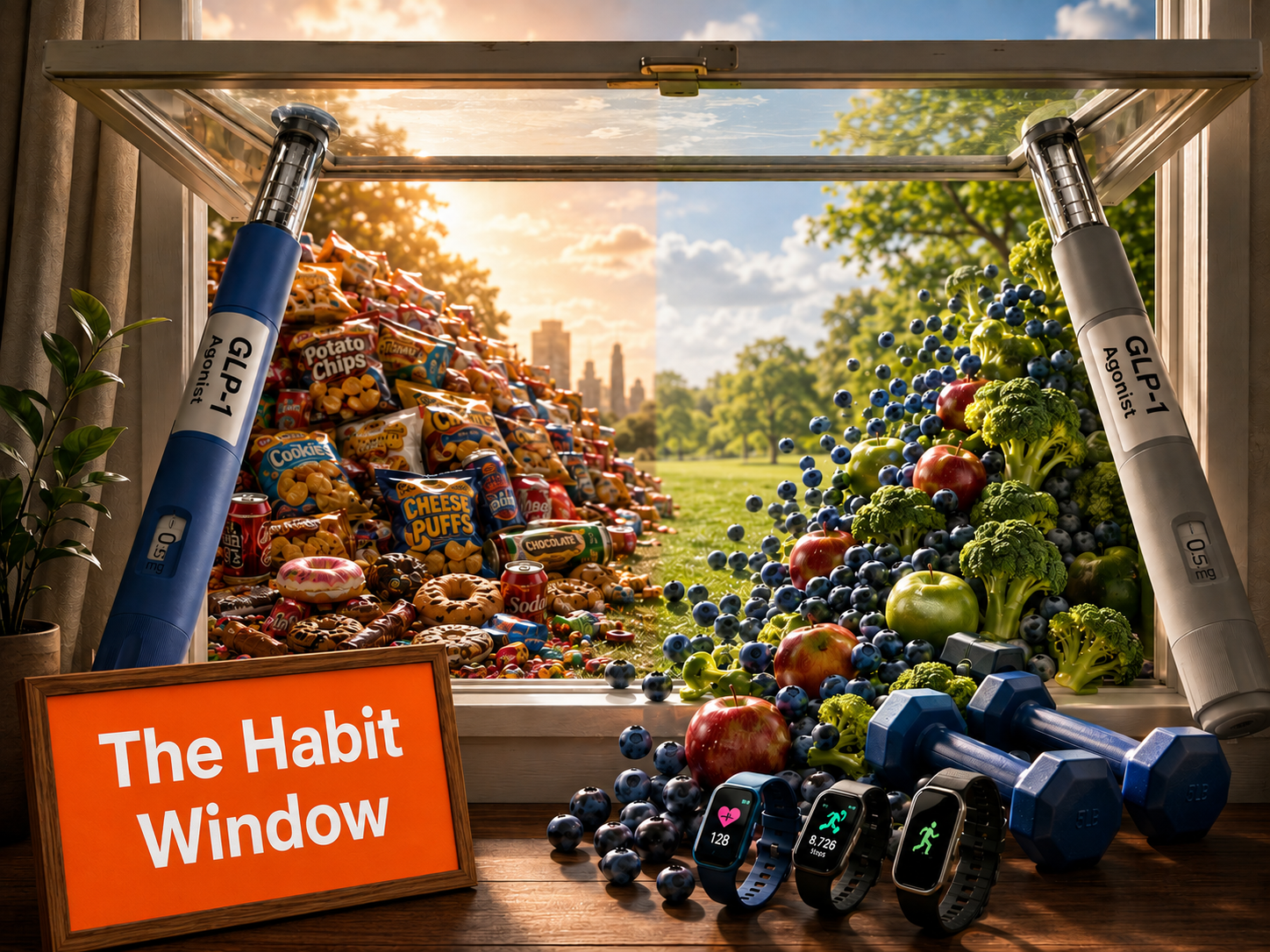
Geoff talked about how GLP-1 medications reduce food noise, freeing up mental bandwidth and self-control, which creates a unique window for behavior change. However, medication alone is not sufficient for lasting results—most people discontinue and risk regaining weight. The key to durability is using this period to build habits and shift identity. By pairing GLP-1s with behavioral support—such as habit loops, cognitive strategies, and environmental design—Noom GLP-1 members can establish routines that persist after the medication ends. The future of obesity treatment is not medication or lifestyle alone, but an integrated model where GLP-1s act as a catalyst for long-term behavior change and improved quality of life.
Mike Hardenbrook: Well, before we get into this, we have some amazing questions lined up. Can you give us a little bit of your background and history, and what you’re doing today?
Geoff Cook: Sure. So I’m the CEO of Noom. I’ve been at that for three years now. Prior to that, I’d spent eighteen years starting a company called The Meet Group, taking it public on NASDAQ, and selling it. Really, what I’ve been concentrating on at Noom is bringing Noom into this age of the GLP-1 and ultimately beyond.
Geoff Cook: And so I’ve been building the medication programs, the HRT programs, blending behavior change with medication. I would call Noom a behavior change company, which is really, I think, what I would call Noom five years ago. It’s still a behavior change company. Our mission is to empower everyone everywhere to live better, longer, every day, and what we’ve been doing the last three years is really embracing medication, pharmacological interventions as part of our behavior change.
Mike Hardenbrook: Yeah. I love all the things that you have been doing over there. I’ve been following for a while. You guys are on the cutting edge, trying new and different things, integrating different philosophies. And I really am interested to get into where you said still doing a lot of what you thought about in five years, but obviously, you guys have come a tremendous way in those five years, which we’ll get into today.
Mike Hardenbrook: But you talk about something called food noise, and anybody that’s hearing this for the first time, what does that mean in practical terms?
Geoff Cook: Sure. So I would call that persistent unwanted thoughts about food. So, what to eat next? When am I gonna eat? How much should I eat?
Geoff Cook: It’s something that’s kinda seated in the default mode network of the brain, which is what your brain is doing when it’s not doing something else. We spend half of our time, 50% of our time, with our brain in this state, and it’s called perspection. You’re thinking about you’re imagining possible futures, and food becomes this kind of maladaptive perspective where you’re constantly thinking about it. When people started GLP-1, what we find is that they experience this uncanny silence. A lot of times, you’re not even aware of the food noise until it’s gone. And so I happened to explore this concept of food noise in an article I wrote for a peer-reviewed journal recently as part of a Master of Science in nutrition that I’m seeking at Tufts.
Geoff Cook: And so basically, what the hypothesis was that I kind of advanced in that paper is that GLP-1s lower the volume of food noise, and they do that by really dampening the reward circuits of the brain. And mindfulness, meanwhile, which is what Noom has been known for for some time, actually has a real impact on food noise too, but from a top-down approach where you become aware of these interoceptive signals, this sense of maybe why your hunger or your appetite, and then you handle that cognitively. I think what GLP-1s are doing is they’re freeing up this cognition that you would otherwise be spending on food, which is maladaptive, and allows you to have this silence where you might then spend that time, that self-control potentially in other areas. So that’s how I would think about food noise.
Mike Hardenbrook: Now I know that you’ve talked about food noise, and you’ve also talked about what’s often misunderstood about what’s driving that. Can you comment a little bit about that?
Geoff Cook: Yeah. So what’s driving food noise? So I think a lot of people experience food noise as simple cravings, right? So this sense that you want something right now. And within obesity, at least, one of the studies that was done was this milkshake study, which basically showed that people with obesity have a significantly dampened wanting response.
Geoff Cook: So it was trying to determine the difference between wanting and liking, and there was a kind of a blunted, a dampened, wanting response for people on a GLP-1. People with obesity had a high wanting response. They really wanted the milkshake, but when they got the milkshake, absent the GLP-1, they didn’t like it as much. When you give them the GLP-1, they want it less, and they end up liking it more. And so it kind of modulated the reward circuits to kind of bring them back into kind of regulation.
Geoff Cook: And so I think I think this manifestation of food noise is kind of this haywire kind of system where the default mode network becomes dysregulated, and it’s essentially neurochemistry. Right? It’s the GLP-1 is having an effect that is really a bottom-up sort of effect.
Mike Hardenbrook: Yeah. Absolutely. And it seems like it goes much deeper than just the cravings level. There’s so much more that food noise takes up, including mind space, which you’ve talked about. Now, on the other side here, Nick has thought about and also written on the concept of the alcohol noise.
Mike Hardenbrook: And, Nick, what are you trying to help people understand about their experience, especially if they spent years seeing it as maybe just a willpower problem?
Nick Allen: Yeah, I think the parallels between what we’re seeing in kind of our deepening understanding of weight loss and metabolic health have direct applications to kind of our approaches with Sunnyside and kind of broadly to changing the way that we understand alcohol as a kind of compulsive behavior and a kind of potential dependent substance. And so when we think about food noise, as Geoff has so eloquently described it, and I’ve done a lot of reading of Geoff’s work, and it’s really worth checking out. The parallels jump out off the page when you read the writing in this space, when you start to think about kind of the way that alcohol interacts with the brain as well. We’ve got these deeply ingrained habits when it comes to drinking that ultimately become so automatic and so subconscious that they are no longer kind of in control for many people. I would describe alcohol noises, that voice that starts to creep in, that’s kind of looking for the next drink, often triggered, you know, at the end of a of a long day, or as, you know, that Friday afternoon approaches and you’re kind of getting ready for the weekend.
Nick Allen: Decades and decades of repeating patterns around food, and in the case of Sunnyside Alcohol, lead to these deeply ingrained associations that become nearly impossible to push back on. And so when I think about this concept of alcohol noise, it’s this association between that next drink and relief in some form or factor. Relief or release, right? That might be stress release. It might be relaxation.
Nick Allen: It might be just a transition between kind of work mode and, you know, and kind of like after work mode or weekend mode. But those associations become so strong that ultimately they can be really dominating of one’s subconscious and psyche. And I think to Geoff’s point, like, that’s not always necessarily something that we naturally notice because it is so constant and so always on. But when you start to introduce GLP-1s in the case of food, and in our case, Naltrexone, in the case of Sunnyside Med and alcohol. What’s so interesting is observing the patterns of folks and hearing the stories of people who are just saying like, wow. Like, I have control of my Friday afternoons for the first time in decades because that voice and that kind of immediate pleasure center that’s put that tended to push me towards alcohol has been dampened.
Nick Allen: And I now have space to make more conscious choices in those moments. And that space is what’s so important and becomes such a catalyst for behavior change broadly, is that there’s room in one’s brain and for conscious thought, where previously I think a lot of that conscious thought has been drowned out by these deeply ingrained habit loops that become very noisy, ultimately.
Geoff Cook: So the parallel
Nick Allen: is And then this is why this is where Geoff and I connected, this idea of what’s happening in metabolic health is the precursor for what needs to happen in alcohol treatment, and I’m just so excited to kind of connect these dots together.
Geoff Cook: Yeah. No. I think that’s really interesting, Nick. And I don’t think food noise really was even a term until GLP-1s kind of put it into the zeitgeist. Right?
Geoff Cook: Like, so I think you’re hungry. You have an appetite. What food noise, though, is this cognitive manifestation of, and it’s almost separate from whether you’re actually physiologically hungry. Right? So, and I’m sure the same goes for alcohol or other substances.
Geoff Cook: But I think one of the mechanistic explanations that I’ve been interested in lately is there’s a fair amount of studies and literature around self-control as a depletable resource. Studies that basically show if you deplete your self-control in doing one thing, you’re gonna be more susceptible to the next thing. And so maybe having that drink at the end of the night, which becomes two, three, four, and so forth, the same with snacking at the end of the night, necessarily. What GLP-1s seem to do, or at least one thought I’ve had, is that GLP-1s are removing that food noise. They’re removing the need to exercise self-control and potentially leaving you with a store of self-control that you can then apply to other things, whether it’s other habits or whether it’s stopping a particular habit.
Geoff Cook: And so I think that’s an interesting way of potentially getting there. Right? If your food noise goes away, well, maybe you’re what that also is helping with is it’s keeping you from having to exercise executive control in order to kinda control yourself.
Nick Allen: Yeah. And and I think that it’s so interesting. I love the way that you described that. I would describe this as kind of like creating space for agency and conscious choice, where previously those things might have been blocked, ultimately by the push of willpower. Right?
Nick Allen: By this kind of feeling of exhaustion of having to push back on what we may have previously described as cravings, we can now describe as food or alcohol noise. It is really tiring to try to hold oneself accountable in the absence of additional tools to goals that you kind of deep down know are aligned with your long-term health goals or lifestyle goals. And yet in the moment, you know, potentially after a long day or when willpower is kind of most depleted, that’s the moment when you’re expected to be the strongest, ultimately. And doing that on your own becomes really, really difficult. And we’ve seen time and time again that the reason these behaviors are so hard to change is because when the tool kit is willpower alone, the reality is that that is a resource that ebbs and flows.
Nick Allen: And so I think the other thing that kind of medications do in these behavioral health spaces is ultimately kind of reenergize the effort towards conscious change by removing the need to kind of constantly have this battle. Right? And I think that the really, really powerful thing and a really important part of the modern habit change toolkit, ultimately, that gives agency and is really empowering, you know, in a world where previously I think it’s we’d looked for personal strength to change dietary patterns or drinking patterns. And I just don’t think that’s fair or necessary given the kind of modern pharmacological toolkit that we have available to us in these areas today.
Geoff Cook: Yeah. It reminds me a little bit of I think there’s an undercurrent right now of people thinking that these GLP-1 medications, what they’re doing is they’re just dampening their reward circuitry of the brain, and people are, oh, yeah. They want less of maybe alcohol. Maybe they want less food, but they want less of everything. And and so, ultimately, it’s you’re just getting less joy.
Geoff Cook: And and I would say that is false. Right? Like, I think you you often see it you you off you off you see this asserted by a journalist who doesn’t doesn’t really talk to folks in in this in this space, but it it sounds like an interesting counter, except for the fact that the opposite is true, which is when we’ve run surveys and we’ll probably publish something relatively soon, but the psychosocial impact of GLP-1 use is profound. Like, if you ask people, are you getting more or less joy from these different dimensions of your life? Like, food being one of them, family, Mhmm.
Geoff Cook: Work, hobbies, especially for family and work hobbies, like, it’s off the charts. 60-plus % reporting more. For food, it is a little bit less. There are still more people actually reporting more joy from food, but it’s not as dramatic an effect as for the other dimensions. But it doesn’t. I haven’t seen anything to really bear out or something I used to do that was positive, I no longer want to do.
Nick Allen: Yeah. And for individuals where the noise is so loud, right, food and in our case, alcohol comes to dominate that joy. Right? They come to be so deeply intertwined with the idea of joy that we don’t even realize how much we’re missing by depending on these things for that sense of release. And so finding other ways to release and to find reward becomes so much more fulfilling.
Nick Allen: And we hear this every single day from Sunnyside members, this idea that alcohol was preventing me from experiencing the life that I wanted to live, whether that was family, activity, or professional. Creating that space is so empowering for individuals. We see the exact same thing ultimately, that the overall experience of life is so much more full when this space is created. And I think we do see a lot of things. I’m sure you see the same kind of folks that are writing off GLP-1s as cheating.
Nick Allen: Right? Same thing with alcohol. Right? This idea that, like, if you take medication, you’re not and you need medication to kind of make a change, that in some way reflects poorly on you as an individual. And I just think so the opposite.
Nick Allen: Right? This is a modern pharmacological toolkit. We don’t judge people for taking medication and medicine in other areas of health, right, for being proactive in introducing new tools to achieve improved health outcomes in virtually every other area. But for whatever reason, in these behavioral health categories, there’s still this stigma and kind of inertia that companies like Noom and Sunnyside, kind of following in your footsteps, are really looking to knock down and to ultimately kind of normalize and embrace a modern science-backed toolkit for achieving a fundamentally higher quality of life. And that’s really what we’re kind of here to do.
Mike Hardenbrook: I love all of this, and we’re gonna get to a little bit of it. But earlier, we were talking about food noise, noise around alcohol. We’re also talking about medications. And then you guys both have mentioned this window, this opportunity where the noise is lower, maybe the motivation is higher. Let’s talk about that window and why it’s so important.
Mike Hardenbrook: Geoff, can you start out?
Geoff Cook: Sure. I think my sense of that catalytic window essentially is that it’s based in part on the fact that so many people do discontinue the medication. They might come back on some months or years later, but they discontinue the medication. Their prime therapeutic studies suggest as many as eleven out of twelve by year three, maybe two out of three by year one. So many people are using the medication as a limited-time tool.
Geoff Cook: Right or wrong, that’s what they’re doing. And so if you kind of take that as a fact on the ground, then what you wanna do is make the most of that window. And so, you know, if you’re if you follow the food noise reduction, the self-control store kind of replenishment, well, then if you can combine that with behavior change, with a different kind of going after both, like system one and system two. Right? Automatic sort of habits help you to, you know, create your choice architecture, think in terms of cue, habit, reward, but then also use the more considered network as well.
Geoff Cook: Think about boosting the self-efficacy, which naturally actually goes up as you master, and as you start improving. So if you can take that window where you’re just naturally gonna have in the case of Noom, you’re gonna lose weight. You’re going to probably move more, maybe in part because you’re losing weight, you’re going to get this sense of mastery. If at the same time you’re really being intentional about creating new habits or building on existing habits, what you’re gonna feel rewarded for them because you are in this is, like, kind of privileged period where you’re gonna notice at least the results on the scale. When that medication goes away, there was actually an interesting Oxford study that came out in January and basically showed that GLP-1 use in the wild, when confronted with med discontinuation, the weight regain is eighteen months, which is actually very fast.
Geoff Cook: The same study suggested that the behavioral review it did suggested it was more like four years. So I do think that because people do come off the medication, and I think because it’s generally a good thing to do in any event, it’s kind of responsible to pair the medication with some form of lifestyle intervention.
Mike Hardenbrook: What do you draw from those two studies? Because I heard eighteen months and four years. What do those two differences tell us?
Geoff Cook: I think it’s that the medication is obviously creating this kind of special neurochemistry period, but that you revert to baseline when it’s removed. And absent change during that period to your habits or your choice architecture, your identity, you know, absent that, you’ll revert. If all you do is eat half a bag of Doritos, well, you’ll start eating that whole bag. And so that’s why we are the Noom program is aimed at boosting this sense that you can do things, resilience, this sense that, like, it’s okay to fall down. Anybody on these programs falls down.
Geoff Cook: And at the same time, to be really intentional about your habits. Right? Thinking in terms of first cue, micro cue, how to reward, but then also chaining habits together, and just getting deeper and deeper. And and as health journeys deepen, and we we we think it takes some months, but what you hope to evoke is an identity shift. Right, where you are, because we feel like that’s the most lasting of all.
Geoff Cook: Right? You become the person who doesn’t go down the snack aisle at the grocery store. It’s not that you walk down it and you’re trying not to pick five things. You don’t walk down it. Right?
Geoff Cook: And this is: You’re the person who always goes and buys all the blueberries. At some point, running in the morning is not a habit. Right? It becomes just part of who you are. That’s going to last longer, and ultimately, that’s what we’re trying to build towards in the new program.
Mike Hardenbrook: Is that something that people need to understand, like, that maybe that, along the lines of the window, and while the medications can be magical, they’re not a magic pill, is getting people to understand that part of success, to just say, it presents a window? And if so, how do you do that?
Geoff Cook: In terms of how, think of it this way, that basically what a person can do, and this is a mental model I’ve used in the past, what constrains the sorts of things that they the habits that they might adopt, is those habits that they can do and want to do. And so I kind of think of it as two semicircles, can do and want to do. And inside of that, it might be, walk five minutes, it might be, do whatever your current capabilities are. You take the GLP-1, and you get some kind of activation energy. So, like, the circle expands because your “can do” improves.
Geoff Cook: Right? You have if you follow the previous line, you know, you have more self-control. You’re less interested in food. It’s much easier for you to lose weight. Your “can-do” has improved.
Geoff Cook: Self-efficacy would be the sense that you can do something. The sense that you want to do something, I would consider it more like motivation. But they tend to follow each other. They don’t follow each other expanding forever, but that’s why you get a health journey, because you start wanting to do more things. You just naturally want to strive a little bit further.
Geoff Cook: And so if you think of the GLP-1 as basically shifting this habit horizon further outward, well, something that was over here that was outside the habit horizon, that that might be like running a 5K. Well, now I can do it. And then you’re running in the mornings, and you’re doing other things. Now suddenly you’re thinking about a half-marathon. Now, not everybody will continue expanding, but that’s how I think of it. The GLP-1 is basically kick-starting this momentum.
Geoff Cook: It reduces the activation energy to change. It allows change to happen. Some people are going to be able to maintain that capability. They’re going to adopt habits. Identity is going to shift; they’re going to deal with it, other people are not, and there’s not a judgment in that.
Geoff Cook: Many people on Noom continue to stay on a medication, some continue on a lower dose, and some come off completely. I think it’s whatever is ultimately best for your health. It’s not even clear to me that you should be off the med. If you look at the weight effects of GLP-1, they’re increasingly profound. This is the non-weight clinical benefit; studies have shown osteoarthritis, inflammation, heart, kidney, and liver. Still clearly quite a bit more profound in weight.
Mike Hardenbrook: Nick, I’m going to kind of throw you a similar question because I’ve talked about this on the podcast, that expanding circle, like you said, many times, like, as far as alcohol goes, like, people could never think about maybe reducing to a certain point or even quitting. But as they move along, that circle expands and and things open up for them. So I want to throw it to you, Nick, because Sunnyside started as a behavior change company without medication, but is now bringing medication into it. So how do you make sure that support is there to work for them and not somebody thinks that it’s going to replace the work?
Nick Allen: Yeah, yeah. It’s really interesting. I think a lot of what Geoff kind of talked about with this idea of kind of like medication paired with behavior change is so critical to the Sunnyside Med success formula as well. The pillars of the Sunnyside Med program are kind of proven evidence based behavioral health tools and strategies paired with kind of modern preventive medicine in naltrexone, in our case, as well as kind of human connection and the sense of belonging that you get through peer to peer support within the Sunnyside app, as well as kind of peer coaching and and now a kind of licensed clinician layer. So we’ve got this kind of holistic toolkit that allows people to do the work around the medication, which I think is so, so critical to creating long-term sustainable change.
Nick Allen: The fact is, in both of these spaces, medication, while it’s incredibly powerful, on its own is not enough. And and there’s tons of research that supports this to create long-term sustained change. It’s creating space and acting as a catalyst to allow room to do the work alongside the medication, right? It can be so hard to take that first step without a nudge, like a GLP-1 or like Naltrexone in the case of alcohol, to give you that head start and to give you that initial sense of progress that ultimately creates a kind of snowball effect when it comes to motivation and your ability to expand what you believe for yourself to be possible. Right?
Nick Allen: So, when you again, in the way that Geoff put it, is to expand that kind of can-do circle. What we find, which is so interesting, is that as one starts to reduce the alcohol noise in their life, space is opened up to make choices that better align with both short-term and long-term health outcomes. And so what we see is that folks, as they’re starting to do the work, they’re building the healthier habits, they’re building awareness around the role that alcohol plays in their life, and they’re finding space to do other, more fulfilling things. Right? And so one thing that’s been so interesting that we’ve observed is, as one reduces the role that alcohol plays in their lives, they ultimately, you know, they create space to kind of drive through healthier habits.
Nick Allen: And that might be weight loss or activity, or increasing time spent with family, or even kind of spending more time productive at work. And all of those things become so, so interesting and powerful as reinforcers of that initial goal of drinking less or eventually kind of eliminating alcohol entirely. So we’re replacing these unconscious routines and creating space for agency and choice to drive forward actions that are just much more aligned with one’s kind of individual health goals.
Mike Hardenbrook: Yeah. And what I’m hearing from both of you is basically it opens up motivation in many ways and and more opportunity. And, Geoff, you’ve talked about this, and you have something called the seven m’s framework. For people who haven’t heard it, what is it in simple terms?
Geoff Cook: Sure. So it has always been this whole person, this holistic platform. Right? We don’t aim at any one thing. We aim at the whole person.
Geoff Cook: And the seven M’s is just an easy mnemonic for that whole person kind of approach. And the seven m’s are things like metabolism, muscle, movement, motivation, mindset, membership, and sleep. So we got a little creative with some of these, but I think there So when we’re designing the program and our content, the Noom app is built around this task list, and you get lessons, you get videos, you get activities. You earn virtual currency for doing these things that you can cash out. But we try to hit across these seven m’s.
Geoff Cook: In some areas, we’re deeper than others. In some areas, we have work to do. We don’t have much in sleep yet, for example. We’re actively expanding our community capabilities, our membership capabilities. We actually launched today a feature that makes it very easy to invite a friend into Noom, and you get rewarded when they hit their step goal.
Geoff Cook: And you get rewarded when you do, and you can bring multiple friends in. And and you you obviously that’s more of a collaborative sort of experience than maybe a competitive one because everybody will have a different step goal. But but, you know, I do think and we we built that in part based on what we saw in a different application that we are familiar with and own, that if you bring just one other person into the program for this sort of step-based dynamic, you get three times the retention at day 30. It’s just so powerful to have somebody else in the program doing it with you. But that’s where the seven m’s is really operating.
Geoff Cook: It’s just how it gives us, makes us kind of have to build across the whole person.
Mike Hardenbrook: Is that community probably the strongest point, or is there one in there that you find the strongest, or maybe somebody underestimates the most, but has a big impact?
Geoff Cook: Yeah. The strongest for Noom, because that’s where we’ve been focused the longest, is definitely metabolic health, right? So food tracking, various cognitive behavioral therapy sorts of lessons towards metabolism or towards metabolic health. I would say second strongest of the Ms for us is movement. So steps are the easiest to deal with, but we also have a pretty comprehensive resistance training protocol inside Noom.
Geoff Cook: And we had Zumba lessons for a while. So we have a pretty significant kinda movement capability. We launched recently. Obviously, a lot of Noom is for a long time, the slogan of Noom before me was, it’s not a diet, it’s a mindset. And I think mindset is actually an important aspect of the Noom program.
Geoff Cook: I built an art therapy mini kinda mini art therapy lesson with digital art, where you earn some virtual currency. You make art a habit. Art, and especially experiences of awe and calm, have been shown to actually dampen the default mode network of the brain, much like GLP-1s and mindfulness, and lead to reduced stress. So we we we build that. But, you know, I I think we have the most to do probably on LEAP, but I always say that we’re very focused right now on the membership area, the community area.
Mike Hardenbrook: Nick, I’m going to ask you a similar question because obviously, there are a lot of different tools that Sunnyside users can utilize within it, and things start to improve, like sleep or craving less, or maybe just trusting themselves. But what are you seeing in there where it’s starting to spark motivation? And it could be tied in, paired with medication, or without.
Nick Allen: Yes, I think one thing that’s just so fulfilling for us as we kind of look at the Sunnyside member base is how much we hear people reporting their results in terms that have nothing to do with alcohol. Right? It has nothing to do with drinking less, but it’s about how much more they’re getting on their kind of health journeys, in their relationships at work. And that’s the thing that’s so important for us to kind of understand here is that drinking less is a means to an end for many folks to achieve outcomes that have been blocked by the role that alcohol has played in their lives. And so I think the thing that becomes so interesting is, like, it’s not so much about fixing one’s drinking as it is about kind of unlocking or or or drinking less as it is about getting more from these other areas of one’s life.
Nick Allen: And I think that’s what’s so fulfilling. From a standpoint of the tools that we have built to support that, we like to think that people kind of come to Sunnyside for the kind of goal setting, planning, and kind of data visualization layer. So we have this kind of motive: create a plan for yourself to kind of hold yourself accountable, work on a daily basis with these micro habits to kind of stay accountable to those individual daily and weekly plans, and then kind of see the impact of those daily micro habits laddering up into longer-term progress over time. So we like to think that people come for that kind of planning and tracking loop, but they stay for the community. They stay for the human connection at the core of the Sunnyside and Sunnyside Med experience.
Nick Allen: The recognition that one is not on this journey alone, but there are many others who are kind of experiencing the same thing day to day, and that are there to support and kind of pull one through and to build resilience when things get tough is so powerful. And we, all on this journey, or at least many of us, have ups and downs. This is for most people not kind of a straight line to success. And so what’s so important is that the community and the aspects of human connection allow individuals to pull through and to keep going and to persist when things get tough in their lives, or when they have a regression or a step backward. And so those pieces work together so perfectly to create a pathway to long-term habit change.
Nick Allen: And alcohol and and the medication, I believe, only reinforces that, right? It kind of opens the door wider for someone to get started. It makes early resilience building easier in many ways because success is much easier to feel early on with the help of the medication. But ultimately, pieces of evidence-based routines and human connection are what really kind of drive folks towards the lifestyle improvements that they signed up for with Sunnyside to achieve. It’s really an amazing kind of loop to watch.
Nick Allen: That’s great.
Mike Hardenbrook: Well, we talked a little bit about, like, motivation and how we have gotten to where we are now. I wanna talk a little bit about where we’re going. And Geoff, you mentioned like five years ago. Don’t even know if you predicted where you are now five years ago to be here, but I’d also love to know, you know, what does behavioral health look like, maybe in five years from now, with your crystal ball, of course, compared to what’s happening right now?
Geoff Cook: Yeah. So I think you’ll continue to see what we’re talking about, right? This combination of pharmacological intervention with behavior, and I think it’ll extend beyond GLP-1. Think you’ll also see within categories like GLP-1, I think you’ll see the much longer-lasting interventions. See a little bit of this with MariTide coming out, which will be a monthly shot as opposed to weekly.
Geoff Cook: I think you’ll get up to an intervention that lasts five years. Right? And it might not take forever to get there. Right? Five to ten years from now, you you you might see that.
Geoff Cook: And I think that’s critically important because I do think that, while right now, GLP-1s are expensive, and one of the reasons people are falling off of them is definitely price, but I don’t think that’s the whole explanation by any means. I think even if you look at statin use, people fall off that, too. I think humans just aren’t very good at doing something regularly, especially if they say, oh, my problem solved. Look in the mirror. And it’s hard to perceive internal problems.
Geoff Cook: You’re not testing your blood every day and so forth. And so maybe, maybe as people wear wearables, maybe as they do kind of more frequent diagnostics, but I think where pharma is going, and the kind of the tip of the spear is long-acting interventions. And I think you’ll start to see them. I think there’s a heart one that will last six months. It’s coming out in the next couple of years.
Geoff Cook: It’s hard for me to imagine that everyone, all the pharma companies, aren’t seeing the same thing. The medication is great. It works extremely well, and people stop taking it anyway. Now, they might later get back on after they gain ten or twenty pounds, but that’s not really in their best interest. If you can make it much longer-lasting, you would have a much more efficacious medication.
Mike Hardenbrook: Do you think that there’s anything that needs to change culturally or systematically? GLP-1s took a little bit to be adopted in some of these things that you see in the future.
Geoff Cook: Yeah. I think we saw the health secretary come out with this pronouncement, it’s fourteen peptides. Of course, we don’t know what they are until it’s formalized, but it’s widely rumored to be things like Selank, which is an antianxiety effect. Ipamorelin may have sleep-inducing effects. BPC-157, soft tissue effects help with recovery.
Geoff Cook: I think, to some extent, what’s happened with the GLP-1 kind of mania is people have gotten accustomed to giving themselves an injection, and they’ve learned that because it’s such a salient thing, you see the scale go down, you look at yourself in the mirror, the effect is undeniable. I think you might see more of that and all at once, because as these 14 different peptides kinda come off the list, now they might be serving different purposes, but they all kinda fit in this healthy aging lane that I think we’ll see. I’m not sure any are as salient as GLP-1, but I think that’s where we’re on the verge of that right now. And I think it’s a different place than we’ve typically been. Right?
Geoff Cook: Because the studies, the RCTs that have to get done, a lot of these 14 peptides, they lack them. The people, the companies that are gonna have to do them are gonna be the companies like the direct-to-consumer platforms, the HIMS, for example, who has bought a peptide facility. Really? You’re going to find players that would ordinarily not be doing those RCTs because they don’t own the patent, but because the peptides are going to be such a large potential commercial opportunity, you’re going to see players actually are able to fund the tens of millions of dollars necessary to do the clinical research.
Mike Hardenbrook: Well, in a very related but somewhat separate, is around GLP-1s, not just other peptides, but also GLP-1 and not intended uses from manufacturing. So the conversation has been around generally with weight loss, but there have been phase three trials around alcohol use disorder with GLP-1s. Do you think that alcohol could become one of the next potential frontiers for this category?
Geoff Cook: Absolutely. I think there have been, I think, a number of different studies on this already, and I think GLP-1 will be incredibly important to addiction generally. I microdose GLP-1. I wouldn’t consider myself as having alcohol abuse disorder, but what I have noticed is that it’s dramatically easier to have just one glass of wine or just one drink. Obviously, that’s calories too.
Geoff Cook: So alcohol moderation, I think it has a dramatic benefit, just in my own anecdotal experience, but the research does the same thing. It’s a profound effect, as I’m sure Nick can say better and more eloquently.
Nick Allen: Yeah. The thing that’s so interesting for us is when we started on this journey towards Sunnyside Med and introduced Naltrexone as an offering for the Sunnyside member base. We had always kind of been talking about this analogy of naltrexone as the Ozempic for alcohol. And it turns out, I think, that in the next couple of years, it’s very likely that Ozempic becomes the Ozempic for alcohol or another kind of GLP-1 that is purposely built and designed for alcohol use. It feels inevitable that alcohol use will come on label for the GLP-1s, given that Eli Lilly, the manufacturer of Zepbound, is currently sponsoring two phase three trials focused on kind of understanding GLP-1 impact on alcohol use.
Nick Allen: The thing that we’re doing at Sunnyside, which sets us up for this long-term future, is building a platform that is kind of medication type agnostic. So it turns out that the behavior change mechanisms around the medication don’t need to change that dramatically from prescribing naltrexone to prescribing GLP-1s for this use case. But it’s really about the kind of bespoke and custom tooling that we’ve built around the medication that kind of gives us a pathway towards ushering in a new revolution of medication-assisted treatment for alcohol use. I think one of the things that’s so interesting when I look forward, the treatment landscape for alcohol is that we are seeing consumer awareness that’s never been higher when it comes to understanding alcohol’s impact on both our kind of short term and long-term health outcomes. And that’s both moderate as well as heavy drinking that we understand now has a pretty acute impact on our health.
Nick Allen: So we’ve got awareness that’s never been higher. And we also have this tailwind of what GLP-1s have done in the metabolic health space, completely revolutionizing our thinking about behavioral health in this category, from one where this was a moral hazard, obesity was often kind of there, and there was a lot of blame that was passed when someone was kind of suffering from obesity or with kind of overweight outcomes. And I believe that that shift in our thinking when it comes to metabolic health will drive a very similar revolution in the treatment for alcohol use disorder and prevention, ultimately of alcohol use disorder. And what that looks like is embracing that this is both a biochemical and a behavioral challenge for individuals, and providing a holistic toolkit that takes the lens of prevention, right, getting medication in the hands of people earlier than as a last line of defense, and ultimately helping people avoid the long-term consequences of long-term unchecked alcohol overuse. And so I think that GLP-1 are actually, like, entering this category, and the clear strategic indication of Eli Lilly and other players in this space to push the GLP-1 kind of treatment landscape beyond metabolic health into these other behavioral health categories has the potential to fundamentally change how we treat these categories.
Nick Allen: And I couldn’t be more excited to kind of help to drive that transition forward through Sunnyside and Sunnyside Med.
Geoff Cook: I’m familiar with a study that I came across recently where those who were administered, I think it was semaglutide, they had the same number of drinking days, but the heavy drinking days were dramatically reduced, and the average drinking was reduced. So, yeah, I think you’re we’re we’re I agree wholeheartedly that we’re we’re on the verge of becoming on-label for probably multiple GLP-1s given just the number of GLP-1s currently in the pipeline.
Nick Allen: I was gonna say it’s just so interesting. It opens up a whole new category of treatment. If you look at kind of compulsive behaviors more broadly, alcohol is probably the most acute in the area where we’re seeing investment from the manufacturers today. But I think following the medication into these other categories feels really, really interesting and compelling as the future state of behavioral health more broadly.
Mike Hardenbrook: What I’d love to know is, Geoff, you’ve worked with GLP-1s and have so much experience with it. Nick, you’re thinking about where the GLP-1 could go. What do you think might be different when it comes to alcohol and GLP-1s that would need to be solved in that regard, that maybe weight loss or weight management doesn’t have to solve for?
Geoff Cook: Yeah, think it’s the concept of moderation versus abstinence. With food, of course, the goal of the GLP-1 is to moderate the intake. With alcohol, probably moderation, of course, is a goal, but various studies would suggest abstinence may be a better goal. I’m not sure you get to abstinence from a GLP-1. There’ll always have to be a behavior change aspect to it, a cognitive aspect, a sense of what the harm is doing from the alcohol.
Geoff Cook: But I think I think that’s one of the more obvious things that, like, the GLP-1 with respect to weight isn’t trying to keep you from eating anything. It’s trying to get you to moderate your eating.
Nick Allen: Yeah. I think that’s so interesting, though, because when I actually look at the kind of profile of many folks that are kind of finding their way to Sunnyside, many people are seeking moderation as their goal. And I think the question becomes if they’re able to sustainably moderate or not. Right? And we know that for many individuals, moderation is not a realistic goal, and therefore, abstinence becomes kind of the default pathway.
Nick Allen: But I think it’s really important that we also embrace, you know, moderation as a realistic and desirable outcome for a lot of people for whom complete abstinence maybe is not palatable or is not something that they feel ready for immediately. And so I actually think if we can find a way to help people, and this is really Sunnyside’s core bread and butter, is to help people achieve sustained moderation, even if abstinence may be the clinically optimal outcome for many people, moderation and kind of consciousness around consumption is certainly better than taking no action at all. And so I do think that there’s a lot to be said in terms of expanding the what what we how we define success in alcohol. To embrace moderation and harm reduction outcomes in addition to a kind of abstinence. So I do think, actually, in many ways, that the medication will, you know, potentially open doors to a more kind of moderation-friendly treatment landscape than historically. Interesting.
Nick Allen: In a in a in an area where that has historically been very binary in our kind of understanding of success. And I think ultimately that’s limiting because there are many millions of people who could benefit from drinking less. Right. When presented with the idea of going completely sober, they choose to do nothing and leave this huge opportunity on the table. So my hypothesis here is that actually embracing moderation opens the door to millions more people to do something about their alcohol habits versus kind of, you know, waiting a decade of and and drinking in risky ways for a long period of time before taking action to address those underlying habits.
Nick Allen: So I actually see that as a tailwind. It kind of enabled GLP-1 in a lot of ways.
Geoff Cook: Yeah, I can see that. That’s very interesting.
Mike Hardenbrook: Yeah. I think medication kinda opens it up to both goals now, and when it comes to alcohol. Obviously, when it comes to food, people aren’t gonna be relapsing on food. So well, I’d love to propose a question to both of you to conclude today. And so if somebody’s listening and has been stuck in the same loop, maybe around food, alcohol, cravings for years, what is one thing that you want them to understand about change that maybe they haven’t heard before?
Geoff Cook: I would say, and I’m not sure if they’ve heard it before, but just really being cognizant of your choice architecture. Right? Like, don’t think that the things you do are conscious. Alright? Like, you’re not often conscious of the things you’re doing.
Geoff Cook: Even things that you think you are conscious of and are making decisions about. And so you have to be really intentional about it if you wanna start a running habit, as I did about a year ago, and I run every single day now. Lay out the clothes the day before so you see them in the morning. Make sure it’s easy to find the shoes on the way out. Start small, for the habit so that even if you just go ten minutes, you could work your way up, but just get out there and do it. And then at the end of that, give yourself kind of a dopamine surge.
Geoff Cook: You’re like, yes, did it. At least I did it. Cup of coffee. Get a reward if that’s reasonable. It has to be right after.
Geoff Cook: But this cue habit reward loop is really powerful for hacking your way to new habits, and so I tend to favor that versus maybe more self-advocacy building sort of tools. But I think both have a have a play have a role to play.
Nick Allen: Yeah. And I think from my point of view, with alcohol, there is still a lot of stigma that prevents people from getting started on the path to habit change. And especially when you kind of consider medication as an option or as a tool in the toolkit of alcohol habit change. Historically, this medication has been prescribed as a last line of defense, right? And kind of the typical kind of treatment landscape has been: try the behavioral health interventions, and when those don’t work, or when you hit a point of acute crisis, then we’ll introduce medication. And I think the thing that we’re really trying to rethink and to help the treatment landscape embrace is that this medication is completely appropriate as a preventive and proactive tool in the toolkit.
Nick Allen: And there’s no reason to wait until a crisis or a rock bottom moment to get started. And so the thing that I’m really advocating for in this space is helping people understand that getting started with medication upfront and paired with behavioral change is a completely valid, science-backed approach to alcohol habit change. And there’s nothing to be ashamed of, right? Just like we’ve learned with metabolic health and weight loss, GLP-1s have become much more normalized, at least over the last five years. The same thing really needs to happen with alcohol.
Nick Allen: There’s nothing to be ashamed of if you’re taking medicine to improve an area of your life where there’s opportunity. We do that in virtually every other area of our health. And we, in most cases, try to do that in a way that is preventive and proactive, not reactive. Don’t wait until it becomes a problem that’s so big that we can’t ignore it before we do something about it. And so I think the thing that I want people to kind of embrace and understand is the earlier you get started on the path to a healthier relationship with alcohol, the easier it becomes to achieve long-term success and the outcomes and lifestyle improvements that you’re looking for. And it’s just so important to take that first step and to be open-minded to the modern toolkit that’s available to help.
Mike Hardenbrook: Gentlemen, these are amazing last final comments. You know, there’s really nothing for me to add on to that, but I can’t wait to see where both of you are taking these things and thinking about behavior change in overlapping ways. But before we do go today, Geoff, I’d love for you to talk about anything that Noom has coming up or that you’re excited about or that you just like other people to know?
Geoff Cook: Yeah. We’re very focused this year on expanding our formulary, and then we added hormone replacement therapy for women in the last twelve months, a number of different GLP-1s, and we’re going to have something to say soon about expanding beyond that even further. So we’re excited about that, but the sorts of things we expand into are essentially those conditions that yield to a combination of behavior change and pharmacological intervention. Exciting time. I’d love to come back at some point, but I think alcohol use disorders, obviously, that’s not one of the ones that we’ve been thinking about near term, but it’s an adjacency that I think is super interesting and super relevant to the GLP-1.
Mike Hardenbrook: Yeah. Well, Geoff, thanks so much for coming on. Of course, you would be invited to come back at any time and have these conversations. You know, Nick and I both enjoyed it so much.
Nick Allen: Yeah. Thank you, Mike. We really enjoyed the conversation. Yeah.
Geoff Cook: Appreciate it, Nick. Great great conversation.
Editorial standards
At Noom, we’re committed to providing health information that’s grounded in reliable science and expert review. Our content is created with the support of qualified professionals and based on well-established research from trusted medical and scientific organizations. Learn more about the experts behind our content on our Health Expert Team page.