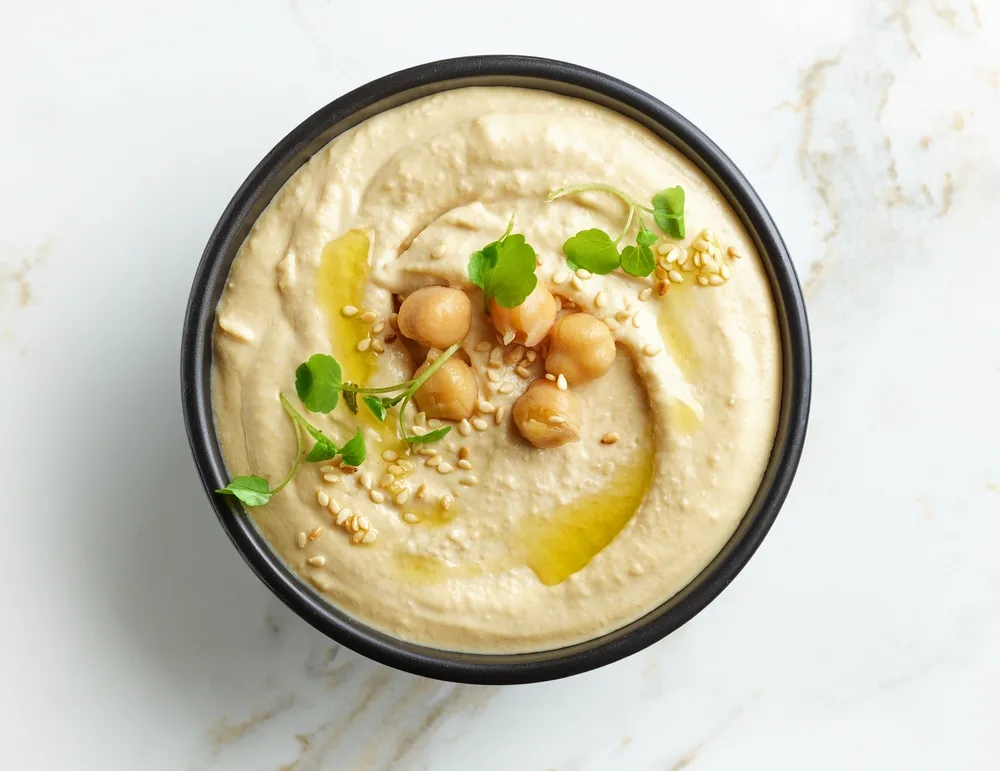
Hummus has a lot going for it if you’re trying to lose weight. It’s made from chickpeas, tahini, olive oil, lemon, and garlic, all whole foods ingredients that bring fiber, plant-based protein, and healthy fats. That combination helps slow digestion and keep blood sugar steady, which can make hummus a good choice when you need a snack that actually holds you over.
The key is treating hummus as a measured part of the meal or snack—not an open-container situation. A 2-tablespoon serving is about 50 calories, which fits easily into most weight-loss plans. But because hummus is creamy, flavorful, and easy to keep scooping, it’s also easy to eat several servings without noticing.
That balance—nutritious, but easy to overdo—is exactly why hummus shows up so often in weight-loss conversations. Below, we’ll break down what it actually provides nutritionally, how it affects hunger and blood sugar, and the most practical ways to use it so it supports your goals rather than quietly working against them.
✅ Quick answer
Yes – hummus can be good to add to a weight loss plan, but it’s best paired with high-fiber vegetables and measured out.
🚀 Weight-loss benefits
- It’s high in fiber – A 2-tablespoon serving of hummus has about 1.8g of fiber, which is a lot for a small portion. Fiber slows digestion, helps regulate blood sugar, and adds volume to meals without adding significant calories—all things that make it easier to stay in a calorie deficit without feeling hungry.
- It contains plant-based protein – With about 2.4g of protein per 2-tablespoon serving, hummus gives you a small but real protein contribution that supports satiety.
- It can help keep blood sugar steady – Hummus has a GI of around 25, firmly in the low range. Low-GI foods digest slowly, produce a gradual rise in blood sugar rather than a spike, and help prevent the energy crashes and cravings that follow high-GI snacks.
⚠️ Things to be mindful of:
- Calorie density adds up quickly – Hummus has about 166 calories per 100g (roughly 7 tablespoons, or just under ½ cup). A standard serving is 2 tablespoons, but it’s easy to go past that without noticing. Portioning it into a small bowl before eating helps keep things in check.
- Sodium can sneak in – Many store-bought versions land around 100 to 130mg of sodium per 2 tablespoons. Not extreme, but it adds up if you’re eating it often or without measuring. Choosing lower-sodium brands or making your own gives you more control.
- It may take your gut a minute to adjust – Chickpeas contain fermentable carbs that can cause gas or bloating, especially if you’re not used to legumes. Starting with 1 tablespoon and building up gradually usually solves it.
🥗 Nutrients in hummus (per 2 tablespoons / 30g)
| Nutrient | Amount | % RDA* |
|---|---|---|
| Calories | 50 calories | 3% |
| Protein | 2.4 g | 5% |
| Total carbs | 4.3 g | 2% |
| Fiber | 1.8 g | 6% |
| Sugars | 0.1 g | — |
| Total fat | 2.9 g | 4% |
| – Saturated fat | 0.4 g | 2% |
| – Monounsaturated fat | 1.2 g | — |
| – Polyunsaturated fat | 1.1 g | — |
| Omega-3 | 0.03 g | — |
| Omega-6 | 1.05 g | — |
*Recommended dietary allowance (RDA) is defined as the average daily amount of nutrients needed to meet the requirements of nearly all healthy people in a specific group.
New from Noom
Microdose GLP-1Rx Plus
An affordable way to start your GLP-1 journey with Compounded Tirzepatide.

*Initial 3 week subscription and 4 weeks of medication from $79 plus tax and $199 per month plus tax for 12 week subscription thereafter. Final pricing depends on program selection. Noom GLP-1Rx Plus Microdose Program involves medication (when appropriate), healthy diet, exercise and support. Individual results vary. Meds & personalization based on need as determined by a third-party clinician. Medications are not reviewed by FDA for safety, efficacy, or quality. No affiliation with Eli Lilly and Company, the only US source of FDA-approved tirzepatide. Not available in all 50 US states.
A 2-tablespoon serving of hummus is about 50 calories, which makes it a solid snack—as long as you keep an eye on portions. You’re getting a mix of fiber (around 2 grams), a small amount of protein (about 2 to 3 grams), and mostly unsaturated fats from tahini and olive oil. That combination helps slow digestion and keeps you full longer than most dips.
It’s also notable for what it doesn’t have. Hummus contains almost no sugar, no cholesterol, and a relatively low amount of carbs overall. Of the roughly 4 grams of carbs, about half come from fiber, so the net carbs are closer to 2 to 3 grams. That’s part of why it has such a gentle effect on blood sugar—it digests slowly and helps avoid the spikes and crashes that can drive cravings later.
For a small serving, hummus pulls more weight nutritionally than you might expect. One of the standouts is copper—just 2 tablespoons gives you close to 20% of your daily needs. That matters because copper plays a role in things like iron use, collagen production, and immune function. You’ll also get a solid boost of manganese (around 10% of your daily needs), which supports bone health and helps your body process carbs.
There are a few quieter contributions that still add up over time. Hummus provides small amounts of folate, zinc, and iron—especially useful if you’re eating more plant-based foods and want to cover your bases. It’s not a major source of any one nutrient beyond copper, but that’s kind of the point: it’s an easy, everyday food that helps fill in gaps without you having to think too hard about it.
🔍 Nutrient breakdown
Glycemic index (GI) of hummus
Glycemic index: ~25 (Low)
💡 Tip: Hummus’s low GI means it digests slowly and raises blood sugar gradually rather than all at once. This helps prevent the energy spikes and crashes that trigger cravings—making it a practical choice for afternoon snacking, when hunger tends to hit hardest.
Is hummus high in protein?
❌ No, not in a single serving – hummus contains 2.4g of protein per 2-tablespoon serving. It’s a modest contribution rather than a primary protein source. Worth counting, especially as part of a plant-based diet, but pair it with something more substantial if protein is your main focus.
Better protein alternatives: Edamame | Greek yogurt | Cottage cheese
Is hummus high in fiber?
✔️ Yes, relative to its calorie count – 1.8g of fiber per 2-tablespoon serving is solid for a dip, and it adds up if you eat hummus regularly.
💡 Tip: Pairing hummus with raw vegetables doubles the fiber benefit—you’re getting fiber from both the dip and the dipper, which is one of the most practical ways to stay full on a calorie deficit.
Is hummus low in carbs?
✔️ Mostly yes – at 4.3g of total carbs per serving (and only about 2.5g net carbs after fiber), hummus is quite low-carb for a serving.
💡 Tip: The dipper matters as much as the dip. Swap crackers or pita for cucumber slices or bell pepper strips to keep the carb count low and the volume high.
Is hummus gluten-free?
✔️ Yes – traditional hummus contains no gluten-containing ingredients. Chickpeas, tahini, olive oil, garlic, and lemon juice are all naturally gluten-free. If you’re celiac or highly sensitive, check store-bought labels for cross-contamination warnings, as some facilities process wheat alongside hummus products.
Is hummus good for fat loss?
✔️ Yes, with smart portioning – hummus supports fat loss through its combination of fiber, protein, and low GI, all of which help manage hunger and reduce overall calorie intake. The potential pitfall is portion size: a few extra scoops can add up. Treat it as a condiment or snack component rather than a main dish, and it works well within a weight-loss plan.
🍽️ Diet compatibility: Which diets include hummus?
| Diet | ✅/❌ | Why |
|---|---|---|
| Keto | ❌ | Even at 2.5g net carbs per serving, hummus can add up quickly and push you over the strict 20–50g daily carb ceiling most keto protocols require. There are lower-carb dip options that fit more easily. |
| Paleo | ❌ | Legumes—including chickpeas—are excluded from the Paleo framework, which avoids foods that weren’t part of a pre-agricultural diet. Since chickpeas are the base of hummus, traditional Paleo eating skips it entirely. |
| Mediterranean | ✅ | Hummus is a symbol of Mediterranean eating. Chickpeas, olive oil, garlic, and lemon juice are all cornerstone ingredients of this dietary pattern, and hummus fits naturally into the emphasis on plant foods, legumes, and healthy fats. |
| Vegan | ✅ | Hummus is 100% plant-based and serves as a useful protein, iron, folate, and zinc source for vegans. It’s one of the more convenient ways to get legume nutrition into meals without cooking dried beans from scratch. |
| Gluten-free | ✅ | Traditional hummus is naturally free of gluten. Most store-bought versions are clearly labeled as such, though anyone with celiac disease should check for cross-contamination disclosures. |
Hummus slots comfortably into most mainstream eating patterns—with the exception of keto and Paleo, which have structural reasons to exclude it. For the vast majority of people eating in a Mediterranean, plant-based, or a generally balanced approach, hummus is an easy addition that contributes nutrition without complicating the diet.
The broader takeaway is that hummus works best as a replacement for less nutritious foods rather than an addition on top of an existing diet. Swapping mayo, sour cream dip, or cream cheese for hummus cuts saturated fat and empty calories while adding fiber, plant protein, and micronutrients. That kind of substitution is where hummus does its best work for weight management.
🌟 Is hummus healthy? What are the health benefits?
Metabolic health: Is hummus good for your metabolism?
- Boosts metabolism? ✔️ Indirectly – The protein in hummus contributes to the thermic effect of food, meaning your body burns slightly more calories digesting it than it would processing simple carbs or pure fat. Hummus also provides B vitamins (particularly B6 and thiamin) that serve as cofactors in the metabolic pathways that convert food into usable energy.
- Improves insulin sensitivity? ✔️ Yes – Hummus has a very low glycemic index (~25), producing a slow, gradual blood sugar response rather than a spike. Research confirmed that hummus produces blood sugar responses about four times lower than white bread. Consistently choosing low-GI foods like hummus over time is associated with improved insulin sensitivity.
- Effect on fat storage? Positive – By keeping blood sugar and insulin levels moderate, hummus helps avoid the hormonal conditions that favor fat storage. Elevated insulin is one of the key drivers of fat accumulation, particularly around the abdomen, so the low-GI nature of hummus is genuinely useful for anyone focused on body composition.
Cholesterol impact: Does hummus affect cholesterol levels?
- Does it lower LDL (bad) cholesterol? ✔️ Possibly – Chickpeas contain soluble fiber and plant sterols, both associated with modest reductions in LDL cholesterol. The oleic acid from olive oil also contributes to a healthier lipid profile. Eating hummus regularly as part of a plant-rich diet can contribute to meaningful improvements over time.
- Does it raise HDL (good) cholesterol? Possibly – The monounsaturated fats in olive oil and tahini are associated with modest HDL increases, though the specific data on hummus and HDL is limited. The overall dietary pattern matters more than any single food.
- Overall impact on heart health? Favorable – The combination of soluble fiber, healthy unsaturated fats, plant protein, and a low glycemic index puts hummus firmly in the heart-supportive column. Regular legume consumption is consistently associated with lower cardiovascular disease risk across large population studies.
💡 Tip: When buying store-bought hummus, look for versions made with olive oil rather than soybean oil as the primary fat—it makes a meaningful difference to the overall nutritional profile.
Can I eat hummus in a calorie deficit?
✔️ Yes, with confidence: Hummus is 50 calories per 2-tablespoon serving and provides fiber and protein that help keep hunger in check, making it one of the more calorie-efficient snack options available. The main risk is portion creep—eating directly from the container makes it very easy to go through 3 to 4 servings without noticing.
💡 Tip: Portion out your hummus into a small bowl before snacking rather than dipping straight from the container. It’s a simple habit that makes staying on track much easier.
Is hummus rich in antioxidants?
✔️ Yes: Hummus provides a meaningful range of antioxidants from multiple sources—polyphenols and flavonoids from chickpeas, oleocanthal from olive oil, allicin from garlic, and vitamin C from lemon juice. Together, these compounds help neutralize free radicals and reduce oxidative stress. The antioxidant content isn’t as concentrated as in berries or dark leafy greens, but hummus contributes meaningfully to your overall antioxidant intake.
Does hummus support gut health?
✔️ Yes: The resistant starch and fiber in chickpeas act as prebiotics, feeding the beneficial bacteria in your gut and supporting a healthy microbiome. A well-nourished gut microbiome is increasingly linked to better metabolic function, immune response, and even mood regulation. For people who don’t regularly eat legumes, hummus is one of the easiest ways to get these gut-supportive carbohydrates into the diet consistently.
Does hummus support digestion?
Positive, for most people: The fiber in hummus promotes regular bowel movements and healthy digestive transit. However, the same chickpea-based compounds that feed gut bacteria can cause gas and bloating in people who aren’t accustomed to legumes. If you’re new to eating hummus regularly, starting with 1 tablespoon and building up gives your digestive system time to adjust.
Does hummus help you feel satiated and less hungry?
✔️ Yes: Research found that an afternoon hummus snack reduced hunger and desire to eat by approximately 70% compared to no snack, and reduced subsequent dessert snacking by about 20%. The fiber-protein-fat combination in hummus slows gastric emptying and prevents the blood sugar swings that drive cravings.
Satiety level: Moderate to High (for its calorie count)
💡 Tip: Pair hummus with high-volume, high-fiber vegetables like cucumber, celery, or bell pepper strips. You get more total food volume—which matters for fullness—without meaningfully increasing calories.
Does hummus help with nighttime cravings?
✔️ Possibly: Having a small hummus-based snack in the late afternoon appears to reduce evening hunger and dessert cravings based on the snack research above. The sustained release of energy from hummus’s low-GI carbs, combined with its protein and fat, helps carry you into the evening without the blood sugar dips that make nighttime snacking feel hard to resist.
💡 Tip: If evening cravings are a regular issue, try having a 2-tablespoon serving of hummus with vegetables around 3–4pm rather than waiting until you’re already hungry at night.
Does hummus help reduce inflammation?
✔️ Yes: Several components of hummus have documented anti-inflammatory properties. Polyphenols in chickpeas, oleocanthal in olive oil, and allicin in garlic have all been shown to reduce markers of inflammation in research. Chronic low-grade inflammation is associated with metabolic dysfunction and weight gain, making anti-inflammatory foods like hummus a useful part of any health-focused eating pattern.
Is hummus beneficial for brain health?
✔️ Modest benefits: Hummus contains folate, vitamin B6, and choline, all of which play roles in neurotransmitter production and cognitive function. Folate in particular is associated with lower risk of depression and cognitive decline in observational studies. The healthy fats from olive oil and tahini also support brain cell membrane integrity.
Can hummus improve skin and hair health?
✔️ Minor but real benefits: The copper (18% RDA per serving) in hummus directly supports collagen and elastin production, which keeps skin firm and hair strong. Zinc plays a role in skin cell renewal and wound healing, and vitamin E provides antioxidant protection. Regular consumption of hummus as part of a nutrient-rich diet contributes to the kind of steady micronutrient supply that supports healthy skin and hair over time.
Access GLP-1 Weight Loss with Noom
Explore a wide range of prescription medications supported by Noom’s program.Microdose GLP-1rx
Noom GLP-1rx
Noom GLP-1rx Plus
Wegovy®
Ozempic®

Metformin
Zepbound®
Mounjaro®
Liraglutide
Can hummus help balance hormones?
Limited evidence, but supportive: The healthy fats in hummus from tahini and olive oil provide the raw materials needed for steroid hormone synthesis, since hormones like estrogen, testosterone, and cortisol are all fat-derived. Sesame seeds in tahini also contain lignans, plant compounds with mild phytoestrogenic activity that some research suggests may support hormone balance in certain women.
💡 Tip: Hormonal balance is most strongly influenced by overall dietary pattern, sleep, and stress management. Hummus can be a small supportive piece of that picture, but no single food moves the needle dramatically.
🍽️ Best ways to eat hummus for weight loss
- Use it as a veggie dip – This is where hummus really works in your favor. Pairing it with cucumbers, peppers, celery, or broccoli gives you volume and fiber from the veggies, plus the staying power of the hummus. It’s a snack that actually feels filling without pushing calories too high.
- Swap it in for higher-calorie spreads – Using hummus instead of mayo, butter, or cream cheese is one of those small changes that adds up. You’re cutting calories and saturated fat while adding fiber and a little protein—without losing flavor or satisfaction.
- Turn it into a sauce – Thin hummus with a little lemon juice or water and use it as a drizzle over roasted vegetables, chicken, or bowls. It spreads the flavor out, keeps portions reasonable, and makes simple meals feel more complete without needing extra ingredients.
International Hummus Day is May 13. Try these healthy hummus recipes:
- Best Hummus Recipe—Love & Lemons
- Hummus Tasty Recipe—Cookie and Kate
- Protein-Packed Breakfast Hummus Bowl—The Mediterranean Dish
🍏 Best alternatives & comparisons (per 2 tablespoons / 30g)
| Food | Calories | Carbs | Fiber | Protein | Fat |
|---|---|---|---|---|---|
| Hummus | 50 | 4.3 g | 1.8 g | 2.4 g | 2.9 g |
| Guacamole | 45 | 2.6 g | 2.0 g | 0.6 g | 4.1 g |
| Baba ganoush | 23 | 2.6 g | 0.7 g | 0.7 g | 1.2 g |
| White bean dip | 39 | 6.6 g | 1.8 g | 2.4 g | 0.2 g |
| Greek yogurt dip (plain 2%) | 22 | 1.7 g | 0 g | 3.0 g | 0.6 g |
Hummus holds up well against most popular dips, especially when it comes to fiber and a little protein. If you’re looking for a lower-calorie option, baba ganoush is worth knowing—it’s a similar Mediterranean-style dip made from roasted eggplant instead of chickpeas, and it comes in at about half the calories per serving. It has a lighter texture and a slightly smoky flavor, but fills a similar role on the plate.
Guacamole lands in a similar calorie range as hummus but leans more on healthy fats from avocado rather than fiber and protein—just a different trade-off. White bean dip is probably the closest match nutritionally, with similar fiber and protein but less fat overall. And if protein is your main goal, Greek yogurt–based dips come out ahead. The takeaway: there’s no single “best” option—rotating between these can keep things interesting while still supporting your goals.
Frequently asked questions about hummus and weight loss
How much hummus should I eat per day for weight loss?
2 to 4 tablespoons per day is a practical target for most people managing their weight. That range keeps you in the 50 to 100 calorie window, gives you the benefit of the fiber and protein, and is realistic enough to maintain consistently. Measure into a small bowl and pairing with high-volume vegetables to make the serving feel more substantial.
Is store-bought hummus as nutritious as homemade?
Mostly, yes. The base nutrition is similar, but store-bought versions can vary in sodium, oils, and flavors. Classic or simple varieties tend to be the most straightforward, while flavored options—like roasted red pepper or garlic—are usually similar nutritionally. Others, like dessert-style or extra-oil blends, can be higher in calories, sugar, or sodium. A quick label check goes a long way: look for olive oil, moderate sodium, and minimal added ingredients.
Can I eat hummus every day?
Yes—eating hummus daily is associated with better overall diet quality and lower body weight in research. The key is consistency in portion size and what you pair it with. Daily hummus in controlled amounts, eaten with vegetables or used in place of less nutritious spreads, supports healthy eating habits rather than working against them.
Is hummus a useful choice for people managing blood sugar?
Hummus is generally considered a practical choice for people managing blood sugar. Its glycemic index of around 25 means it has a minimal impact on blood glucose, and the fiber and protein further slow digestion and reduce any glycemic response. Research has specifically confirmed that hummus produces blood sugar responses about four times lower than white bread. As always, portion size matters and should be discussed with a healthcare provider in the context of individual management plans.
Does hummus cause bloating?
It can, particularly for people who aren’t used to eating legumes regularly. Chickpeas contain raffinose, a type of fermentable carbohydrate that gut bacteria break down, producing gas in the process. Starting with smaller portions (1 tablespoon) and increasing gradually over a few weeks typically resolves the issue as your gut microbiome adjusts. If you have IBS, hummus may be a moderate-FODMAP trigger and is worth testing carefully.
What should I dip in hummus for weight loss?
Raw vegetables are the most practical choice: cucumbers, bell peppers, celery, broccoli florets, cherry tomatoes, and snap peas all add fiber, water, and nutrients for very few additional calories. They also add volume that makes the snack feel more satisfying than the hummus alone.
Is hummus a useful option if I’m on a GLP-1 medication?
Hummus can work well as part of a meal or snack for people on GLP-1 medications, since appetite is often reduced and every bite matters more. The fiber and protein in hummus help with satiety in smaller amounts, and pairing it with vegetables adds volume. Keeping portions measured and opting for lower-sodium varieties is particularly worth doing in this context.
🧠 The bottom line: Hummus can be part of a weight-loss plan
Hummus is a strong addition to a weight loss approach—because it makes eating well easier. The fiber helps you stay full, the small amount of protein takes the edge off hunger, and its low glycemic impact helps keep energy steady. It’s also versatile enough to show up in snacks, meals, and swaps without getting repetitive. Research reflects that pattern too: people who regularly eat hummus and chickpeas tend to have lower body weight and smaller waist measurements.
Where it can work against you is portion size. A 2-tablespoon serving is about 50 calories, which fits easily into most plans—but it’s easy to go well beyond that without realizing it. Keeping it simple helps: portion it out, pair it with vegetables, and use it as a replacement for higher-calorie spreads when you can. Done consistently, it’s one of those small, sustainable habits that add up.
📖 Scientific evidence
- An afternoon hummus snack might reduce hunger and subsequent calorie intake. (Journal of Nutrition, 2020) In a small study, an afternoon hummus snack was linked to about 70% lower hunger ratings compared to no snack, and reduced dessert snacking by about 20%.
- Eating hummus may slow blood sugar rise and may help curb cravings. (Nutrition Journal, 2015) Researchers found that hummus produced blood sugar responses about four times lower than white bread. This slower, steadier response is likely due to its mix of fiber, fat, and protein, and may help avoid the spikes and crashes that can drive hunger.
- Regularly eating hummus is linked to better blood sugar control, cholesterol levels, and appetite. (Nutrients, 2020) A review of hummus and its key ingredients found that people who include it in their diet tend to have steadier blood sugar, improved lipid profiles, and better appetite control compared to typical snack options.
- People who eat hummus and chickpeas regularly tend to have lower body weight and smaller waistlines. (Journal of Nutrition & Food Sciences, 2014) An analysis found that people who regularly ate hummus and chickpeas tended to have better overall diet quality and were less likely to have elevated BMIs and high blood sugar.
Editorial standards
At Noom, we’re committed to providing health information that’s grounded in reliable science and expert review. Our content is created with the support of qualified professionals and based on well-established research from trusted medical and scientific organizations. Learn more about the experts behind our content on our Health Expert Team page.