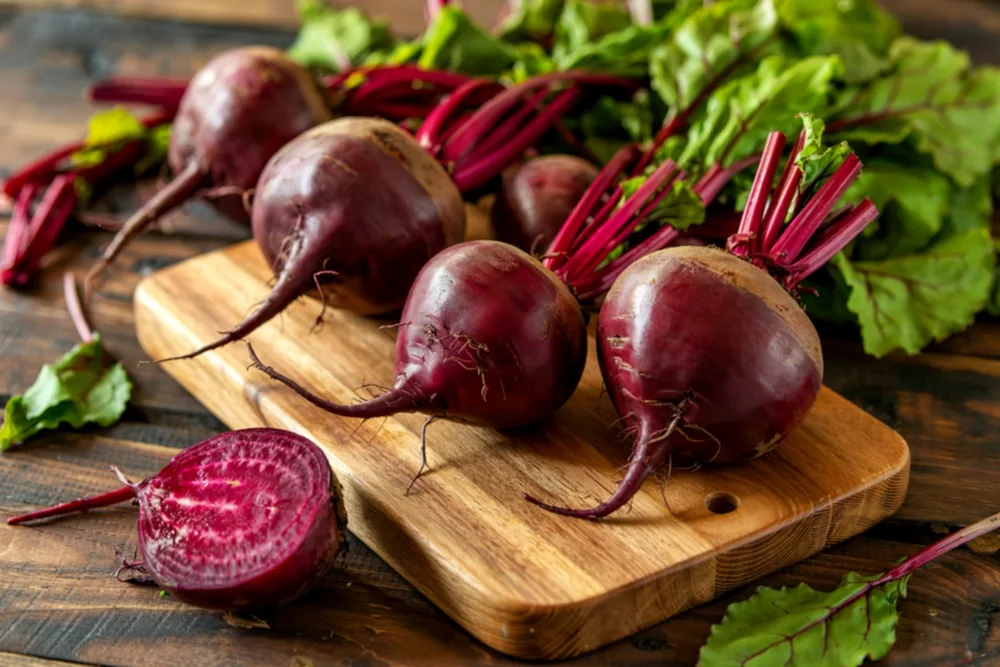
Beets tend to divide people—some love them roasted with olive oil, shaved into salads, or blended into smoothies, while others can’t get past the earthy flavor. But there’s also more variety than many people realize. Deep red beets are the most common, but golden beets and candy cane beets tend to be milder, slightly sweeter, and less “earthy,” which can make them easier to enjoy if you’ve never been a beet fan.
If weight loss is a goal, beets are worth another look. One cup has just 58 calories while delivering fiber, folate, potassium, and plant compounds called betalains that have been studied for their antioxidant and anti-inflammatory effects. Beets are also one of the richest dietary sources of nitrates, compounds your body converts into nitric oxide to support blood flow and potentially exercise performance.
At the same time, beets do contain natural sugars, and beet juice isn’t nutritionally identical to eating whole beets. Here’s a clear-eyed look at where beets actually fit into a weight-loss eating plan.
✅ Quick answer
Yes—beets are a smart choice for weight loss. They’re low in calories and provide nearly 4 grams of fiber per cup to help keep you full and support digestive health. Their naturally occurring nitrates may improve exercise efficiency, and their unique anti-inflammatory compounds add a layer of metabolic support you won’t find in most vegetables.
🚀 Weight-loss benefits
- They’re low in calories and high in fiber – A cup of beets has just under 60 calories and nearly 4 grams of fiber, making them filling for relatively few calories. That fiber helps slow digestion, supports steadier blood sugar levels, and can make a calorie deficit feel easier to sustain. Eating more low-calorie, high-fiber foods is one of the most consistently supported strategies for long-term weight management.
- Nitrates may support exercise performance – Beets are naturally rich in nitrates, which your body converts into nitric oxide to improve blood flow and oxygen delivery to muscles. Some research suggests this may help improve endurance and workout efficiency over time.
- Betalains support metabolic health – Beets contain colorful plant compounds called betalains, which have antioxidant and anti-inflammatory properties. Red beets are especially rich in red betalains, while golden beets contain yellow forms of these same compounds. Since chronic inflammation is closely linked to metabolic dysfunction, regularly eating foods rich in betalains may help support overall metabolic health.
⚠️ Things to be mindful of:
- Beet juice loses the fiber advantage – Juicing beets preserves many of the nitrates and betalains but removes most of the fiber. Since fiber plays a major role in fullness, blood sugar regulation, and calorie control, whole beets are usually the better everyday choice for weight management.
- The carbs can add up quickly – Beets are still relatively moderate in calories, but they contain more natural carbohydrates than many non-starchy vegetables. One cup has about 13 grams of carbs, so portion size may matter if you’re closely monitoring carbohydrate intake or trying to keep meals lower in carbs overall.
- High in oxalates—relevant for some – Beets are naturally high in oxalates, compounds that can contribute to calcium oxalate kidney stones in susceptible people. For most people, this isn’t a reason to avoid them, but if you have a history of kidney stones, it may be worth discussing intake with your doctor.
🥗 Nutrients in beets (per 1 cup raw / 136g)
| Nutrient | Amount | % RDA* |
|---|---|---|
| Calories | 58 calories | 3% |
| Protein | 2.2 g | 4% |
| Total carbs | 13 g | 5% |
| Fiber | 3.8 g | 14% |
| Sugars | 9 g | — |
| Total fat | 0.2 g | 0% |
| – Saturated fat | 0 g | 0% |
| – Monounsaturated fat | 0 g | — |
| – Polyunsaturated fat | 0.1 g | — |
| Omega-3 | 0.04 g | — |
| Omega-6 | 0.06 g | — |
*Recommended dietary allowance (RDA) is defined as the average daily amount of nutrients needed to meet the requirements of nearly all healthy people in a specific group.

See if your insurance
covers GLP-1s.
The form only takes 2 minutes to answer. We’ll handle the rest.
GET STARTEDFrom a macronutrient perspective, beets are mostly carbohydrates, but they also bring a meaningful amount of fiber for a vegetable. A cup contains nearly 4 grams of fiber, which helps slow digestion and makes the carbs more filling and slower to absorb. Protein and fat are both minimal, which is why beets are usually best paired with foods that add staying power—like Greek yogurt, goat cheese, salmon, chicken, lentils, or olive oil.
The natural sugar content can sound high at first glance, but context matters. Those sugars come packaged with fiber and water inside a whole food, so beets don’t affect blood sugar the same way a processed sugary snack would. Their overall glycemic load remains relatively low, especially when eaten as part of a balanced meal.
💊 Vitamins & minerals in beets (per 1 cup raw / 136g)
| Vitamin/Mineral | Amount | % RDA* |
|---|---|---|
| Folate | 148 mcg | 37% |
| Manganese | 0.4 mg | 17% |
| Potassium | 442 mg | 9% |
| Vitamin C | 6.7 mg | 7% |
| Magnesium | 31 mg | 7% |
| Iron | 1.1 mg | 6% |
| Phosphorus | 54 mg | 4% |
Folate is the standout nutrient in beets—one cup provides about 37% of the recommended daily intake. Folate helps support DNA production, cell repair, and red blood cell formation, and it also plays an important role in energy metabolism and heart health. While folate often gets associated with pregnancy, it’s an important nutrient for everyone, and beets are one of the better vegetable sources outside of leafy greens.
Beets also provide a solid mix of minerals that support overall health. Potassium helps regulate fluid balance, muscle contractions, and blood pressure, while manganese is involved in energy metabolism and antioxidant defenses. Smaller amounts of magnesium, iron, phosphorus, and vitamin C round out the profile, giving beets a broader nutritional value than their bright color might suggest at first glance.
🔍 Nutrient breakdown
Glycemic index (GI) of beets
Glycemic index: 61 (Medium—but with a low glycemic load of approximately 5)
💡 Tip: The glycemic index number for beets can sound alarming, but the glycemic load—which accounts for how much of the food you’re actually eating—is quite low. In a typical serving, beets cause only a gentle rise in blood sugar. Pairing them with protein or healthy fat (like a drizzle of olive oil) flattens that curve even further.
Are beets high in protein?
❌ No – beets contain 2.2g of protein per cup. Useful but not a primary protein source.
Better protein alternatives: Lentils | Edamame | Greek yogurt
Are beets high in fiber?
✔️ Yes – beets have 3.8g of fiber per cup, covering about 14% of the daily recommended intake in a single serving.
💡 Tip: To maximize the fiber benefit, eat beets whole—roasted, raw, or steamed—rather than juicing them. Juicing removes most of the fiber and reduces the satiety value significantly.
Are beets low in carbs?
❌ Not especially – beets have 13g of carbs per cup.
💡 Tip: For most people following a moderate low-carb or low-calorie approach, 13g of carbs from a fiber-rich whole vegetable is completely reasonable. If you’re doing strict keto, keep portions to about half a cup and factor it into your daily carb count.
Are beets gluten-free?
✔️ Yes – beets are naturally gluten-free in all forms—fresh, frozen, canned, and roasted. Just check labels on pre-packaged beet products, as added sauces or marinades occasionally contain gluten.
Are beets good for fat loss?
✔️ Yes, as part of a balanced approach – beets support fat loss in a practical, indirect way—they’re low in calories, high in fiber for satiety, and their nitrates may improve workout performance. They don’t burn fat directly, but they make it easier to eat less and move more, which is ultimately what drives fat loss.
🍽️ Diet compatibility: Which diets include beets?
| Diet | ✅/❌ | Why |
|---|---|---|
| Keto | ⚠️ Use sparingly | At 13g of carbs per cup, beets are borderline for strict keto. Small portions (half a cup) can work, but they’re not a keto staple. |
| Paleo | ✅ | Root vegetables are fully paleo-approved. Beets fit naturally into a whole-food, grain-free eating approach. |
| Mediterranean | ✅ | Beets are an excellent fit for Mediterranean eating—roasted with olive oil, tossed into salads, or blended into dips, they align perfectly with its principles. |
| Vegan | ✅ | Beets are completely plant-based and work across all vegan dietary patterns. |
| Gluten-free | ✅ | Beets are naturally gluten-free and safe for people with celiac disease or gluten sensitivity. |
Beets are one of the more diet-versatile vegetables. They slot easily into plant-based, Mediterranean, and gluten-free approaches, and they’re a natural fit for anyone eating a whole-food diet. The one exception is strict keto, where the carbohydrate content requires portion control—though even there, small amounts can work within a daily carb budget.
🌟 Are beets healthy? What are the health benefits?
Metabolic health: Are beets good for your metabolism?
- Boosts metabolism? ⚠️ Neutral – Beets don’t directly raise metabolic rate, but their nitrates improve oxygen efficiency during exercise, which may allow you to train at higher intensities. Over time, consistent higher-quality exercise has a meaningful impact on body composition and resting metabolism.
- Improves insulin sensitivity? ✔️ Maybe – Beets’ low glycemic load and fiber content support stable blood sugar, which reduces the insulin spikes that can promote fat storage. Some early research on betaine (a compound in beets) suggests a potential role in insulin metabolism, but direct human evidence is still limited.
- Effect on fat storage? Positive – The stable blood sugar response from beets’ fiber content means lower and steadier insulin levels, which creates a metabolic environment less favorable to fat storage. Their anti-inflammatory properties may also indirectly support healthier fat metabolism over time.
Cholesterol impact: Do beets affect cholesterol levels?
- Do they lower LDL (bad) cholesterol? ❌ No direct evidence – Beets don’t have strong evidence for directly lowering LDL cholesterol. However, their folate and potassium support cardiovascular health through other pathways, including blood pressure regulation.
- Do they raise HDL (good) cholesterol? ❌ No clear evidence – Current research doesn’t show a significant HDL-raising effect from beets specifically.
- Overall impact on heart health? Positive – The nitrate-to-nitric oxide conversion beets trigger is well-documented to support healthy blood pressure and endothelial function. Their betalains and nitrates together support vascular function and reduce oxidative stress.
💡 Tip: Eat beets two to three hours before exercise to time the nitrate peak—blood nitrate levels are highest in that window, which is when you’ll get the best blood pressure and performance benefit.
Can I eat beets in a calorie deficit?
✔️ Yes, with confidence: At 58 calories per cup, beets are one of the more calorie-friendly vegetables you can add to a deficit-based diet. They give you volume, fiber, and genuine nutritional value without making a dent in your calorie budget.
💡 Tip: Use beets as a base or bulk component in meals—roasted and tossed into a grain bowl, grated raw into a salad, or added to a soup—to increase meal volume and fiber without meaningfully increasing calories.
Are beets rich in antioxidants?
✔️ Yes: Beets are genuinely rich in antioxidants, primarily through their betalain pigments (betanin and vulgaxanthin), which have demonstrated potent free-radical-scavenging activity in research.
Do beets support gut health?
✔️ Yes: The fiber in beets acts as a prebiotic, feeding beneficial gut bacteria and supporting a healthy microbiome. A diverse, well-fed gut microbiome is increasingly linked to better metabolic outcomes, lower inflammation, and more stable energy levels—all of which matter for sustainable weight management.
Do beets support digestion?
Positive: Beets’ fiber adds bulk to stools and promotes regular bowel movements. They also contain betaine, which supports healthy liver function and bile production—both of which are relevant to how well your body processes and absorbs the food you eat.
Do beets help you feel satiated and less hungry?
Moderate: Beets are good for satiety given their calorie count, largely because of their fiber and water content (about 88% water). They won’t keep you full the way a protein-rich meal would, but as a component of a balanced plate, they contribute meaningfully.
Satiety level: Moderate
💡 Tip: Pair beets with a protein source—grilled chicken, eggs, lentils, or Greek yogurt in a dip—to significantly boost the satiety of any beet-containing meal.
Do beets help with nighttime cravings?
✔️ Possibly: Beets’ stable glycemic impact and fiber content support steadier blood sugar through the day, which can reduce the intensity of evening hunger and cravings. A fiber-rich, well-balanced dinner that includes beets is less likely to leave you hungry by 9pm.
💡 Tip: If nighttime hunger is a recurring issue, make sure your dinner includes beets alongside adequate protein and fat—that combination does the most to reduce late-evening appetite.
Do beets help reduce inflammation?
✔️ Yes: This is one of beets’ most research-supported benefits. Betalains have demonstrated significant anti-inflammatory activity in multiple studies. Chronic low-grade inflammation is closely associated with weight gain and metabolic disease, so this benefit has real relevance for weight management.
Are beets beneficial for brain health?
✔️ Yes: The nitric oxide produced from beets’ nitrates improves blood flow throughout the body—including to the brain. Better cerebral blood flow is associated with improved cognitive performance. Beets’ folate content also supports healthy nerve function and mood regulation.
Can beets improve skin and hair health?
✔️ Minor benefits: Beets’ folate supports cell turnover, which is relevant to skin health, and their vitamin C contributes to collagen synthesis. These are modest effects, but they’re real.
Can beets help balance hormones?
⚠️ Limited evidence: Beets contain betaine, which may support liver function and the liver’s role in clearing excess hormones from the body. Their fiber also helps the body eliminate estrogen through the digestive tract. The direct evidence for beets as a hormone-balancing food is still limited.
Access GLP-1 Weight Loss with Noom
Explore a wide range of prescription medications supported by Noom’s program.Microdose GLP-1rx
Noom GLP-1rx
Noom GLP-1rx Plus
Wegovy®
Ozempic®

Metformin
Zepbound®
Mounjaro®
Liraglutide
💡 Tip: Hormonal balance is best supported by a broad dietary pattern—plenty of fiber, adequate protein, healthy fats, and regular exercise—rather than any single food. Beets contribute positively to that overall picture.
🍽️ Best ways to eat beets for weight loss
- Roasted whole beets – Roasting concentrates beets’ natural sweetness and makes them deeply satisfying without any added calories from sauces or dressings. Cube them, toss with a small amount of olive oil and salt, and roast at 400°F for 35–40 minutes. Use them as a side, toss into a grain bowl, or layer onto a salad.
- Raw and grated into salads or slaws – Raw beets retain all their fiber and nutrients, and grating them finely makes them much easier to eat. They add crunch, color, and earthy sweetness to salads and slaws, and because they’re raw, they hold up well when prepped ahead.
- Pre-workout snack (whole or as juice) – Because blood nitrate levels peak two to three hours after eating beets, having them before a workout gives your cardiovascular system a meaningful boost. A small portion of whole beets or a shot of beet juice about two hours before exercise can improve endurance and reduce the oxygen cost of effort.
Try these healthy beet recipes:
- Beet Salad with Goat Cheese and Balsamic – Love & Lemons
- Roasted Beet Hummus – Minimalist Baker
- Roasted Beets with Labneh and Chives – The Mediterranean Dish
🍏 Best alternatives & comparisons (per 1 cup cooked or raw
| Food | Calories | Carbs | Fiber | Protein | Fat |
|---|---|---|---|---|---|
| Beets (raw) | 58 | 13 g | 3.8 g | 2.2 g | 0.2 g |
| Carrots (raw) | 52 | 12 g | 3.6 g | 1.2 g | 0.3 g |
| Turnips (cooked) | 34 | 7.9 g | 3.1 g | 1.1 g | 0.1 g |
| Sweet potato (baked) | 103 | 24 g | 3.8 g | 2.3 g | 0.1 g |
| Parsnips (cooked) | 111 | 27 g | 5.6 g | 1.8 g | 0.5 g |
| Butternut squash (cooked) | 82 | 22 g | 6.6 g | 1.8 g | 0.2 g |
Beets fall into an interesting middle ground among root vegetables. They’re slightly sweeter and higher in carbs than turnips, but still relatively moderate compared to starchier options like sweet potatoes or parsnips. Carrots are probably the closest nutritional comparison—they’re similarly low in calories while offering fiber and natural sweetness that can make vegetables feel more satisfying.
Turnips are one of the lightest options if you’re specifically trying to keep carbohydrates lower, while sweet potatoes, parsnips, and butternut squash are more energy-dense and tend to work better as a more substantial starch component of a meal. Beets stand out less for their macros and more for the compounds you don’t see on a nutrition label, particularly their nitrate content and betalains, which give them a different nutritional profile than most other root vegetables.
Frequently asked questions about beets and weight loss
How many beets should I eat per day for weight loss?
There’s no magic number, but around one cup of cooked or raw beets per day is a practical amount for most people. That’s enough to provide meaningful fiber, folate, potassium, and nitrate intake while still fitting easily into a balanced eating pattern. More importantly, beets work best as part of an overall diet rich in vegetables, protein, and fiber—not as a standalone ‘weight loss food.
Is beet juice good for weight loss?
Beet juice still delivers many of the nitrates and betalains that make beets nutritionally interesting, so it may support blood flow, exercise performance, and some anti-inflammatory benefits. But juicing removes most of the fiber, which is one of the main reasons whole beets are so filling and supportive for weight management in the first place.
That doesn’t make beet juice “bad,” but it changes how your body experiences it. It’s easier to consume quickly, less satisfying than whole beets, and more concentrated in natural sugars. Beet juice probably makes the most sense as an occasional pre-workout drink, while whole beets are the better everyday option if your goal is staying full and supporting long-term weight loss.
Are beets high in sugar?
Beets do contain natural sugar—about 9 grams per cup—but that’s actually a fairly moderate amount, especially for a root vegetable. For comparison, a medium apple has around 19 grams of sugar, and even carrots contain naturally occurring sugars.
What also matters is the overall package. Beets come with fiber, water, and nutrients that slow digestion and make them much more balanced than foods high in added sugar. In normal serving sizes, whole beets are not considered a high-sugar food and fit easily into most healthy eating patterns.
Can I eat beets every day?
Yes, for most people, beets are perfectly fine to eat every day. They provide fiber, folate, potassium, and beneficial plant compounds without being especially high in calories, making them an easy fit in a balanced diet.
There are a couple of situations where moderation may make sense. Beets are relatively high in oxalates, so people prone to calcium oxalate kidney stones may want to discuss intake with their doctor. And because beets contain fermentable carbohydrates, some people with sensitive digestion or IBS may notice bloating or discomfort with larger amounts. But for most healthy people, regularly eating beets is a nutritious habit, not something to worry about.
Are canned beets as nutritious as fresh?
Canned beets are actually pretty comparable to fresh nutritionally. They still provide fiber, folate, potassium, and many of the betalains and nitrates that make beets interesting from a health perspective. So if canned beets make it easier for you to eat more vegetables regularly, they’re still a solid option.
The main thing to watch is sodium, since many canned varieties are packed with added salt. Choosing low-sodium or no-salt-added versions—or simply rinsing them before eating—can help reduce that significantly. Texture-wise, canned beets are usually softer and a little milder tasting than fresh roasted beets, but nutritionally the gap is much smaller than people often assume.
Do beets help with belly fat specifically?
No single food specifically targets belly fat—that’s not how fat loss works. Your body decides where it loses fat based largely on genetics, hormones, age, and overall weight loss, not on eating one particular ingredient.
What beets can do is support the habits that help reduce overall body fat over time. Their fiber helps make meals more filling and satisfying, and their nitrates may support exercise performance and endurance. That combination can make it a little easier to stay consistent with both eating and activity habits, which is what actually drives long-term changes in body composition.
What’s the best time to eat beets for weight loss?
If you’re eating beets specifically for their nitrate content and potential exercise benefits, timing may matter a bit. Research suggests nitrate levels tend to peak about two to three hours after eating beets or drinking beet juice, so that’s often considered the ideal window before a workout.
For general weight loss, though, timing probably isn’t very important. Beets can work well whenever they help make meals more satisfying and balanced—whether that’s added to a lunch salad, roasted alongside dinner, or blended into a smoothie. Consistency matters far more than eating them at a “perfect” time of day.
🧠 The bottom line: Beets can be good for weight loss
Beets are one of those vegetables that quietly bring a lot to the table nutritionally. They provide fiber for fullness, folate and potassium for overall health, and plant compounds called betalains that have been studied for their antioxidant and anti-inflammatory effects. Their natural nitrate content may also help support exercise performance and circulation in a way most vegetables don’t.
None of that makes beets a weight loss shortcut, but they are a smart, versatile food that fits well into a balanced eating pattern. Eating them whole—roasted, raw, or blended into smoothies—helps you get the fiber that makes them more satisfying. Pairing them with protein and healthy fats can make meals even more filling and balanced.
And while there’s no magic serving size, regularly incorporating beets into meals is a simple, sustainable habit that can support long-term health and weight management goals.
See if your insurance
covers GLP-1s.
The form only takes 2 minutes to answer. We’ll handle the rest.
GET STARTED📖 Scientific evidence
- Nitrates in beetroot may help your body use oxygen more efficiently during exercise. (Applied Physiology, Nutrition, and Metabolism, 2014) A review found that nitrate supplementation—mostly from beetroot juice—reduced the amount of oxygen the body needed to sustain the same effort during exercise. In other words, your body may be able to do the same work without working quite as hard. That said, results can vary depending on your fitness level, how much you consume, and your own body’s response.
- Beetroot juice may help nudge blood pressure down, at least in the short term. (Journal of Applied Physiology, 2013) In a small study, healthy men who consumed different amounts of concentrated beetroot juice saw reductions in blood pressure within a few hours, with larger doses producing a stronger response. Researchers linked the effect to dietary nitrates converting to nitric oxide in the body. Keep in mind this was a small study in a specific group, so more research is needed to know how broadly these findings apply.
- Betalains—the pigments that give beets their color—may have natural anti-inflammatory properties. (Food Human Nutrition & Metabolism, 2021) A comprehensive review found that betalains showed anti-inflammatory activity across lab, animal, and some clinical research, suggesting they could have real health-promoting potential. That’s promising, though most of the evidence is still early-stage, and more research in humans is needed to understand the full picture.
- Red beetroot supplementation has been linked to reduced oxidative stress, better endothelial function, and lower blood pressure in some research. (Nutrients, 2015) A narrative review found that beetroot’s nitrate and betalain content may work together to support these effects—nitrates by boosting nitric oxide availability, and betalains through their antioxidant and anti-inflammatory properties. That said, this is a review of early-stage evidence, and results across studies varied, so more research is needed to fully understand the scope and consistency of these benefits.
- Red beetroot shows promising antioxidant and anti-inflammatory properties, with some early-stage findings around weight-related effects. (Phytotherapy Research, 2020) A review found solid evidence for beetroot’s antioxidant and anti-inflammatory activity, along with preliminary findings suggesting possible anti-obesity effects—primarily from animal studies. The authors note that large-scale human trials are still needed before any weight-related conclusions can be drawn.
Editorial standards
At Noom, we’re committed to providing health information that’s grounded in reliable science and expert review. Our content is created with the support of qualified professionals and based on well-established research from trusted medical and scientific organizations. Learn more about the experts behind our content on our Health Expert Team page.