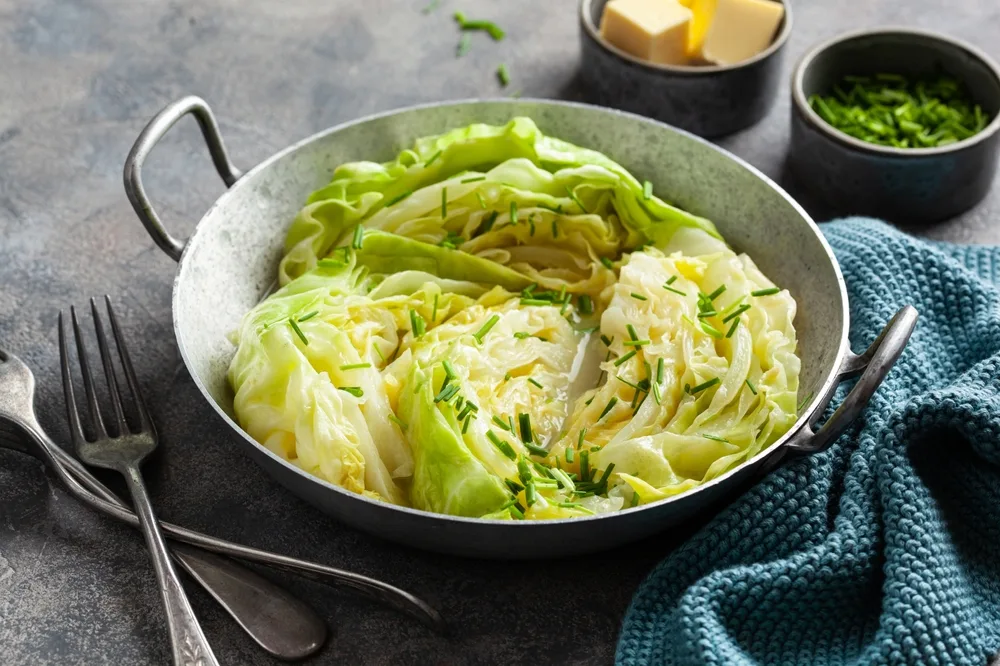
Cabbage is one of those vegetables that earns its place on your plate for a few straightforward reasons. It adds a lot of volume for very few calories, it’s relatively affordable, and it’s widely considered a healthy vegetable linked to overall health. It’s also highly versatile—whether it’s shredded into a slaw, simmered into soup, or fermented into sauerkraut, cabbage shows up in cuisines around the world for good reason.
Cabbage also has a long history in the weight loss conversation (hello, cabbage soup diet). While single-food diets aren’t a sustainable approach, the reason cabbage shows up in them is straightforward: it’s very low in calories. It has about 25 calories per cup of raw shredded cabbage—and is naturally high in water and fiber, which can help you feel full.
That combination is what makes cabbage stand out. You can eat a generous portion without driving calories up, while still getting nutrients like vitamin C and vitamin K.
There are several types of cabbage, including green (often called “white”), red (purple), and Savoy. They vary slightly in texture and nutrients, but they’re all relatively low in calories and work similarly in meals. For simplicity, this article focuses on a standard head of green or red cabbage—the kind you’ll find in most grocery stores—which typically weighs about 2 to 3 pounds (roughly 900 to 1,300 grams) before trimming.
Let’s break down what’s in cabbage, how it can support weight loss, its nutritional benefits, and simple ways to use it in meals that actually feel satisfying.

The Easy Way
to lose weight and get healthy.
See if you qualify
✅ Quick answer
Yes, cabbage is an excellent food for weight loss. It’s incredibly low in calories, and high in water, which means you can eat a satisfying portion for very few calories. And it’s high in fiber and nutrients you need while losing weight.
🚀 Weight loss benefits
- High volume, low calorie – Cabbage is mostly water, along with fiber that helps you feel full and satisfied. That combination means you can eat a generous portion for relatively few calories—about 25 calories per cup of raw shredded cabbage.
- Rich in fiber – One cup of raw shredded cabbage has about 2 grams of fiber. That’s not extremely high, but it can still help slow digestion and support steadier blood sugar levels when paired with protein or fat. Over time, that can help with fullness and make it easier to manage hunger.
- Metabolic support – Cabbage contains sulfur compounds and B vitamins that are essential for energy metabolism. These nutrients support the liver’s natural detoxification processes, helping your metabolism convert food into usable energy rather than stored fat.
⚠️ Things to be mindful of
- Digestive discomfort – Cabbage contains raffinose, a complex sugar humans can’t fully digest, which can lead to gas and bloating. This temporary abdominal discomfort might mask weight loss progress on the scale. Cooking cabbage thoroughly helps break down these sugars and reduce symptoms.
- Thyroid considerations – Raw cabbage contains goitrogens—substances that can interfere with iodine uptake and thyroid function if consumed in very large amounts. A sluggish thyroid can slow metabolism and make weight loss harder. Cooking cabbage largely neutralizes this effect.
- Low protein content – While cabbage fills you up on volume, it offers very little protein—the most satiating macronutrient and the key to preserving muscle during weight loss. Pair cabbage dishes with a quality protein source like eggs, chicken, tofu, or legumes to make a complete meal.
🥗 Nutrients in cabbage (per 1 cup shredded / about 89 g)
Note: 100 g of raw cabbage contains 25 calories, 5.8 g carbs, 2.5 g fiber, 1.28 g protein, and 0.1 g fat—nearly identical to the serving below.
| Nutrient | Amount | % RDA* |
|---|---|---|
| Calories | 22 calories | 1% |
| Protein | 1.1 g | 2% |
| Total carbs | 5.2 g | 2% |
| Fiber | 2.2 g | 8% |
| Sugars | 2.9 g | — |
| Total fat | 0.1 g | <1% |
| – Saturated fat | 0.0 g | <1% |
| – Monounsaturated fat | 0.0 g | — |
| – Polyunsaturated fat | 0.0 g | — |
| Omega-3 | 0.05 g | — |
| Omega-6 | 0.04 g | — |
*Recommended dietary allowance (RDA) is defined as the average daily amount of nutrients needed to meet the requirements of nearly all healthy people in a specific group.
Cabbage’s nutrition profile is part of what makes it so useful for weight loss. At just 22 calories per cup, it’s a very low-calorie food that can add a lot of volume to your meals without adding much to your overall intake. That’s why it often shows up in weight-loss plans as a “free” or low-impact food.
Carbohydrates are modest overall, and a portion of those carbs comes from fiber, which can help support fullness and more stable blood sugar levels. The fat content is nearly zero, which keeps calories low, and while cabbage does contain a small amount of protein, it’s not enough to rely on as a primary source. Instead, cabbage works best as a base or volume booster—something that helps round out meals so they feel more satisfying. The combination of low calories and a decent amount of fiber for its size can support digestion and make it easier to stay full when paired with protein and fat.
💊 Vitamins & minerals in cabbage (per 1 cup shredded / about 89 g)
| Vitamin / Mineral | Amount | % RDA* |
|---|---|---|
| Vitamin K | 68 µg | 57% |
| Vitamin C | 32.6 mg | 36% |
| Folate (B9) | 38 µg | 10% |
| Vitamin B6 | 0.11 mg | 6% |
| Manganese | 0.14 mg | 6% |
| Potassium | 151 mg | 3% |
| Calcium | 36 mg | 3% |
| Magnesium | 11 mg | 3% |
| Iron | 0.42 mg | 2% |
| Phosphorus | 23 mg | 2% |
| Zinc | 0.16 mg | 1% |
| Vitamin A | 87 IU | 2% |
Cabbage is low in calories, but it still provides a meaningful amount of vitamins and minerals. One cup of shredded cabbage delivers over half of your daily vitamin K needs, which plays a role in bone health and blood clotting, along with about a third of your daily vitamin C, which supports immune function and collagen production.
It also contains smaller amounts of nutrients like folate, vitamin B6, and manganese. These support processes, like cell growth, metabolism, and overall health. While cabbage isn’t a high-calorie or high-protein food, it adds nutritional value to meals without increasing calories much, which can be useful when you’re trying to lose weight.
🔍 Nutrient breakdown
Glycemic index (GI) of cabbage
Glycemic index: 10 (Low)
💡 Tip: Eating cabbage can help blunt the overall glucose spike of the meal, keeping energy levels steady and cravings in check.
The Easy Way
to lose weight and get healthy.
See if you qualifyIs cabbage high in protein?
❌ No: Cabbage contains 1.1 g of protein per cup. It’s primarily a fiber and water source and lacks the amino acids needed for muscle repair. Pair it with a quality protein source.
Better protein alternatives: Chicken breast | Tofu | Edamame
Is cabbage high in fiber?
✔️ Yes: Cabbage has 2.2 g of fiber per cup. While the gram count seems moderate, the fiber-to-calorie ratio is excellent—helping you hit your daily fiber goals without adding many calories.
💡 Tip: Drink plenty of water when increasing cabbage intake to help the fiber move smoothly through your digestive system.
Is cabbage low in carbs?
✔️ Yes: Cabbage has 5.2 g of carbs per cup, with roughly half coming from fiber. The net carb count is about 3 g per serving, making it perfectly suited to keto and low-carb eating plans.
💡 Tip: Try using large cabbage leaves as taco shells or burger wraps to cut out the carbs from bread entirely.
Is cabbage gluten-free?
✔️ Yes: Cabbage is naturally gluten-free and contains no wheat, barley, or rye proteins, making it safe for people with celiac disease or gluten sensitivity. It’s often used as a pasta or noodle substitute in gluten-free recipes.
Is cabbage good for fat loss?
✔️ Yes: Cabbage’s low-calorie, high-fiber profile makes it genuinely effective for fat loss. It enables ‘high volume eating,’ which research shows helps people stick to their calorie goals by reducing feelings of deprivation.
Is cabbage good for fat loss?
✔️ Yes: Cabbage’s low-calorie, high-fiber profile makes it genuinely effective for fat loss. It enables ‘high volume eating,’ which research shows helps people stick to their calorie goals by reducing feelings of deprivation.
🍽️ Diet compatibility: Which diets include cabbage?
| Diet | ✅ / ❌ | Why |
|---|---|---|
| Keto | ✅ | Very low net carbs (~3 g per cup) fit easily within the typical 20–50 g daily limit. |
| Paleo | ✅ | A natural, unprocessed vegetable that would have been available to hunter-gatherers. |
| Mediterranean | ✅ | A staple in Mediterranean cooking, often used in salads, stews, and side dishes. |
| Vegan | ✅ | A 100% plant-based food that adds crunch, volume, and key nutrients to vegan meals. |
| Gluten-free | ✅ | Naturally free of gluten and safe for celiacs; often used to replace pasta or wraps. |
Cabbage fits into a wide range of eating styles, which is part of what makes it so practical. It’s low in net carbs (around 3 grams per cup), so it can work in keto or low-carb plans. It’s also a whole, minimally processed vegetable, which aligns with approaches like Paleo and Mediterranean eating.
Because it’s plant-based and naturally gluten-free, cabbage also fits easily into vegan and gluten-free diets. It’s often used to add volume to meals or as a lower-carb swap for things like wraps or noodles.
There are a few situations where cabbage might be limited—for example, certain digestive protocols like low-FODMAP diets, or specific thyroid-related concerns—but those are more individualized. For most people, cabbage is a flexible, easy-to-use vegetable that can support a variety of eating patterns, including those focused on weight loss.
🌟 Is cabbage healthy? What are the health benefits?
Metabolic health: Is cabbage good for your metabolism?
- Boosts metabolism? ✔️ Yes – The B-vitamins in cabbage help convert food into energy, and the high fiber content requires energy to digest (the thermic effect of food).
- Improves insulin sensitivity? ✔️ Yes – By slowing gastric emptying, cabbage prevents blood sugar spikes, which improves insulin sensitivity and reduces fat storage signals.
- Effect on fat storage? Helps prevent – Its incredibly low energy density means excess energy is rarely available to be stored as fat after a cabbage-based meal.
Cholesterol impact: Does cabbage affect cholesterol levels?
- Does it lower LDL (bad) cholesterol? ✔️ Yes – Soluble fiber in cabbage binds with bile acids in the gut, forcing the liver to use cholesterol to produce more bile—effectively lowering LDL levels.
- Does it raise HDL (good) cholesterol? ❔ Limited data – There isn’t strong direct evidence that cabbage significantly raises HDL on its own.
- Overall impact on heart health? Favorable – The combination of fiber, potassium, and antioxidants makes cabbage a heart-healthy choice that supports healthy blood pressure.
💡 Tip: Steam cabbage rather than boiling it to better preserve the bile-binding capacity of its soluble fiber.
Can I eat cabbage for a calorie deficit?
✔️ Yes, with confidence: Cabbage is one of the most effective foods for maintaining a calorie deficit because you can physically fill your stomach for under 25 calories per cup. Few foods offer this level of volume-to-calorie efficiency.
💡 Tip: Substitute half your pasta or rice portion with shredded cabbage to cut meal calories by up to 50% without reducing portion size.
Is cabbage rich in antioxidants?
✔️ Yes: Cabbage is rich in Vitamin C, manganese, and polyphenols like anthocyanins (especially in red cabbage), which help fight oxidative stress and reduce cellular damage.
💡 Tip: Mix red and green cabbage to get a broader spectrum of antioxidants in one bowl.
Does cabbage support gut health?
✔️ Yes: Cabbage contains insoluble fiber that acts like a broom for the digestive tract and feeds beneficial gut bacteria. Fermented forms like sauerkraut and kimchi go further by directly introducing probiotics to the gut microbiome.
Does cabbage support digestion?
Positive: Generally yes—fiber keeps things moving, and when it’s fermented into sauerkraut, it provides live cultures that support a healthy gut environment. Those with IBS should be aware that raffinose in raw cabbage can cause bloating; cooking usually resolves this.
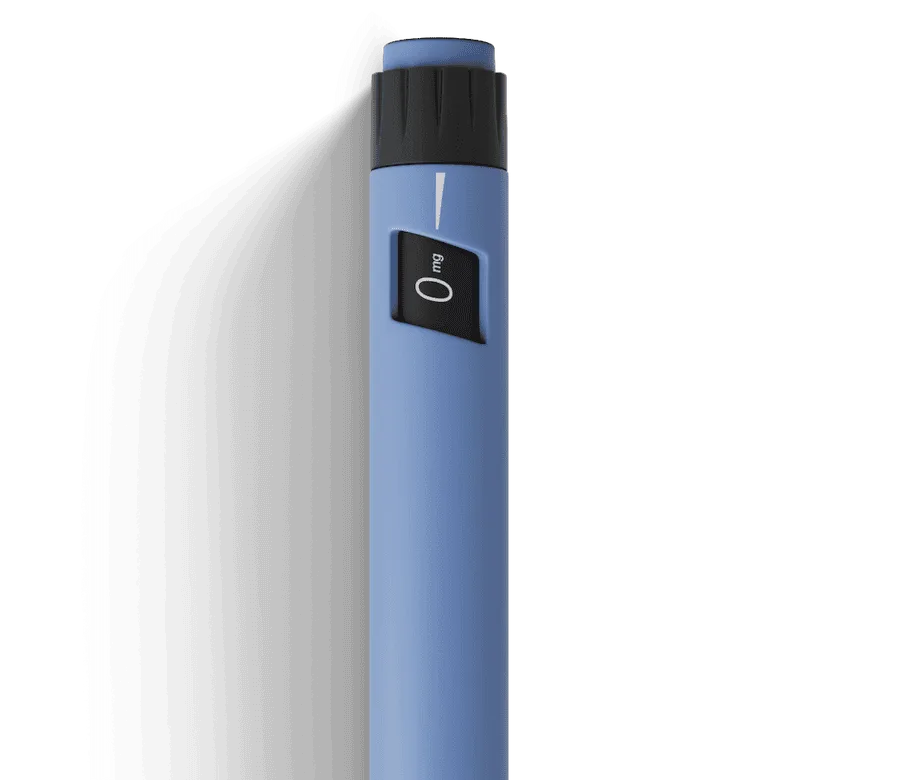
Access GLP-1 Weight Loss with Noom
Explore a wide range of prescription medications supported by Noom’s program.Microdose GLP-1rx
Noom GLP-1rx
Noom GLP-1rx Plus
Wegovy®
Ozempic®

Metformin
Zepbound®
Mounjaro®
Liraglutide
Does cabbage help you feel satiated and less hungry?
✔️ Yes: The water volume and structural bulk of cabbage physically stretch the stomach walls, sending fullness signals to the brain before you’ve consumed many calories.
Satiety level: High
💡 Tip: Drink a glass of water with or before your meal to support fullness. Pairing high-fiber foods like cabbage with fluids can help you feel more satisfied.
Does cabbage help with nighttime cravings?
✔️ Yes: It can help: Cabbage is low in calories and high in water and fiber, so it can add volume and help you feel more satisfied.
Does cabbage help reduce inflammation?
✔️ Yes: Sulforaphane and kaempferol, found in cabbage, are potent anti-inflammatory compounds that may help reduce chronic low-grade inflammation.
Is cabbage beneficial for brain health?
✔️ Yes: Vitamin K and anthocyanins found in cabbage support cognitive function and may help protect neural pathways from oxidative damage.
Can cabbage improve skin and hair health?
✔️ Yes: The high vitamin C content supports collagen production, which keeps skin firm and hair strong—particularly useful during weight loss when nutritional demands on the body increase.
Can cabbage help balance hormones?
✔️ Yes: Indole-3-carbinol in cabbage helps the liver metabolize estrogen effectively, which may support hormonal balance over time.
💡 Tip: Include a variety of cruciferous vegetables like broccoli and Brussels sprouts alongside cabbage for broader hormonal support.
🍽️ Best ways to eat cabbage for weight loss
- ✅ Fermented (sauerkraut/kimchi) – Fermentation introduces beneficial probiotics to your gut microbiome, which is increasingly linked to better weight regulation and reduced inflammation. The sour, tangy flavor can also help curb sugar cravings.
- ✅ Steamed or stir-fried – Lightly cooking cabbage retains its satisfying crunch and most of its vitamins, while breaking down some of the gas-causing sugars. Use a small amount of oil or water to keep the calorie count low.
- ✅ As cole slaw with a vinaigrette or low-fat Greek yogurt – Traditional coleslaw can be heavy with mayonnaise and even sugar, turning a 22-calorie food into a 300-calorie side dish. Opt for a vinegar-based dressing or a light yogurt alternative instead.
🍏 Best alternatives & comparisons (per 1 cup / about 89–100 g)
| Food | Calories | Carbs | Fiber | Protein | Fat |
|---|---|---|---|---|---|
| Cabbage | 22 | 5.2 g | 2.2 g | 1.1 g | 0.1 g |
| Spinach (raw) | 7 | 1.1 g | 0.7 g | 0.9 g | 0.1 g |
| Broccoli | 31 | 6.0 g | 2.4 g | 2.6 g | 0.3 g |
| Iceberg lettuce | 10 | 2.0 g | 0.9 g | 0.7 g | 0.1 g |
| Cauliflower | 25 | 5.3 g | 2.5 g | 1.9 g | 0.3 g |
| Kale | 33 | 6.7 g | 2.6 g | 2.9 g | 0.5 g |
When you compare cabbage to other leafy and cruciferous vegetables, it lands in a practical middle ground. It’s not the lowest in calories, but it offers a solid mix of volume, fiber, and nutrients that can help meals feel more filling.
Spinach and iceberg lettuce are lower in calories, but they’re also lighter and tend to shrink down quickly, especially when cooked. That can make portions feel smaller. Cabbage holds its structure better, which can make a plate feel more substantial.
Broccoli and cauliflower are the closest comparisons nutritionally, with similar calories and fiber, but they’re typically eaten in smaller portions or as sides. Cabbage is often easier to build a full meal around, whether in slaws, soups, or stir-fries.
Kale is higher in fiber and protein, but it also comes with more calories per cup. If you’re focused on maximizing portion size for fewer calories, cabbage can be an easier base.
From a practical standpoint, cabbage is also one of the more affordable options and tends to last longer in the fridge, which makes it easier to keep on hand and use consistently.
Frequently asked questions about cabbage and weight loss
How many calories are in 100 g of cabbage?
Raw cabbage contains just 25 calories per 100 grams, making it one of the lowest-calorie vegetables available. That same 100 g provides 5.8 g of carbs, 2.5 g of fiber, 1.28 g of protein, and 0.1 g of fat. It’s also packed with 40% of your daily Vitamin C and over 60% of your daily Vitamin K—impressive nutrition for such a small caloric cost.
Does the cabbage soup diet actually work for weight loss?
The cabbage soup diet is a short-term, restrictive plan that involves eating large amounts of a low-calorie cabbage-based soup for seven days, often alongside specific foods on each day. People who follow it typically lose weight quickly—but most of that initial loss is water weight, not fat. The diet is extremely low in protein, healthy fats, and key micronutrients, which can lead to muscle loss, fatigue, and nutrient deficiencies. Any weight lost is usually regained once normal eating resumes. While cabbage itself is a genuinely great food for weight loss, extreme mono-food diets aren’t a sustainable or healthy approach. A better strategy is to use cabbage as a regular, filling component of balanced meals rather than a crash diet centerpiece.
How much cabbage should I eat per day for weight loss?
There’s no strict daily limit, but one to two cups of shredded cabbage (roughly 90–180 g) per day is a practical and effective amount for most people. At this quantity, you’re getting meaningful fiber, Vitamin K, and Vitamin C without overloading your digestive system. If you’re new to high-fiber vegetables, start with one cup and increase gradually to give your gut time to adjust.
Is raw or cooked cabbage better for weight loss?
Both forms are excellent for weight loss. Raw cabbage retains slightly more Vitamin C and requires more chewing, which naturally slows your eating pace and gives your brain more time to register fullness. Cooked cabbage is gentler on the digestive system, breaks down the gas-causing sugars, and is often more palatable in larger quantities. The best approach is to enjoy both depending on the meal—raw in slaws and salads, cooked in soups and stir-fries.
Is red cabbage or green cabbage better for weight loss?
Both are similarly low in calories and high in fiber, making either a great choice for weight management. Red cabbage has the edge nutritionally—it contains anthocyanins, the pigments that give it its purple color, which are potent antioxidants with anti-inflammatory properties. Green cabbage is more widely available and has a milder flavor, making it easier to use in larger quantities. For maximum benefit, try mixing the two.
Can I eat cabbage every day?
Yes, for most people, cabbage can be enjoyed daily as part of a varied diet. However, if you have thyroid issues, it’s worth talking to your doctor about raw cabbage intake, since it contains goitrogens that can interfere with thyroid function in large amounts. Cooking cabbage deactivates most of these compounds. People with IBS may also want to be mindful of portion sizes with raw cabbage, as the sugar raffinose can trigger bloating.
Does cabbage burn belly fat?
No single food burns belly fat on its own. What cabbage does exceptionally well is support the conditions needed for overall fat loss: it’s ultra-low in calories, high in fiber to keep you full, and helps stabilize blood sugar to reduce cravings. Including cabbage regularly as part of a calorie-controlled, nutrient-dense diet can absolutely support fat loss—including around the midsection—over time.
🧠 The bottom line: Cabbage is a great choice for weight loss
Cabbage stands out because it makes it easier to eat satisfying portions while keeping calories in check. It adds volume, provides fiber, and contributes key nutrients—all without requiring much from your daily calorie budget. But like any single food, it works best as part of a bigger picture. Pairing cabbage with protein and healthy fats, and using it to build balanced meals, is what turns it from a “diet food” into something you can actually stick with.
If you’re trying to lose weight, cabbage can be a simple, practical tool—not because it’s special on its own, but because it helps support habits that matter. It can make meals feel more filling, stretch ingredients further, and fit into a wide range of eating styles. Used consistently alongside a calorie deficit and a balanced diet, it’s an easy way to make weight loss feel a little more manageable.
📖 Scientific evidence
- Increased intake of cruciferous vegetables like cabbage is associated with less weight gain over time. (PLOS Medicine, 2015). A large longitudinal study found that high-fiber, low-glycemic load vegetables were among the food groups most strongly linked to long-term weight loss, likely due to their effect on satiety and calorie displacement
- Dietary fiber supports weight regulation through multiple mechanisms. (American Journal of Clinical Nutrition, 2017). A comprehensive review found that fiber promotes satiety, decreases energy absorption, and alters gut hormones to favor weight loss—all of which align with the benefits seen from regular cabbage consumption.
- The sulfur-containing compounds in cabbage (glucosinolates) have been studied for their anti-inflammatory and potential metabolic benefits. (Frontiers in Pharmacology, 2021). Research has explored how these compounds may support liver function and reduce inflammatory markers that are often elevated in people with obesity.
- Vitamin K, found in abundance in cabbage, has been studied in relation to glucose metabolism and insulin sensitivity. (Food Science & Nutrition, 2025). Research suggests that adequate Vitamin K intake may help improve how the body regulates blood sugar—an important factor in preventing fat storage and supporting weight management.
- Fermented cabbage products like kimchi and sauerkraut have shown promise in animal studies for inhibiting fat accumulation and reducing obesity-related inflammation (Food & Nutrition Research, 2024), suggesting that the probiotic content may contribute benefits beyond the vegetable’s raw nutritional profile.
Editorial standards
At Noom, we’re committed to providing health information that’s grounded in reliable science and expert review. Our content is created with the support of qualified professionals and based on well-established research from trusted medical and scientific organizations. Learn more about the experts behind our content on our Health Expert Team page.