What you’ll learn:
- Lymphatic walking isn’t a special type of exercise—it’s essentially regular walking with extra cues like deeper breathing, better posture, and a fuller arm swing.
- The science supports walking for lymphatic flow, but there’s no evidence that “lymphatic walking” works better than any other purposeful walk.
- If your goal is weight loss, the real benefit comes from walking consistently—not from activating a special lymphatic mechanism or “draining” fat.
Walking seems like one of the simplest exercises. Put one foot in front of the other, repeat. But social media has a way of turning basic things into trends with rules, hacks, and catchy names—and walking has gotten the full treatment lately. There’s been tai chi walking, weighted vest walking, backward walking, “silent walking,” and now, lymphatic walking.
The pitch: walk a certain way, and you’re not just getting your steps in—you’re actively draining your lymphatic system. The lymphatic system is the network of vessels and nodes that moves fluid, waste, and immune cells through your body. Videos framing it as a “challenge,” “plan,” or “technique” have racked up millions of views, usually paired with claims about reduced bloating, less puffiness, a lighter, less swollen feeling, and sometimes even weight loss.
So what is it, actually? Walking is genuinely good for your lymphatic system—that part checks out. Whether the specific version people are calling “lymphatic walking” adds anything beyond a normal walk is a different question, and the answer is more nuanced.
Here’s what the trend actually involves, what the research says about walking and lymph flow, and how to try a version of it that’s worth your time. Plus, we ask Maggie Hudspeth, RDN, Noom’s Senior Manager of Coaching, to weigh in on the trend.
Quick answer: Is lymphatic walking worth trying?
It depends. Walking supports lymphatic flow because your lymphatic system has no central pump like your heart—it relies on muscle contractions, breathing, and movement to push fluid along. Any walk gives you that. There’s no research showing that the specific posture, pace, or arm-swing cues attached to “lymphatic walking” videos work better than a normal walk at the same intensity. If you have a diagnosed condition like lymphedema, walking can be a helpful part of managing it, but talk to your doctor or a lymphedema-trained physical therapist before starting a new routine.

The Easy Way
to lose weight and get healthy.

What is lymphatic walking?
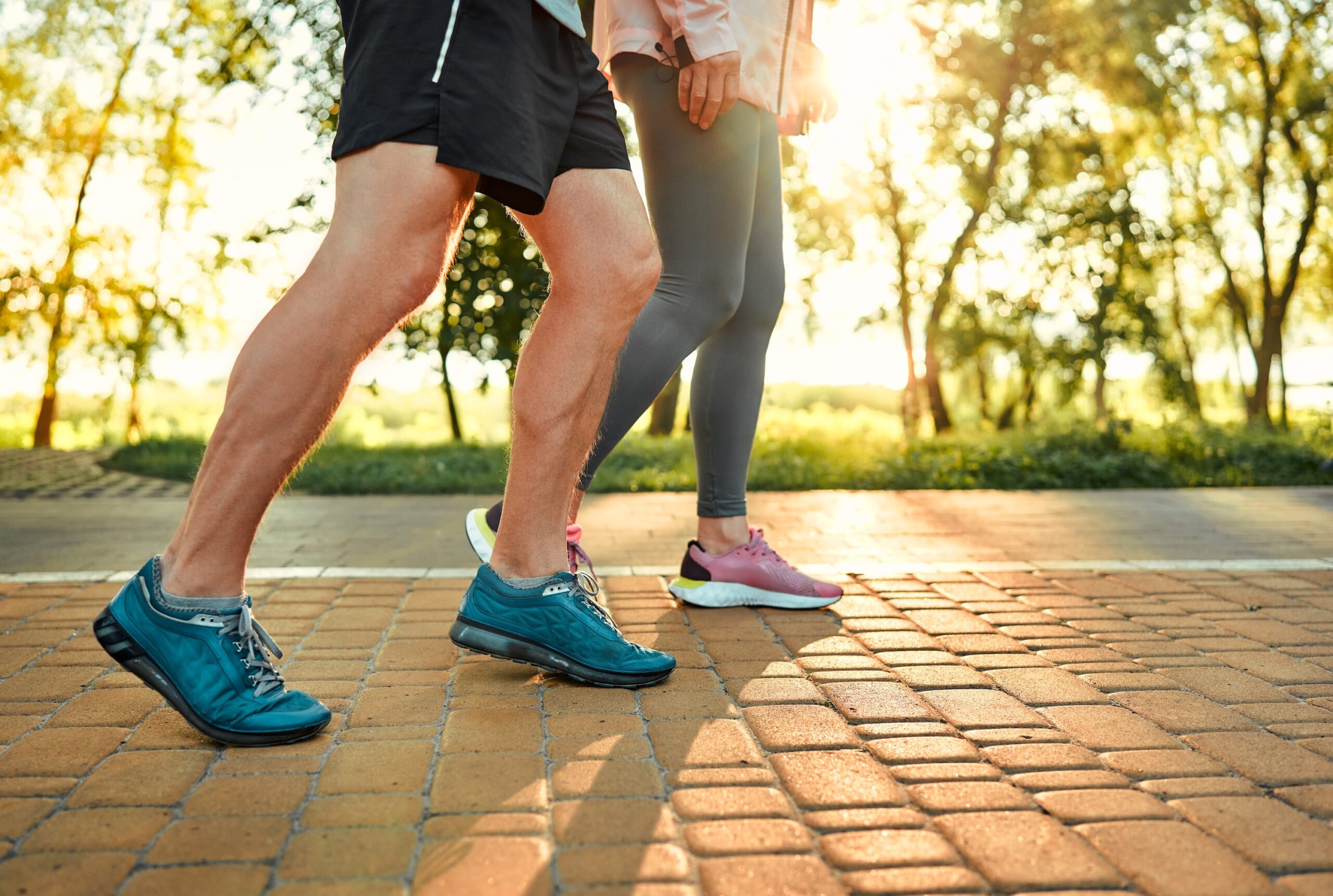
Lymphatic walking is a trend where people walk in a specific way to move lymph through the body. Most “lymphatic walking” content describes the same basic idea: walk at a brisk but comfortable pace, swing your arms more deliberately than you normally would, breathe deeply from your belly, and keep your posture upright. You can see the trend in action across TikTok’s lymphatic walking videos and in physical-therapist-led walkthroughs on YouTube that break the movement down step by step. Some versions add specific counts — walk for a set number of minutes, then rest — and market the whole thing as a “challenge” or “plan” you follow for a set number of days.
None of this is a distinct exercise science technique. It’s closer to a set of form cues layered onto ordinary walking, presented as though it targets the lymphatic system specifically. The vocabulary likely comes from a real practice, though: physical therapists who treat lymphedema prescribe structured movement routines — arm swings, marching, gentle walking, deep breathing — to keep lymph moving in people whose systems need the help. Lymphatic walking borrows that same language — arm swing, breath, deliberate movement — and applies it to a general audience walking outside, not a therapist-guided routine for a diagnosed condition.
How is lymphatic walking different from regular walking?
Physiologically, not much. A brisk walk moves lymph through the same mechanisms whether or not you’re thinking about your lymphatic system while you do it: muscle contractions in your legs squeeze the lymphatic vessels running alongside them, and deeper breathing changes pressure in your chest and abdomen in a way that helps pull lymph toward your bloodstream. The “lymphatic walking” framing mostly adds intention—arm swing, posture, breath—to a pace and duration you’d get from any purposeful walk. That intentionality might make you more consistent about walking, which has its own value, but it’s not evidence of a separate mechanism at work.
Why is the lymphatic system important?
Your lymphatic system is a network of vessels, nodes, and organs that moves a fluid called lymph through your body. Think of it as your body’s cleanup crew: lymph picks up excess fluid, waste, and immune cells from your tissues, then carries them back toward your bloodstream. Along the way, it passes through lymph nodes, where immune cells check for anything harmful.
Here’s the part that matters for walking: your lymphatic system has no pump of its own. Your heart pumps blood. Lymph doesn’t get that. It relies on you to move.
Your leg muscles do most of the heavy lifting. Every time you contract them—walking, climbing stairs, even shifting your weight—you squeeze the lymphatic vessels running alongside them, pushing lymph forward through a series of one-way valves. Deeper breathing helps too: it changes the pressure in your chest and belly just enough to pull lymph toward your bloodstream.
A review looked specifically at how muscle activity, breathing, and the simple act of standing and walking keep fluid moving through your veins and lymphatic vessels. It lays out, mechanism by mechanism, why movement isn’t just generally good for you—it’s the actual engine behind lymphatic flow. A body that sits still all day gives lymph almost nothing to work with.
Does walking help lymphatic drainage? Here’s what the research says
Yes—walking, along with most forms of movement, measurably increases lymph flow. In one study, researchers injected a tracer into people’s leg muscles so they could see how fast it moved out, then compared that at rest versus during muscle contractions like knee extensions. The tracer cleared several times faster once the muscles were active—a direct sign that muscle movement pushes lymph along. A more recent study used ultrasound to look at the body’s largest lymph vessel before and after exercise in 20 healthy adults, and found it visibly widened afterward—another sign that lymph was flowing more.
What the research doesn’t show is that walking needs to look a particular way to get this benefit. The mechanism is muscle contraction and breathing—a normal-paced walk activates the same calf and leg muscle pump as a walk performed with deliberate arm swings and posture cues. There’s no published research evaluating “lymphatic walking” as a distinct technique separate from walking or other moderate exercise, and the trend itself doesn’t appear to be built on any specific study.
Where the research gets more specific is in populations with an actual lymphatic condition. Movement-based interventions have been studied directly in lymphedema, a condition affecting an estimated 3 to 5 million people in the U.S., where lymph fluid builds up and causes chronic swelling, often after lymph node removal during cancer treatment.
Access GLP-1 Weight Loss with Noom
Explore a wide range of prescription medications supported by Noom’s program.
Microdose GLP-1rx

Noom GLP-1rx
Noom GLP-1rx Plus
Wegovy®
Ozempic®
Metformin

Zepbound®
Mounjaro®
Liraglutide
A trial testing a structured lymphatic exercise program in people with heart failure—a population prone to fluid overload—found that those who did the exercises were about 64% less likely to report waking up breathless at night, with a trend toward less shortness of breath, cough, and limb swelling. That program combined muscle tightening, stretching, and breathing rather than walking alone, but it illustrates the same underlying principle: coordinated movement can meaningfully support lymphatic function in people whose systems need the help.
What about lymphatic tai chi walking?
Tai chi shows up in the same searches as lymphatic walking, and it actually has more research behind it. One study looked at breast cancer survivors with arm swelling and had them try qigong—slow, tai chi-style movement paired with deep breathing. Their arm swelling went down over the course of the program. Researchers think it’s the breathing and gentle stretching working together to help fluid move. That’s a different practice from walking, but it’s a useful data point: slow movement paired with breathing has real evidence behind it—more than “lymphatic walking” can currently claim.
Is lymphatic walking good for weight loss?
Not in the way most videos imply. A lot of “lymphatic walking” and “lymphatic drainage” content leans on words like detox and drainage right next to before-and-after weight loss claims. Your lymphatic system doesn’t need help draining unless you have a specific medical condition, and moving lymph fluid around isn’t the same thing as losing fat.
“You might feel lighter after a walk from less water retention and less bloating, but that lighter feeling is usually just fluid shifting, not fat leaving your body. The scale doesn’t move because of the walk itself—it moves because you kept doing it,” says Hudspeth.
Any fluid shift like that is temporary and comes back once you eat or drink normally again. It’s a good feeling, just not a real change on the scale in the way it’s often promoted.
Walking itself is recommended for weight management for the reasons walking always is: It burns calories, and it’s a form of movement most people can sustain most days. If lymphatic walking gets you walking more often, that consistency is worth something. Just don’t expect the “lymphatic” part of it to be doing anything extra for your weight.
How to do lymphatic walking: A simple version worth trying
If you want to build the practical version of this trend, here’s a straightforward approach:
- Walk at a pace that raises your breathing rate but still lets you talk. This is the intensity where muscle contraction and breathing changes are both doing real work, without tipping into something unsustainable.
- Breathe from your belly, not just your chest. A few deliberate deep breaths at the start of your walk—inhaling so your stomach expands, not just your chest—engages the pressure changes that help move lymph through your thoracic duct.
- Let your arms swing. You don’t need an exaggerated pump; a natural, full arm swing engages your shoulders and upper body rather than leaving them still.
- Aim for 20 to 30 minutes, most days of the week. This lines up with general physical activity guidelines rather than any lymphatic-specific number, and it’s long enough to sustain the muscle-pump effect rather than just start it.
- Stand up and move during the day, too. Long stretches of sitting work against everything a walk accomplishes. A few minutes of movement every hour matters more than most people assume.
None of this requires a “challenge” structure, a specific day count, or special gear. It’s a walk done with a bit more attention—which is a reasonable thing to want, even without a unique mechanism behind it.
“You don’t need a special version of walking to get the benefit—you need a version you’ll actually do again tomorrow. Add one or two of these cues, not all five at once, and let it become automatic before you build on it,” says Hudspeth.
Other ways to support lymphatic health
Walking is one piece of a larger picture. A few habits with more established backing:
- Stay hydrated. Lymph is largely water, and dehydration makes it harder for your body to move fluid efficiently.
- Avoid long periods of complete stillness. Standing desks, walking breaks, and simple stretching all keep the muscle pump active during the day.
- Consider manual lymphatic drainage massage for a diagnosed condition. This is a technique performed by a licensed therapist for conditions like lymphedema or post-surgical swelling. It’s not something to self-administer based on a video, since incorrect technique on an area you don’t understand anatomically can worsen a problem rather than help it.
- Talk to a doctor about persistent swelling. One arm or leg that’s noticeably more swollen than the other, or swelling paired with burning or itching, is worth a medical evaluation rather than a home routine.
FAQs about lymphatic walking
Does normal walking help lymphatic drainage?
Yes. Walking engages the muscle contractions and breathing changes that move lymph through your body, since the lymphatic system has no central pump of its own. Studies measuring lymph clearance during exercise have found several-fold increases over resting levels.
Is lymphatic walking different from regular walking?
Not physiologically. The mechanisms that move lymph—muscle contraction and breathing—work the same way whether or not you’re following posture cues from a video. The difference is mostly in intention, not mechanism.
How long should I walk for lymphatic drainage?
There’s no lymphatic-specific number, so it’s reasonable to follow general physical activity guidelines: about 20 to 30 minutes most days, or 150 minutes a week. That’s long enough to keep your muscles contracting consistently, which is what actually moves lymph along.
What’s the best exercise for lymphatic drainage?
There isn’t one single best option—experts point to walking, swimming, cycling, yoga, and tai chi as equally solid choices, since they all involve the muscle contractions and breathing changes that move lymph. The best one is whichever you’ll actually keep doing. If you’re managing a diagnosed condition like lymphedema, ask your doctor or a certified lymphedema therapist which type and intensity is right for you.
What is a lymphatic walking challenge or plan?
These are structured versions of the trend, usually a set number of days or minutes per day, presented as a program to follow. They’re built around the same walking style described above; there’s nothing in the research suggesting the structure itself adds a benefit beyond consistent walking.
The Easy Way
to lose weight and get healthy.
Reviews from real Noom users
“My favorite parts of Noom are the care team and other Noomers. Sharing and getting help made me feel like I wasn’t doing it alone. That support made all the difference.”
Desirea N. — Real Noom user
“Noom has taught me that every day is a new chance to make better, healthier choices. It’s taught me how to stop overeating.”
Matthew M. — Real Noom user
“Clinicians who understand how supportive medication can be is one of the best parts of Noom! I was convinced I wouldn’t have success but I’m down 11 pounds in two months.”
Lila M. — Real Noom user
“Noom provided me with the medication which I could not get through Medicare. I have learned the tricks to better eating and life in general.”
Steve M. – Real Noom user
“Noom has changed my life and I’m so thankful, I feel great, have more energy and am no longer prediabetic.”
Daisy R. – Real Noom user
“All of the Noom providers that I’ve met with have been exceptional and prescribed medications that are appropriate for my situation and health.”
Sarah R. – Real Noom user
“Noom made the process so simple and now I feel full, free from diet obsession, and at ease in my body again.”
Madison S. – Real Noom user
“My doctor recommended Noom after I was frustrated trying to lose weight. The lessons helped change my relationship with food. My body feels lighter & energized.”
Sonday K. – Real Noom user
“I built healthy habits with coaching and lessons that make me confident I can maintain my weight loss long term.”
Cam K. – Real Noom user
“With the right medication through Noom, hunger and sugar cravings finally quieted and I have the tools to break the cycle.”
Laura TR. – Real Noom user
“Cravings and food noise are gone, I finally feel confident in the healthy habits I’ve built to last with Noom.”
Jessica S. – Real Noom user
The bottom line: Should you try lymphatic walking?
Walking is good for you regardless of what you call it. The evidence supports movement—any movement that engages your leg muscles and changes your breathing pattern—as a genuine driver of lymphatic flow. What the evidence doesn’t support is the idea that a specific arm-swing, posture, or “challenge” structure outperforms a walk you’d take anyway.
“If the ‘lymphatic walking’ framing gets you outside more consistently, that’s a real benefit—just one that comes from walking regularly, not from a unique mechanism unlocked by the label,” says Hudspeth.
If you’re managing a diagnosed lymphatic condition, walking can be part of a supportive routine, but it’s worth building that routine with your doctor or a lymphedema specialist rather than a social media script. For more tips on building healthier habits that last, download Noom on iOS or Android.
Editorial standards
At Noom, we’re committed to providing health information that’s grounded in reliable science and expert review. Our content is created with the support of qualified professionals and based on well-established research from trusted medical and scientific organizations. Learn more about the experts behind our content on our Health Expert Team page.