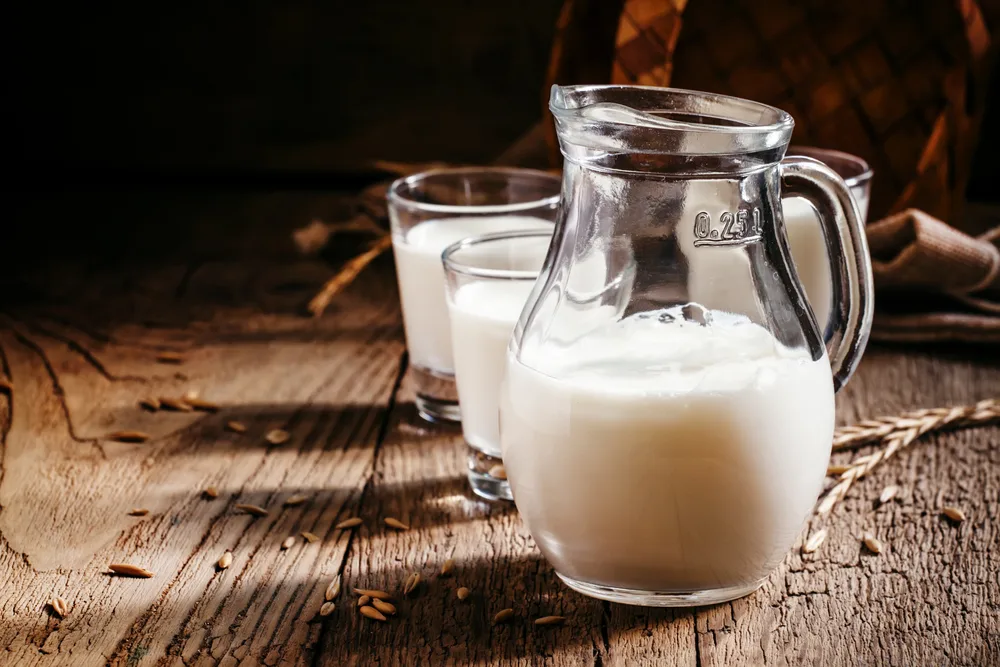
Goat milk has been showing up in a lot more places lately—coffee shops, wellness influencers’ grocery hauls, and specialty food menus—as many people seek alternatives to cow milk.
A lot of the headlines focus on digestion and gut health, which have become major topics in wellness circles. Goat milk’s fat is broken into smaller droplets than cow milk’s, and its main protein is a slightly different form called A2 casein rather than the A1 form found in most cow milk. Marketers lean on both points to sell goat milk as gentler on the gut than standard cow milk, and research does back up a modest digestibility difference behind some of that claim—which we’ll get into below.
But trending and proven aren’t quite the same thing, and a lot of the online enthusiasm doesn’t match up to the actual weight loss evidence. That doesn’t mean goat milk isn’t worth including in a healthy eating plan—just that its digestibility story and its weight loss case are two separate questions.
A cup (8 oz) of goat milk has about 9 grams of protein and 168 calories, putting it close to whole cow milk nutritionally. Here’s what that means for your weight loss goals.
Quick answer: Is goat milk good for weight loss?:
It depends. Goat milk can fit into a weight loss plan the same way any dairy milk can—it gives you protein and calcium, but it’s not low-calorie, and its fat content (10 grams per cup, over half of it saturated) adds up fast if you’re pouring it freely. Your best bet is to count it toward your daily calories rather than treating it as a freebie, and to keep pours to a cup or less at a time.
🚀 Goat milk weight-loss benefits
- Goat milk’s protein can help you stay full. A cup of goat milk has about 9 grams of protein. Protein slows digestion and helps you stay satisfied after eating, which may make it easier to avoid unnecessary snacking. That’s the main weight-loss benefit of goat milk—not anything unique to the milk itself. If you’re looking for even more protein, Greek yogurt and cottage cheese are stronger options.
- Goat dairy may help curb hunger. In one study, people felt fuller and less hungry after a breakfast made with goat dairy. They also had a bigger increase in GLP-1, a hormone your gut releases after eating that helps signal fullness. The difference was modest, and the study only looked at one meal, but it suggests goat dairy may help keep hunger in check.
- Goat milk provides calcium your body needs. One cup provides about a quarter of your daily calcium needs. Calcium won’t make you lose weight on its own, but it’s important for healthy muscles and the many processes your body relies on to turn food into energy.
⚠️ Goat milk downsides to watch for
- Goat milk is relatively high in fat. A cup of whole goat milk has about 10 grams of fat, including around 6 grams of saturated fat. If you’re trying to limit saturated fat for heart health, it’s something to keep in mind. Choosing a smaller serving or a lower-fat version, if you can find one, can help.
- The calories can add up. One cup of goat milk has about 170 calories. That’s perfectly reasonable as part of a balanced diet, but pouring multiple cups throughout the day can make it harder to stay in a calorie deficit if weight loss is your goal.
- It isn’t safe for people with a cow’s milk allergy. Goat milk is often described as being easier to digest, but that doesn’t mean it’s a good substitute for someone with a cow’s milk allergy. The proteins are very similar, so it can trigger the same allergic reaction. If you have a milk allergy, talk with your healthcare provider before trying goat milk.
🥗 Nutrients in goat milk (per 1 cup / 8 fl oz)
| Nutrient | Amount | % RDA* |
|---|---|---|
| Calories | 168 calories | 8% |
| Protein | 9 g | 18% |
| Total carbs | 11 g | 4% |
| Fiber | 0 g | 0% |
| Sugars | 11 g | — |
| Total fat | 10 g | 13% |
| – Saturated fat | 6.5 g | 33% |
| – Monounsaturated fat | 2.7 g | — |
| – Polyunsaturated fat | 0.4 g | — |
| Omega-3 | 0.03 g | — |
| Omega-6 | 0.3 g | — |
*Recommended dietary allowance (RDA) is defined as the average daily amount of nutrients needed to meet the requirements of nearly all healthy people in a specific group.
New from Noom
Microdose GLP-1Rx Plus
An affordable way to start your GLP-1 journey with Compounded Tirzepatide.

*Initial 3 week subscription and 4 weeks of medication from $79 plus tax and $199 per month plus tax for 12 week subscription thereafter. Final pricing depends on program selection. Noom GLP-1Rx Plus Microdose Program involves medication (when appropriate), healthy diet, exercise and support. Individual results vary. Meds & personalization based on need as determined by a third-party clinician. Medications are not reviewed by FDA for safety, efficacy, or quality. No affiliation with Eli Lilly and Company, the only US source of FDA-approved tirzepatide. Not available in all 50 US states.
Goat milk contains a mix of protein, carbohydrates, and fat. A cup provides 9 grams of protein, 11 grams of naturally occurring carbohydrates, and 10 grams of fat, including 6.5 grams of saturated fat. The carbohydrates come from lactose, the natural sugar in milk, and plain goat milk doesn’t contain added sugar.
💊 Vitamins & minerals in goat milk (per 1 cup / 8 fl oz)
| Vitamin/Mineral | Amount | % RDA* |
|---|---|---|
| Riboflavin (B2) | 0.34 mg | 26% |
| Calcium | 327 mg | 25% |
| Phosphorus | 271 mg | 22% |
| Vitamin D | 3.2 mcg | 16% |
| Vitamin A | 139 mcg | 15% |
| Pantothenic acid (B5) | 0.76 mg | 15% |
| Potassium | 498 mg | 11% |
| Magnesium | 34 mg | 8% |
| Zinc | 0.73 mg | 7% |
| Vitamin B12 | 0.17 mcg | 7% |
| Vitamin B6 | 0.12 mg | 7% |
| Selenium | 3.4 mcg | 6% |
*Recommended dietary allowance (RDA) is defined as the average daily amount of nutrients needed to meet the requirements of nearly all healthy people in a specific group.
Goat milk is naturally rich in several important nutrients, especially calcium, phosphorus, and riboflavin (vitamin B2). One cup provides about a quarter of your daily calcium needs and more than 20% of your daily phosphorus, two minerals that work together to support healthy bones and teeth. Riboflavin also stands out, providing about 26% of your daily needs and helping your body turn the food you eat into energy.
Goat milk also provides vitamin A, potassium, magnesium, zinc, selenium, and several B vitamins. Most pasteurized goat milk sold in the U.S. is also fortified with vitamin D, similar to cow’s milk, although the exact amount can vary by brand. Together, these nutrients make goat milk a nutrient-dense choice that offers more than just protein and calories.
What is A2 casein? The difference between goat milk and cow milk
Casein is the main protein in milk. Goat milk naturally contains mostly A2 beta-casein, while most cow’s milk contains a mix of A1 and A2 beta-casein (although some cows naturally produce only A2 milk).
Some research suggests that people who experience digestive discomfort after drinking standard cow’s milk may have fewer symptoms after drinking milk that contains only A2 beta-casein. But the research is still limited, and scientists haven’t concluded that A2 milk is healthier or easier for everyone to digest. One study found that adults with lactose intolerance or lactose maldigestion reported fewer digestive symptoms after drinking A2-only milk compared with conventional milk containing both A1 and A2 beta-casein.
It’s also important to know that A2 doesn’t mean lactose-free. Goat milk still contains lactose, so it may not be suitable if you’re lactose intolerant. And if you have a cow’s milk allergy, goat milk usually isn’t a safe alternative because its proteins are very similar to those in cow’s milk.
🔍 Nutrients in goat milk
Glycemic index (GI) of goat milk
Glycemic index: 25 (Low)
💡 A low GI means goat milk causes a gradual rise in blood sugar rather than a sharp spike, which can help support steadier energy levels between meals.
Is goat milk high in protein?
❌ No. Goat milk provides about 9 grams of protein per cup. That’s a solid amount for a beverage, but it’s not considered a high-protein food like Greek yogurt, cottage cheese, or lean meats.
Is goat milk low in carbs?
❌ No. Goat milk contains about 11 grams of carbohydrates per cup, almost all from lactose, the natural sugar in milk. If you’re following a low-carb eating plan, count it as one of your carbohydrate sources.
Is goat milk gluten-free?
✔️ Yes. Plain goat milk is naturally gluten-free because it doesn’t contain wheat, barley, or rye. If you buy flavored goat milk products, check the label for added ingredients.
Is goat milk good for fat loss?
✔️ It can be. Goat milk’s protein may help keep you full, and its low glycemic index supports steady blood sugar. But at about 170 calories per cup, it’s best enjoyed in portions that fit your calorie goals rather than as an unlimited drink.
🍽️ Diet compatibility: Which diets include goat milk?
| Diet | ✅ / ❌ | Why |
|---|---|---|
| Keto | ❌ | A cup contains 11 grams of carbs from lactose, which can use up over a quarter of a strict 20-to-50-gram daily keto carb allowance on its own. |
| Paleo | ❌ | Dairy of any kind, including goat milk, falls outside most paleo frameworks, which exclude animal milk as a category. |
| Mediterranean | ✅ | The Mediterranean pattern includes moderate amounts of dairy, and goat and sheep milk products are traditional staples in several Mediterranean regions. |
| Vegan | ❌ | Goat milk is an animal product and doesn’t fit a vegan diet under any circumstances. |
| Gluten-free | ✅ | Plain goat milk contains no gluten-containing ingredients and is safe on a gluten-free diet. |
Goat milk fits into a Mediterranean-style or general omnivorous eating pattern, but it doesn’t fit carb-restricted or animal-product-free diets. Its compatibility comes down to whether dairy has a place in your diet at all—if it does, goat milk is a reasonable option within that category.
🌟 Is goat milk healthy? What are the health benefits?
Metabolic health
- Boosts metabolism? ❌ No. Goat milk doesn’t directly increase your metabolic rate. Its protein requires more energy to digest than carbohydrates or fat, but that’s true of protein from any food—not something unique to goat milk.
- Improves insulin sensitivity? ➖ Probably not. Goat milk has a low glycemic index, so it causes a gradual rise in blood sugar. While that can help support steadier blood sugar levels after a meal, there’s no good evidence that drinking goat milk improves insulin sensitivity on its own.
- Reduces fat storage? ➖ No direct effect. Goat milk doesn’t prevent your body from storing fat. Its mix of protein and fat may help keep you full, which can make it easier to eat fewer calories overall, but fat loss still comes down to maintaining a calorie deficit over time.
Cholesterol impact
- Does goat milk lower LDL (“bad”) cholesterol? ❌ No. There’s no good evidence that regular goat milk lowers LDL cholesterol. While some studies have found cholesterol benefits from specially formulated goat dairy products, those results don’t apply to the goat milk you’ll find in most grocery stores.
- Is goat milk heart-healthy? ➖ It depends. Goat milk can be part of a heart-healthy diet, but it isn’t a heart-health food on its own. One cup contains about 6.5 grams of saturated fat, so it’s worth counting toward your daily intake, especially if you have high LDL cholesterol or heart disease. Overall, the foods you eat throughout the day matter much more than any single glass of milk.
💡 If heart health is a concern, reduced-fat goat milk delivers the same protein and most of the same micronutrients with about half the saturated fat per cup.
Can you drink goat milk in a calorie deficit?
✔️ Yes. Goat milk can absolutely fit into a calorie deficit. One cup of whole goat milk has about 170 calories, so it’s worth measuring your portions and counting it toward your daily calorie budget rather than pouring it freely.
💡 Tip: Use goat milk in oatmeal, smoothies, or coffee instead of drinking multiple glasses throughout the day.
Does goat milk support gut health?
➖ Maybe. Plain goat milk doesn’t contain probiotics, so it won’t directly support your gut microbiome. However, fermented goat milk products like goat yogurt and goat kefir contain live cultures that may benefit gut health. If you’re looking to support a healthy gut, fermented foods are generally a better bet than plain milk.
Does goat milk support digestion?
✔️ For some people. Some people find goat milk easier to digest than cow’s milk, possibly because of differences in its proteins and fat structure. But the research is mixed, and goat milk still contains lactose, so it isn’t a reliable solution for lactose intolerance or a cow’s milk allergy.
Does goat milk help you feel fuller?
✔️ Maybe. One small study found that people felt slightly fuller and less interested in eating after a breakfast made with goat dairy than after a similar breakfast made with cow dairy. The difference was modest and only measured after a single meal, but it suggests goat dairy may help support fullness.
Satiety level: Moderate
💡 Tip: Pair goat milk with other filling foods, such as oats, fruit, or eggs, to build a more satisfying meal.
Does goat milk reduce inflammation?
❌ There’s no good evidence. While one study found anti-inflammatory benefits from a specially formulated goat cheese enriched with omega-3 fats, those findings don’t apply to regular goat milk. At this point, there’s no strong evidence that plain goat milk reduces inflammation.
Can goat milk help balance hormones?
❌ Not directly. Goat milk contains protein, fat, and other nutrients that support overall health, but there’s no evidence that it balances hormones or treats hormone-related conditions. Any effects on hormone health are likely to come from maintaining an overall nutritious diet rather than drinking goat milk specifically.
🍽️ Best ways to use goat milk for weight loss
Use it as your smoothie base instead of juice or a sugary yogurt drink. Blending a cup of goat milk with fruit and a scoop of protein powder gives you a filling breakfast that combines goat milk’s protein with fiber from the fruit, extending fullness longer than milk alone would.
Portion it into a measured glass rather than pouring freely. Because a cup carries 168 calories, treating goat milk like a mixer you can add without limit—in coffee, cereal, or recipes—is an easy way to add several hundred unaccounted-for calories to your day.
Avoid pairing large amounts with high-sugar cereals or sweetened coffee drinks. The combination stacks goat milk’s own calories on top of added sugar, turning what could be a reasonably filling breakfast into a calorie-dense one.
Recipes to try:
- Green Goat Milk Smoothie — Summerhill Goat Dairy
- Overnight Oats with Goat Milk — Meyenberg
- Goat Milk Latte — Dans le Lakehouse
🍏 Best alternatives & comparisons (per 1 cup / 8 fl oz)
| Food | Calories | Carbs | Fiber | Protein | Fat |
|---|---|---|---|---|---|
| Goat milk (whole) | 168 | 11 g | 0 g | 9 g | 10 g |
| Cow milk (whole) | 149 | 12 g | 0 g | 8 g | 8 g |
| Cow milk (2%) | 122 | 12 g | 0 g | 8 g | 5 g |
| Pea milk (unsweetened) | 70 | 0 g | 0 g | 8 g | 4.5 g |
| Soy milk (unsweetened) | 80 | 4 g | 2 g | 7 g | 4 g |
| Oat milk (unsweetened) | 80 | 14 g | 2 g | 3 g | 2 g |
| Almond milk (unsweetened) | 30–40 | 1 g | 1 g | 1 g | 2.5–3 g |
Goat milk is one of the highest-protein milk options, with about 9 grams per cup, but it’s also one of the highest in calories and fat. If you’re looking for similar protein with fewer calories, pea milk and reduced-fat cow’s milk are strong alternatives.
If your priority is simply lowering calories, unsweetened almond milk is the lightest option. If you want a balance of protein and calories, pea milk stands out by providing nearly as much protein as dairy with less than half the calories of whole goat milk. Ultimately, the best choice depends on what matters most to you—whether that’s protein, calories, taste, or digestibility.
❓ Frequently asked questions about goat milk and weight loss
How much goat milk should you drink for weight loss?
There’s no ideal amount for weight loss. A cup a day can fit into a healthy eating pattern, but it’s best to count it as part of your overall daily calorie intake rather than treating it as a free food.
Access GLP-1 Weight Loss with Noom
Explore a wide range of prescription medications supported by Noom’s program.Microdose GLP-1rx
Noom GLP-1rx
Noom GLP-1rx Plus
Wegovy®
Ozempic®

Metformin
Zepbound®
Mounjaro®
Liraglutide
Is goat milk better than cow’s milk for losing weight?
Not really. Goat milk and cow’s milk have similar amounts of protein, and while goat milk may help with fullness slightly more after a meal, the evidence is limited. The biggest factors for weight loss are your overall eating pattern and portion sizes.
Can you drink goat milk every day?
Yes. For most people, goat milk can be part of a healthy daily diet. If you have a cow’s milk allergy, however, goat milk usually isn’t a safe alternative because the proteins are very similar.
Does goat milk cause bloating?
Some people find goat milk easier to digest than cow’s milk, but everyone’s digestive system is different. Goat milk still contains lactose, so it isn’t a reliable substitute if your symptoms are caused by lactose intolerance.
Is goat milk safe for people with a cow’s milk allergy?
No. Goat milk contains proteins that are very similar to those in cow’s milk, so it can trigger the same allergic reaction. If you have a diagnosed cow’s milk allergy, don’t switch to goat milk without talking with your healthcare provider.
Is goat milk a good choice for older adults?
It can be. Goat milk provides protein, calcium, and phosphorus, nutrients that help support healthy bones and muscles as you age. Like any milk, it’s most beneficial when it’s part of an overall balanced diet.
🧠 The bottom line: In moderation, goat milk can be part of certain weight-loss diets
Goat milk’s growing popularity is largely driven by claims that it’s easier to digest than cow’s milk, and there is some evidence to support that for certain people. But that’s a different question from whether it helps with weight loss.
When it comes to losing weight, goat milk doesn’t have any special advantage. It provides protein that can help you stay full and a range of important nutrients, but it also contains more calories and saturated fat than many lower-fat dairy and plant-based alternatives. Like any milk, it works best when it fits into your overall eating pattern.
If goat milk agrees with your stomach better than cow’s milk or you simply prefer the taste, there’s no reason it can’t be part of a healthy weight-loss plan. Just don’t expect it to speed up fat loss on its own. The benefits come from how it fits into your diet—not from anything unique about goat milk itself.

See if your insurance
covers GLP-1s.
The form only takes 2 minutes to answer. We’ll handle the rest.
GET STARTED📖 Scientific evidence
- Goat milk protein is highly digestible—but not uniquely so. (American Journal of Clinical Nutrition, 2021) Researchers measured how much goat milk protein was absorbed in healthy women and found that about 94% was digested and absorbed by the end of the small intestine. That’s essentially the same as published values for cow’s milk protein, suggesting that while goat milk is an excellent source of high-quality protein, it isn’t inherently more digestible than cow’s milk overall.
- A goat dairy breakfast increased fullness slightly more than a cow dairy breakfast. (Nutrients, 2017) In a small study, healthy adults felt less hungry and less interested in eating after a breakfast made with goat dairy than after a similar breakfast made with cow dairy. They also had higher levels of GLP-1, a hormone your gut releases after eating that helps signal fullness. The study only looked at a single meal, so more research is needed to know whether these effects translate to long-term weight loss.
- Milk containing only A2 casein may cause fewer digestive symptoms than regular milk. (Nutrients, 2020) In a study of adults with lactose intolerance or lactose maldigestion, participants reported less bloating, stomach pain, and digestive discomfort after drinking milk containing only A2 beta-casein compared with conventional milk containing both A1 and A2 beta-casein. The findings suggest A2 casein may be easier for some people to tolerate, although more research is needed to confirm the benefits, and the study didn’t test goat milk specifically.
- Goat milk isn’t a safe substitute for people with a cow’s milk allergy. (Journal of Allergy and Clinical Immunology, 1999) In a controlled study, most children with a confirmed cow’s milk allergy also had an allergic reaction to goat milk. Because goat and cow’s milk share many of the same allergy-triggering proteins, goat milk isn’t considered a safe alternative for people with a cow’s milk allergy.
Editorial standards
At Noom, we’re committed to providing health information that’s grounded in reliable science and expert review. Our content is created with the support of qualified professionals and based on well-established research from trusted medical and scientific organizations. Learn more about the experts behind our content on our Health Expert Team page.