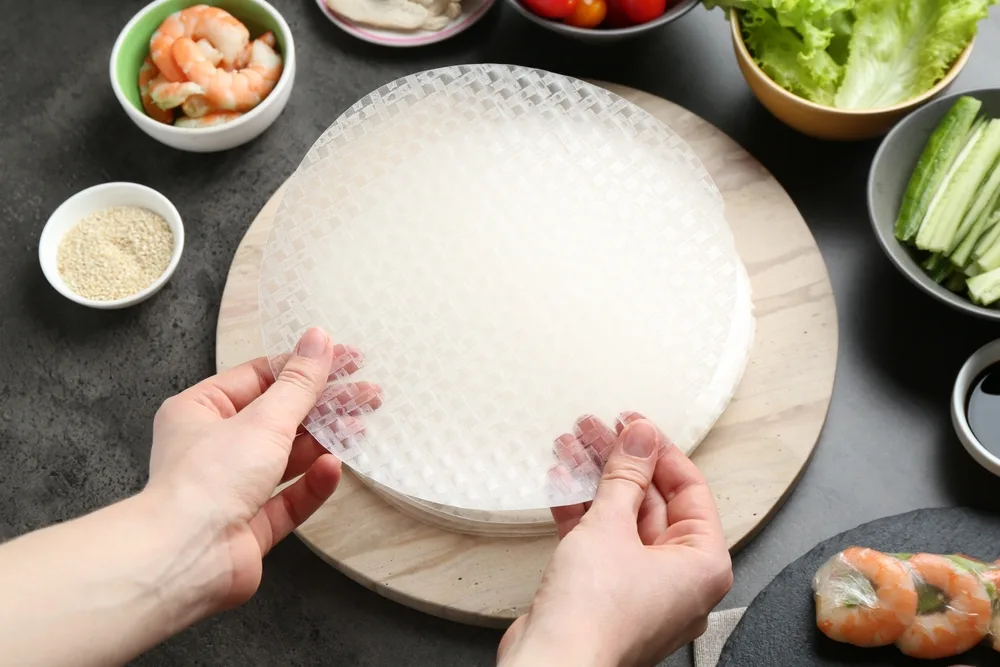
Rice paper is a thin, translucent sheet made from rice flour, tapioca starch, water, and salt. After a quick soak in warm water, it becomes soft and flexible enough to wrap around fillings. Left dry, it can be baked or air-fried into a light, crispy cracker.
While it’s best known as the wrapper for Vietnamese fresh spring rolls, rice paper has recently become one of social media’s favorite ingredient swaps. Creators are using it in place of tortillas, pasta, chips, croissants, and even bagels, often highlighting it as a lighter, gluten-free alternative.
Part of the appeal is its nutrition profile. A single sheet contains about 30 calories and is naturally fat-free and gluten-free, making it an easy way to cut calories from meals and snacks.
But does that make rice paper good for weight loss? Not necessarily. While it’s lower in calories than many wraps and crusts, it’s also made mostly from refined carbohydrates and contains very little protein or fiber. Let’s take a closer look at what rice paper is, how it compares with other wrappers, and when it can—and can’t—support your weight-loss goals.
Quick answer: Is rice paper good for weight loss?:
Yes—rice paper can support weight loss, but it’s what you put inside it that matters most. A sheet of rice paper has about 30 to 35 calories and almost no fat, making it lighter than many wraps. Because rice paper is made mostly from refined carbohydrates, pairing it with lean protein, fiber-rich vegetables, and healthy fats creates a more filling, balanced meal that can better support weight-loss goals.
🚀 Weight-loss benefits of rice paper
- Rice paper is lower in calories than many other wraps. One sheet has about 30 to 35 calories, making it a lighter option than most tortillas, sandwich bread, or pastry-based wrappers. If wraps are a regular part of your meals, switching to rice paper may help lower calories without changing the overall meal.
- Rice paper is naturally gluten-free and made with just a few ingredients. Most varieties contain only rice flour, tapioca starch, water, and salt, with no added oils or sugars. That can make rice paper a simple option for people avoiding gluten or looking for a minimally processed wrapper.
- Rice paper lets the filling do the nutritional work. On its own, rice paper doesn’t provide much protein or fiber, but it works well as a wrapper for lean protein, vegetables, herbs, and healthy fats. Building your roll this way creates a meal that’s more satisfying than the wrapper alone.
⚠️ Things to be mindful of
- Rice paper is mostly refined carbohydrates. Rice paper has a moderately high glycemic index (about 70 to 80), so eating it by itself can raise blood sugar relatively quickly. Pairing it with protein, fiber, and healthy fat slows digestion and creates a more balanced meal.
- Rice paper isn’t very filling by itself. A sheet contains very little protein or fiber, two nutrients that help you stay full. The ingredients you wrap inside have a much bigger impact on how satisfying the meal will be.
- Fried rice paper is much higher in calories. Fresh rice paper is very low in calories, but deep-frying adds a significant amount of oil and energy. If you want a crispy texture, baking or air-frying is a lighter alternative.
🥗 Nutrients in rice paper (per 2 sheets, about 16 grams)
| Nutrient | Amount | % RDA* |
|---|---|---|
| Calories | 60 calories | 3% |
| Protein | 0.5 g | 1% |
| Total carbs | 14 g | 5% |
| Fiber | 0.3 g | 1% |
| Sugars | 0 g | — |
| Total fat | 0 g | 0% |
| – Saturated fat | 0 g | 0% |
| – Monounsaturated fat | 0 g | — |
| – Polyunsaturated fat | 0 g | — |
| Omega-3 | 0 g | — |
| Omega-6 | 0 g | — |
*Recommended dietary allowance (RDA) is defined as the average daily amount of nutrients needed to meet the requirements of nearly all healthy people in a specific group.
New from Noom
Microdose GLP-1Rx Plus
An affordable way to start your GLP-1 journey with Compounded Tirzepatide.

*Initial 3 week subscription and 4 weeks of medication from $79 plus tax and $199 per month plus tax for 12 week subscription thereafter. Final pricing depends on program selection. Noom GLP-1Rx Plus Microdose Program involves medication (when appropriate), healthy diet, exercise and support. Individual results vary. Meds & personalization based on need as determined by a third-party clinician. Medications are not reviewed by FDA for safety, efficacy, or quality. No affiliation with Eli Lilly and Company, the only US source of FDA-approved tirzepatide. Not available in all 50 US states.
Rice paper is nutritionally simple. Most of its calories come from refined carbohydrates, with very little protein, fiber, or fat. That’s why the ingredients you wrap inside matter much more than the wrapper itself. Filling rice paper with lean protein, vegetables, and healthy fats creates a more balanced and satisfying meal.
Sodium varies by brand. Some rice paper products contain as little as 7 mg of sodium per sheet, while others have closer to 60 mg. If you’re watching your sodium intake, check the Nutrition Facts label—but even the higher-sodium varieties contribute relatively little sodium per serving for most people.
💊 Vitamins & minerals in rice paper (per 2 sheets, about 16 grams)
| Vitamin/Mineral | Amount | % RDA |
|---|---|---|
| Manganese | 0.19 mg | 8% |
| Copper | 0.02 mg | 2% |
| Phosphorus | 16 mg | 1% |
| Iron | 0.03 mg | <1% |
| Calcium | 2 mg | <1% |
Rice paper isn’t a significant source of vitamins or minerals. Manganese is the only nutrient it provides in a meaningful amount, contributing about 8% of the daily value in two sheets. Manganese supports bone health and energy metabolism, but rice paper shouldn’t be relied on for micronutrients.
Instead, think of rice paper as the wrapper—not the nutritional centerpiece. The vegetables, lean protein, herbs, and healthy fats you fill it with will contribute far more vitamins, minerals, and fiber than the rice paper itself.
🔍 Nutrient breakdown
Glycemic index (GI) of rice paper: Glycemic index: 85 (High)
💡 Tip: A high GI means rice paper’s carbs hit your bloodstream fast, which can lead to a quicker return of hunger. Pairing it with protein or fat helps slow that response.
Is rice paper high in protein?
❌ No: rice paper contains about 0.5 grams of protein per serving. Better protein alternatives: soy paper | whole wheat tortilla | edamame wrapper
Is rice paper high in fiber?
❌ No: rice paper has about 0.3 grams of fiber per serving. 💡 Tip: Stack in shredded carrot, cucumber, and fresh herbs to bring real fiber into the meal, since the wrapper won’t provide any.
Is rice paper low in carbs?
❌ No: rice paper has about 14 grams of carbs per serving. 💡 Tip: If you’re watching carb intake, use fewer sheets per roll and lean on vegetables for bulk instead of noodles or rice fillings.
Is rice paper gluten-free?
✔️ Yes: standard rice paper made from rice flour, tapioca starch, water, and salt contains no wheat, barley, or rye. It’s worth double-checking labels on flavored or specialty varieties, since a few brands blend in other starches.

See if your insurance
covers GLP-1s.
The form only takes 2 minutes to answer. We’ll handle the rest.
GET STARTEDIs rice paper good for fat loss?
✔️ Maybe: rice paper’s low-calorie, fat-free profile means it doesn’t add much to a meal’s total on its own, but its lack of protein and fiber means it does little to help you feel full. Its usefulness for fat loss depends on what you build around it.
🍽️ Diet compatibility: Which diets include rice paper?
| Diet | ✅ Yes / ❌ No | Why |
|---|---|---|
| Keto | ❌ | Rice paper is almost pure starch, and even a couple of sheets can use up a meaningful share of a strict daily carb allowance. |
| Paleo | ❌ | Paleo frameworks generally exclude grain-derived starches like milled rice flour, even though rice paper is minimally processed in other respects. |
| Mediterranean | ✅ | The Mediterranean pattern centers on vegetables, seafood, and whole grains, but occasional rice paper rolls filled with shrimp, herbs, and vegetables fit comfortably within its flexibility. |
| Vegan | ✅ | Standard rice paper contains no animal products, and fillings like tofu, herbs, and vegetables keep a full roll plant-based. |
| Gluten-free | ✅ | Made from rice flour and tapioca starch, rice paper contains no wheat-derived gluten, making it one of the more reliably gluten-free wrapper options available. |
Rice paper fits comfortably into gluten-free, vegan, and Mediterranean-style eating, mainly because those patterns don’t restrict refined carbohydrates outright. It runs into trouble with keto and paleo specifically because of how carb-focused and grain-derived it is.
In practice, it’s usually the fillings and portion count, not the wrapper, that determine whether a rice paper meal fits a particular way of eating.
🌟 Is rice paper healthy? What are the health benefits?
Metabolic health: Is rice paper good for your metabolism?
- Boosts metabolism? ❌ No – rice paper has no compounds shown to raise metabolic rate; it’s a neutral calorie source with no thermogenic effect beyond normal digestion.
- Improves insulin sensitivity? ❌ No – as a high-glycemic refined starch, rice paper produces a fast insulin response rather than improving sensitivity over time.
- Effect on fat storage? Neutral – occasional rice paper rolls in a calorie-controlled diet don’t meaningfully promote fat storage, but frequent large portions of a fast-digesting starch can make it easier to overeat overall.
Cholesterol impact: Does rice paper affect cholesterol levels?
- Does it lower LDL (bad) cholesterol? ❌ No – there’s no evidence rice paper affects LDL levels one way or another, since it functions as a near-neutral carrier food.
- Does it raise HDL (good) cholesterol? ❌ No – the same applies here; rice paper hasn’t been studied as an isolated variable in lipid research.
- Overall impact on heart health? Rice paper contains no saturated fat or cholesterol, so it doesn’t work against heart health directly, but it also doesn’t offer the fiber or unsaturated fat that actively support it.
💡 Tip: Pair rice paper rolls with a source of unsaturated fat, like avocado or a peanut-based dipping sauce, to make the meal more heart-supportive.
Can I eat rice paper for a calorie deficit?
✔️ Yes, with confidence: at roughly 30 calories per sheet, rice paper leaves plenty of room in a calorie-controlled meal for protein and vegetables. The deficit comes down to total portions and fillings, not the wrapper. 💡 Tip: Build the filling first, then use only as many sheets as needed to hold the roll together.
Is rice paper rich in antioxidants?
❌ No: milled white rice flour loses most of the bran layer where rice’s natural antioxidant compounds are concentrated, so rice paper isn’t a meaningful antioxidant source.
Does rice paper support gut health?
❌ No: with almost no fiber, rice paper doesn’t feed gut bacteria the way whole grains or legumes do.
Does rice paper support digestion?
Positive: rice paper is easy to digest and rarely causes bloating or discomfort, which is part of why it’s often recommended for sensitive stomachs or after illness.
Does rice paper help you feel satiated and less hungry?
Low: with almost no protein or fiber, rice paper does little on its own to trigger fullness signals. Satiety Level: Low 💡 Tip: The filling is where satiety comes from — shrimp, tofu, and peanut sauce all add more staying power than extra sheets of wrapper.
Does rice paper help with nighttime cravings?
❌ No: its high glycemic index means blood sugar can dip again within an hour or two, which may prompt hunger rather than curb it later in the evening. 💡 Tip: If you’re eating rice paper rolls in the evening, add extra protein to help you stay satisfied until morning.
Does rice paper help reduce inflammation?
❌ No: rice paper has no notable anti-inflammatory compounds; it’s a neutral carbohydrate base.
Is rice paper beneficial for brain health?
❌ No: beyond providing glucose as a basic fuel source, rice paper offers none of the omega-3s, antioxidants, or B vitamins associated with brain health benefits.
Can rice paper improve skin and hair health?
❌ No: rice paper contains no vitamins, minerals, or fatty acids in amounts that would meaningfully affect skin or hair.
Can rice paper help balance hormones?
❌ No: there’s no evidence linking rice paper specifically to hormonal effects, positive or negative. 💡 Tip: Any hormone-relevant benefits in a finished roll would come from ingredients like fatty fish or healthy fats in the dipping sauce, not the wrapper itself.
🍽️ Best ways to eat rice paper for weight loss
- Turn it into a high-protein lunch. Rice paper is really just the wrapper—what makes it filling is everything inside. Wrap grilled chicken, shrimp, tofu, edamame, or smoked salmon with crunchy vegetables and fresh herbs for a meal that’s high in protein and volume without being heavy. Our favorite combinations include everything from classic Vietnamese-inspired rolls to buffalo chicken wraps and Greek-style fillings.
- Think beyond spring rolls. Rice paper has become one of social media’s favorite ingredients because it’s so versatile. It can be layered into crispy sandwiches, wrapped around dumpling fillings, baked into chips for dipping, or even cut into noodle-like strips. Using it in place of higher-calorie breads or pastry won’t automatically make a meal “healthy,” but it can be an easy way to lighten recipes while still keeping them satisfying.
- Add crunch without deep frying. Rice paper naturally crisps in the oven or air fryer, making it easy to create crunchy snacks and wraps with far less oil than traditional deep-fried versions. Pair baked rice paper chips with hummus, salsa, or Greek yogurt dip, or crisp-filled rolls for a satisfying texture.
Try these 8 rice paper recipes.
❓ Frequently asked questions about rice paper and weight loss
Is rice paper good for weight loss?
It can be. Rice paper is a low-calorie wrapper, with about 30 to 35 calories per sheet, making it one of the lightest alternatives to bread, tortillas, or pita. Since it’s almost entirely carbohydrate and low in protein and fiber, it’s most satisfying when paired with lean protein and plenty of vegetables.
How many calories are in rice paper?
A standard rice paper sheet contains about 30 to 35 calories, almost all of them from carbohydrates. Most fresh rolls use one to two sheets, so the wrapper contributes about 30 to 70 calories before fillings and dipping sauce.
Is rice paper healthier than tortillas?
It depends on what you’re looking for. Rice paper is lower in calories and fat than both flour and corn tortillas, making it a lighter wrapper. Whole wheat tortillas, however, provide more protein, fiber, and micronutrients. If your goal is lowering calories, rice paper has an advantage. If you’re looking for a more nutrient-dense wrap, a whole wheat tortilla may be the better choice.
Can I eat rice paper on a low-carb diet?
Usually, yes—if it fits your carb budget. Two sheets provide about 14 to 16 grams of net carbohydrates, which can work in many moderate low-carb eating patterns but may use up much of the daily allowance on a ketogenic diet. Filling rice paper with mostly protein and non-starchy vegetables helps keep the overall meal lower in carbs.
Is rice paper the same as spring roll wrappers?
Not always. Rice paper is made primarily from rice flour and is commonly used for fresh spring rolls. Traditional spring roll wrappers are usually made with wheat flour and are designed for frying. Because labeling varies, it’s worth checking the ingredient list if you’re looking for one specifically.
Access GLP-1 Weight Loss with Noom
Explore a wide range of prescription medications supported by Noom’s program.Microdose GLP-1rx
Noom GLP-1rx
Noom GLP-1rx Plus
Wegovy®
Ozempic®
Metformin
Zepbound®
Mounjaro®
Liraglutide
How do I use rice paper without it tearing?
Don’t soak it for too long. Dip each sheet in warm water for about 10 to 15 seconds until it just begins to soften. It will continue becoming more flexible after you remove it from the water, so taking it out while it’s still slightly firm helps prevent tearing. Rolling on a clean, slightly damp surface also helps keep it from sticking.
Is rice paper a good choice if you have diabetes?
It can be, especially when paired with protein, healthy fats, and fiber-rich vegetables. Rice paper has a relatively high glycemic index, but the overall blood sugar response depends on the entire meal, not just the wrapper. If you have diabetes, it’s a good idea to monitor how meals containing rice paper affect your blood sugar and adjust your fillings and portions accordingly.
🧠 The bottom line: Rice paper can be a fun alternative to traditional wraps
If you’re looking to switch up your usual tortillas or bread, rice paper is worth trying. At about 30 to 35 calories per sheet, it’s a lighter wrapper that works well in everything from fresh spring rolls to crispy wraps and snacks. It’s also naturally gluten-free, making it a useful option for people who avoid wheat.
Like most foods, what matters most is the overall meal. Rice paper doesn’t provide much protein or fiber on its own, but filling it with lean protein, colorful vegetables, and fresh herbs creates a meal that’s satisfying, flavorful, and nutrient-rich. Rich dipping sauces and large portions of noodles can add up quickly, so it’s helpful to think of them as part of the meal rather than an afterthought.
Whether you’re making classic spring rolls, crispy chips, or trying one of the many creative recipes that have become popular online, rice paper can be a fun addition to a weight-loss plan. Focus on the balance of the meal, choose fillings that help keep you full, and enjoy rice paper as one more flexible way to build meals that fit your goals.

The Easy Way
to lose weight and get healthy.
See if you qualify
📖 Scientific evidence
- Pairing refined carbohydrates with protein and fiber can reduce the blood sugar rise after a meal. (Journal of the American College of Nutrition, 2004) This review found consistent evidence that adding protein and fiber slows carbohydrate digestion and absorption, leading to smaller glucose and insulin responses after eating. While the research didn’t specifically examine rice paper, it helps explain why filling rice paper rolls with lean protein and fiber-rich vegetables may produce a different glycemic response than eating the wrapper alone.
- Higher-protein meals can help you feel fuller for longer. (Physiology & Behavior, 2020) This review found that increasing protein intake consistently reduced hunger, increased feelings of fullness, and influenced hormones involved in appetite regulation. While the study wasn’t specific to rice paper, it helps explain why a rice paper roll filled with lean protein is likely to be more satisfying than one filled mostly with refined carbohydrates.
- Adding more fruits and vegetables to meals can help lower calorie density while making meals more filling. (Nutrition Reviews, 2004) This review found that increasing fruit and vegetable intake—especially alongside an overall reduction in calorie intake—can promote satiety and support weight management. While it didn’t examine rice paper rolls specifically, the findings help explain why filling them with plenty of crunchy vegetables can make the meal more satisfying without adding many calories.
- Meals that are lower in calorie density can help you feel full on fewer calories. (The Journal of Nutrition, 2018) This review found that people eating lower energy-dense meals reported greater fullness and consumed fewer calories overall than those eating more energy-dense meals. While the research wasn’t specific to rice paper, it helps explain why filling rice paper rolls with plenty of vegetables and lean protein can create a satisfying meal with fewer calories than many heavier wrap-based options.
Editorial standards
At Noom, we’re committed to providing health information that’s grounded in reliable science and expert review. Our content is created with the support of qualified professionals and based on well-established research from trusted medical and scientific organizations. Learn more about the experts behind our content on our Health Expert Team page.