Modeled Noom data from a sample population show Noom may help maintain weight loss after discontinuation.
In two preliminary studies, Noom members maintained most of their weight loss after discontinuing GLP-1 medication — and members who kept practicing healthy habits did best across several measures, regaining an estimated 20% of their weight loss after 12 months.
GLP-1 medications have changed weight loss care. For many people, they reduce hunger, quiet cravings, and make meaningful weight loss possible for the first time in years.
But they have also created a new question: What happens if I stop?
Growing evidence suggests that weight regain is expected, with research showing many individuals regain all of the weight they lost on a GLP-1 within 18 months of discontinuing the medication. A recent meta-analysis of multiple GLP-1s showed significant weight regain, with 60% of weight loss being regained by one year, and approximately 75% beyond one year.
New Noom data suggest a more hopeful possibility: people who build healthy habits while taking a GLP-1 may be better prepared to maintain their weight loss after medication ends.
At a glance
In two smaller-sample analyses of Noom members who used GLP-1-supported programs and later stopped medication:
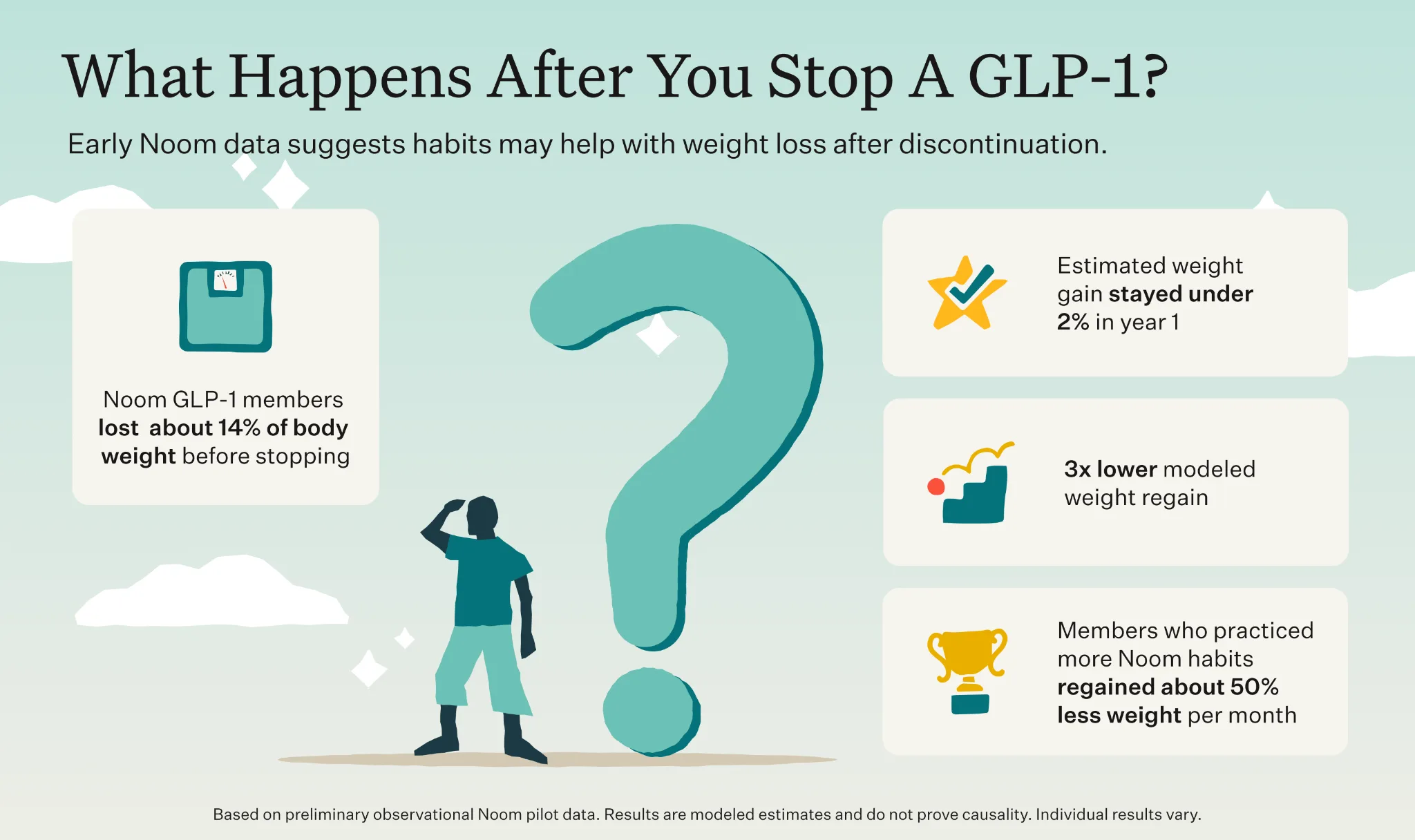
- Members lost roughly 14% of their body weight before discontinuation.
- Modeled estimates suggest average weight gain stayed below 2% during the first year after stopping.
- Compared with published post-discontinuation benchmarks, Noom members showed roughly threefold lower modeled weight regain.
- Members who continued practicing more Noom habits regained about 50% less weight per month.
The core idea is simple: GLP-1s can help create the opening. Habits may help make the outcome last.
Three Things We Found
1. Noom members maintained most of their weight loss after stopping
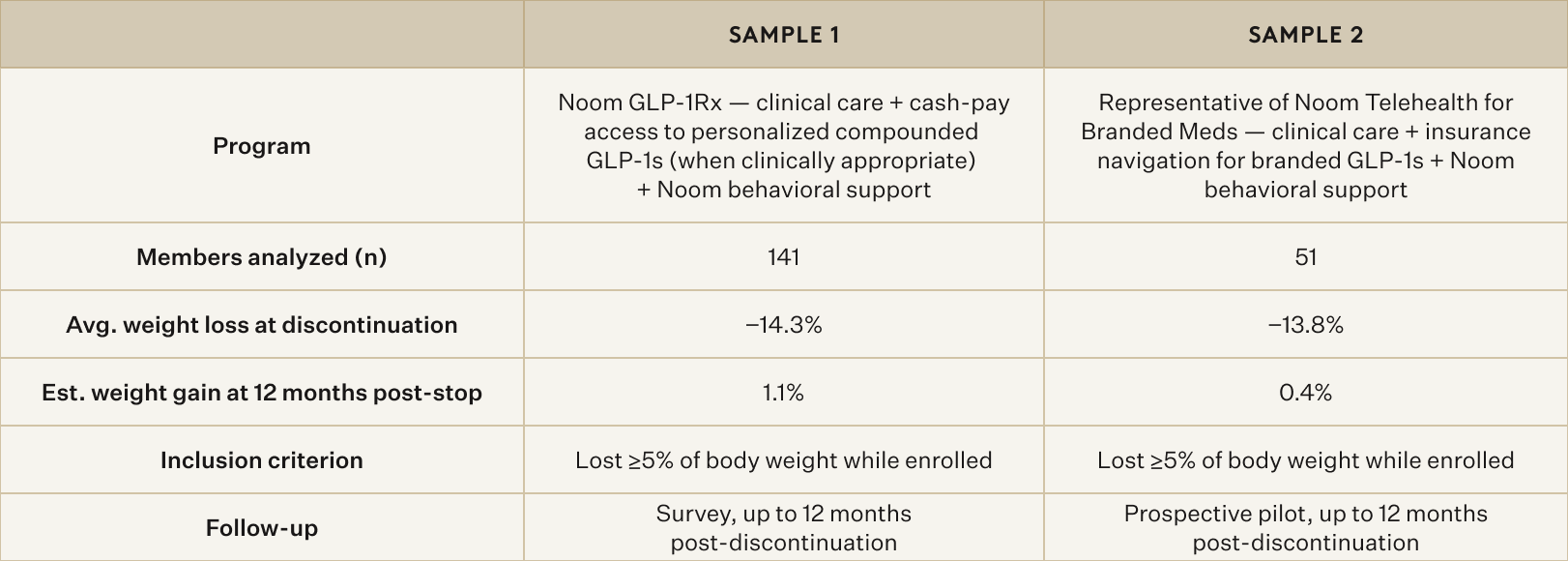
Noom analyzed two pilot samples of members who had used GLP-1-supported Noom programs, lost at least 5% of their body weight, and later stopped medication.
Across both groups, members had lost roughly 14% of their body weight before discontinuation. After stopping, modeled estimates suggest average weight gain remained low: 1.1% body weight at 12 months in one sample and 0.4% in the other. In other words, members were estimated to gain less than 2% of body weight during the first year after stopping, which is less than what is considered clinically meaningful weight change.
Plot 1: How do Noom member’s weights trend after stopping a GLP-1 medication?
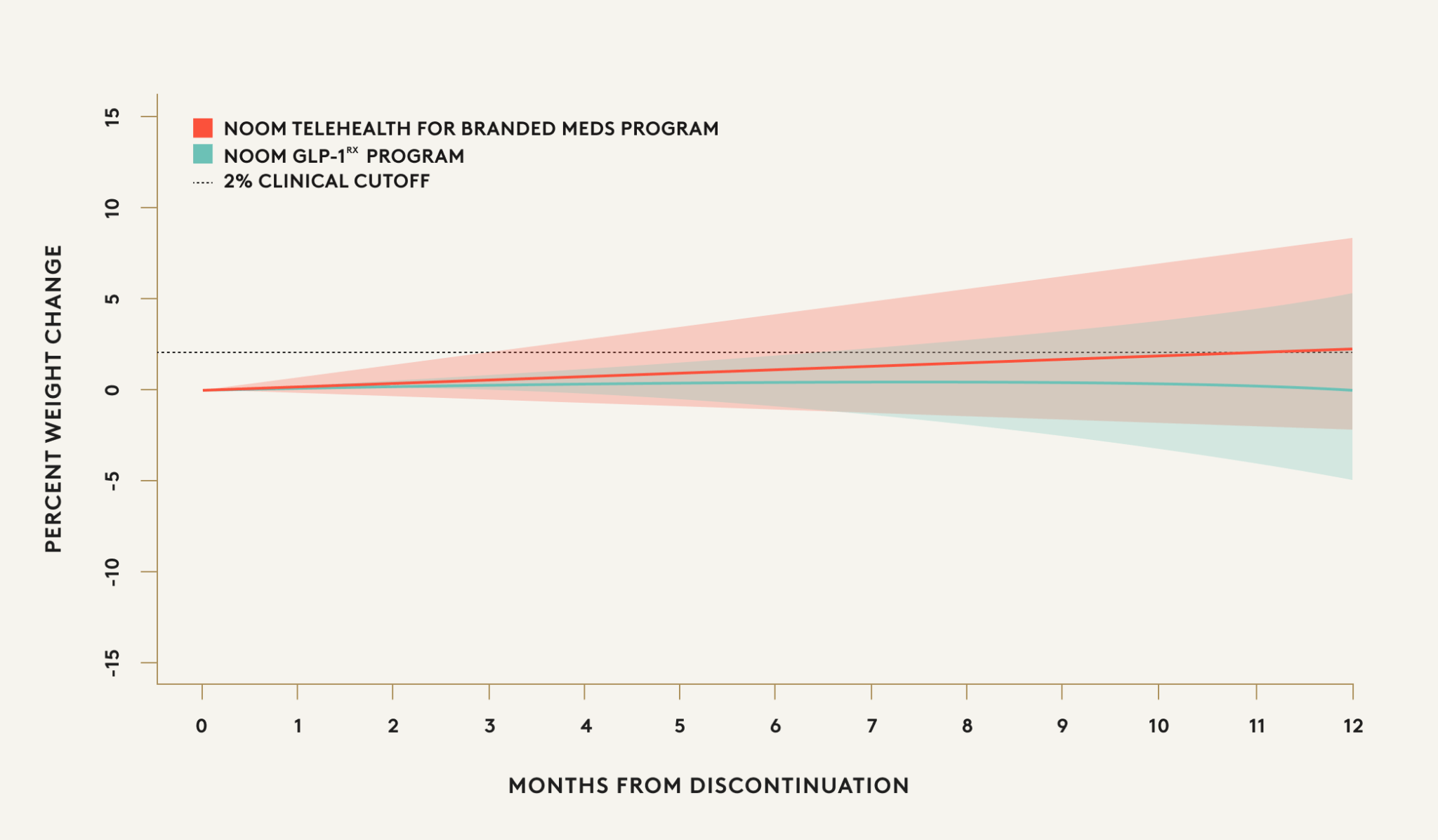
The average user is estimated to gain less than 2% body weight in the first year after stopping a GLP-1.
2. Noom members showed lower regain than published benchmarks
Published research shows that people often regain a meaningful share of the weight they lost after stopping GLP-1 medication.
In Noom’s analysis, members appeared to regain substantially less.
At 6 months after discontinuation, Noom members were estimated to regain just 11.5% of the weight they had lost during treatment, compared with 43% in published post-discontinuation benchmarks.[5]
At 12 months, Noom members were estimated to regain 21.2% of lost weight, compared with 61.4% in published benchmarks.[5]
That translates to approximately threefold lower modeled weight regain among Noom members compared with published post-discontinuation studies.
Plot 2: How does Noom member weight regain compare to standard of care?
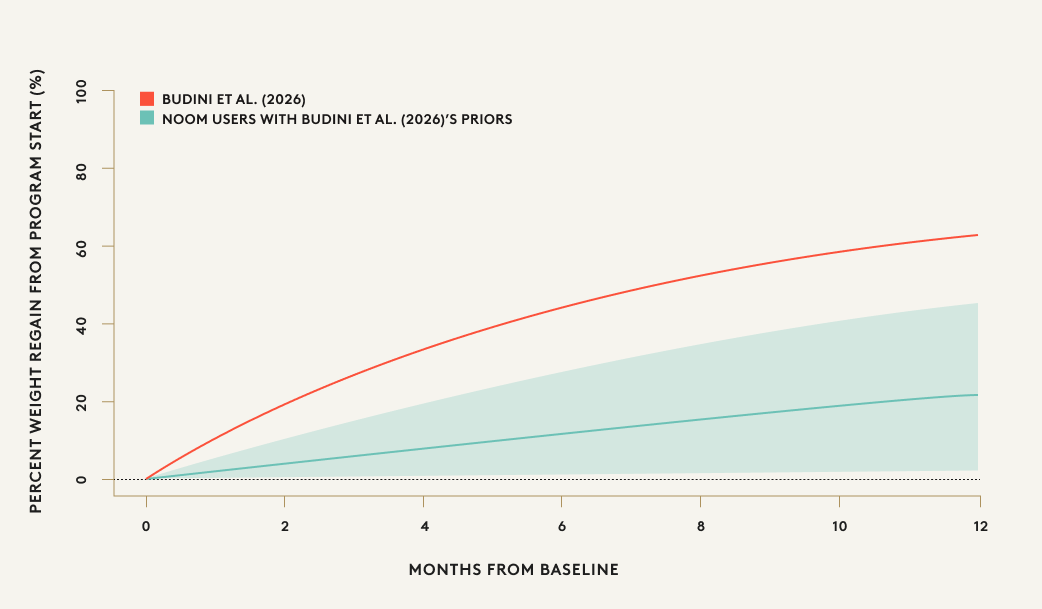
At 12 months after discontinuation, Noom members showed roughly threefold lower modeled regain of lost weight than published post-discontinuation benchmarks.
These comparisons should be interpreted cautiously. The Noom samples were not randomized against the published comparison groups, and the populations, study designs, medication types, treatment duration, and behavioral support may differ. Still, the size and consistency of the difference suggest that behavioral support may be an important factor in post-GLP-1 weight maintenance.
3. Habits were associated with better weight maintenance
The strongest signal in the data was not just that members maintained weight loss; it was that habits — and the persistence of those habits — appeared to matter.
Noom GLP-1Rx members who continued practicing more habits after stopping medication regained weight more slowly — about 50% less per month than members who practiced fewer habits.
Compared with semaglutide users in a randomized controlled trial (STEP 10) who lost a similar share of weight while on medication, Noom GLP-1Rx members — particularly those with high habit persistence — showed better weight maintenance six months after stopping.[9] Members who were highly engaged with the Noom app during the program were also 2.4x more likely than less-engaged members to report still using Noom habits after discontinuation (Noom internal data, 2026).
Plot 3. Does habit persistence after stopping a GLP-1 medication matter for weight loss maintenance success and how does that compare to a published Wegovy trial?
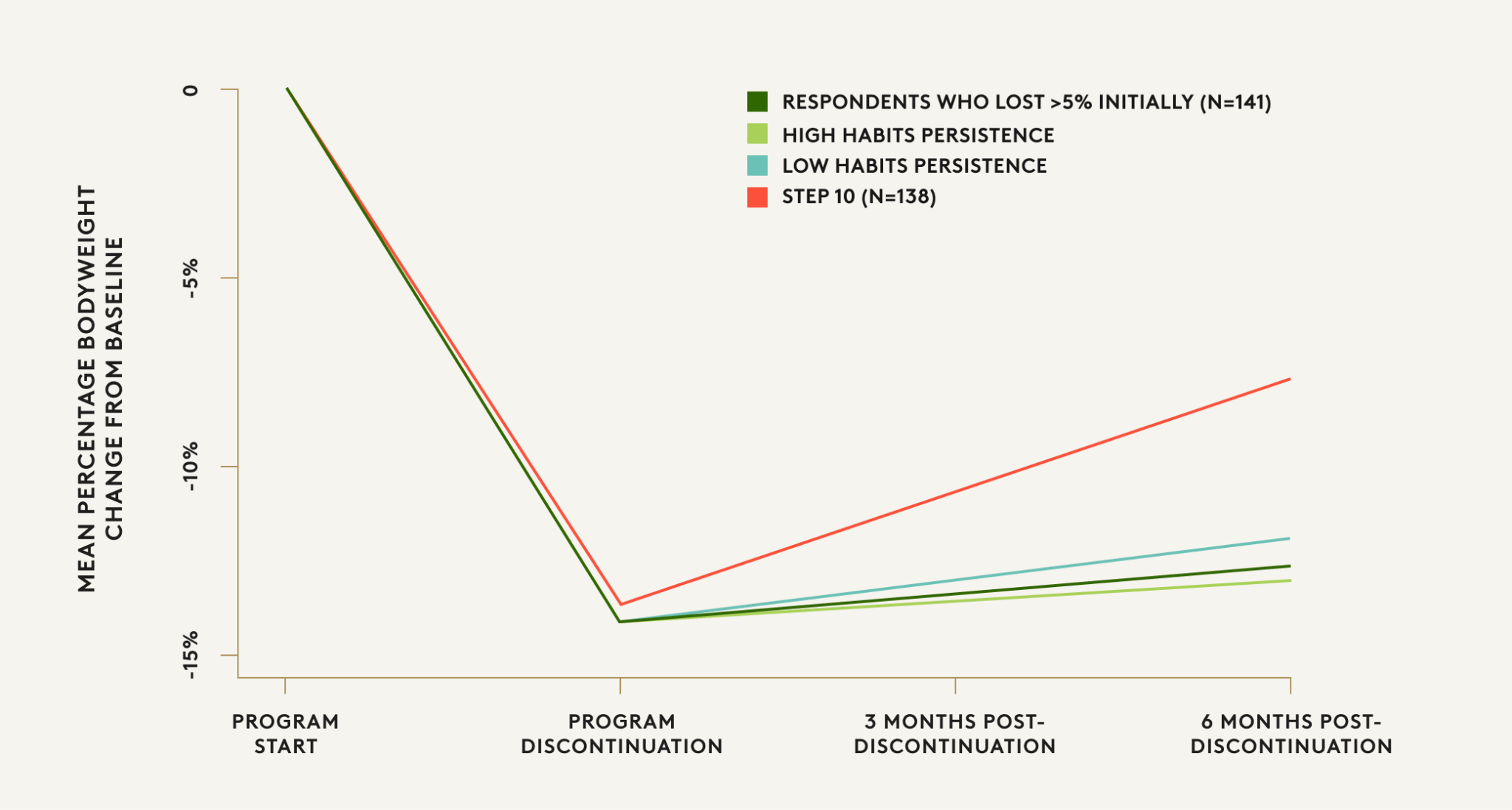
Note. This figure shows the percentage of weight lost from program start to discontinuation as well as the percentage of weight regained 3 and 6 months post-discontinuation for all respondents included in these analyses (n = 141) and for the subsets that reported high habit persistence (75th percentile) and low habit persistence (25th percentile). The red lines correspond to former Noom GLP-1Rx users. The blue line refers to participants enrolled in the STEP 10 RCT of semaglutide.
This suggests that what people do after discontinuation matters — and what skills they build while medication is working may help shape what happens next.
Noom’s program is designed to help members build skills that last beyond medication use, including self-monitoring, healthier eating patterns, physical activity routines, stress management, and strategies for navigating cravings, setbacks, and everyday decision-making.
Putting it all together: three different analyses point to the same core insight. Noom users maintained weight loss after discontinuing Noom’s GLP-1-plus-habits programs and showed about 3x better weight maintenance than published studies of weight regain — and those who persisted with more habits had the most durable results.
Bottom Line
Stopping a GLP-1 does not have to mean giving up on long-term results. For many people, long-term treatment may be appropriate, and medication decisions should always be made with a qualified healthcare provider. But the bigger lesson is this: don’t wait until you stop medication to start thinking about maintenance.
GLP-1s can create a powerful window when it may be easier to build routines around food, movement, sleep, stress, and self-monitoring. Noom’s data suggest that members who built and continued practicing healthy habits maintained more of their weight loss after discontinuation and had substantially lower modeled regain than published benchmarks.
GLP-1s can help create the opening. Habits may help make the outcome last.
How to interpret this data
These findings are observational. They are based on two smaller-sample analyses of Noom members, not a randomized controlled trial. Some outcomes were self-reported, and the 6- and 12-month results include modeled estimates. Comparisons with published benchmarks are informative but not the same as a head-to-head control group.
The results should be read as early evidence that habit support may be associated with stronger weight maintenance after GLP-1 discontinuation — not proof that Noom caused the difference.
Data and Methodology
Results reported here are preliminary. Analyses were conducted in April 2026 and include data from 141 Noom GLP-1Rx Program members who started a GLP-1Rx plan in November–December 2025 (Sample 1) and 51 Noom GLP-1Rx Program members who started between November 2024 and June 2025 (Sample 2) and responded to a follow-up survey after discontinuation.
Sample 1: 2,070 former Noom GLP-1Rx Program members were contacted, 169 responded, resulting in a response rate of 15%. Analyses were conducted on eligible users who lost at least 5% total body weight while enrolled in Noom (n = 141).
Sample 2: A prospective study of 3,204 Noom GLP-1Rx Program members, of which, a subset of 51 participants opted into a pilot study to monitor weight loss post-discontinuation.
The small sample sizes and high attrition rates (dropping from 51 in month 3 to 24 by month 6 in sample 2) make the results of longitudinal trajectory analyses exploratory as statistical power to detect effects is limited.
Weight loss was estimated in GLP-1Rx Program members (Sample 2) by using a Bayesian analysis with priors informed from Sample 1 results.
Comparison to standard of care programs was estimated by using a Bayesian analysis for Sample 2 with priors informed from Budini et al. 2026 results.
Results are modeled estimates – 95% Bayesian credible intervals apply to Plot 1 and Plot 2; true values may vary. See full methodology in our whitepaper for details.
About the analysis
These findings reflect observational analyses and report predicted weight change after GLP-1 discontinuation among members in these samples only. Results are preliminary and subject to change. Individual results vary. GLP-1 medications should be used under the guidance of a qualified healthcare provider.
References
1. KFF Health Tracking Poll, May 2024: The Public’s Use and Views of GLP-1 Drugs. https://www.kff.org/health-costs/kff-health-tracking-poll-may-2024-the-publics-use-and-views-of-glp-1-drugs/
2. Prime Therapeutics, GLP-1 Therapy to Treat Obesity Among Members Without Diabetes: Three-Year Persistence, 2024. https://www.primetherapeutics.com/documents/d/primetherapeutics/prime-therapeutics_glp-1-therapy-to-treat-obesity-among-members-without-diabetes_three-year-persistence
3. Blue Health Intelligence, Real-World Trends in GLP-1 Treatment Persistence and Discontinuation, 2024. https://www.bcbs.com/media/pdf/BHI_Issue_Brief_GLP1_Trends.pdf
4. Wilding JPH, et al. Weight regain and cardiometabolic effects after withdrawal of semaglutide: The STEP 1 trial extension. Diabetes Obes Metab, 2022. https://dom-pubs.onlinelibrary.wiley.com/doi/full/10.1111/dom.14725
5. Budini B, et al. Trajectory of weight regain after cessation of GLP-1 receptor agonists: a systematic review and nonlinear meta-regression. eClinicalMedicine, 2026. https://www.thelancet.com/journals/eclinm/article/PIIS2589-5370(26)00043-X/fulltext
6. Metabolic rebound after GLP-1 receptor agonist discontinuation: a systematic review and meta-analysis. eClinicalMedicine, 2025. https://www.thelancet.com/journals/eclinm/article/PIIS2589-5370(25)00614-5/fulltext
7. Lundgren JR, et al. Healthy Weight Loss Maintenance with Exercise, Liraglutide, or Both Combined. N Engl J Med, 2021. https://www.nejm.org/doi/full/10.1056/NEJMoa2028198
8. Wadden TA, et al. Effect of Subcutaneous Semaglutide vs Placebo as an Adjunct to Intensive Behavioral Therapy on Body Weight (STEP 3). JAMA, 2021. https://jamanetwork.com/journals/jama/fullarticle/2777025
9. McGowan BM, et al. Once-weekly semaglutide 2.4 mg vs placebo in people with obesity and prediabetes (STEP 10). Lancet Diabetes Endocrinol, 2024. https://www.thelancet.com/article/S2213-8587(24)00182-7/abstract
Editorial standards
At Noom, we’re committed to providing health information that’s grounded in reliable science and expert review. Our content is created with the support of qualified professionals and based on well-established research from trusted medical and scientific organizations. Learn more about the experts behind our content on our Health Expert Team page.