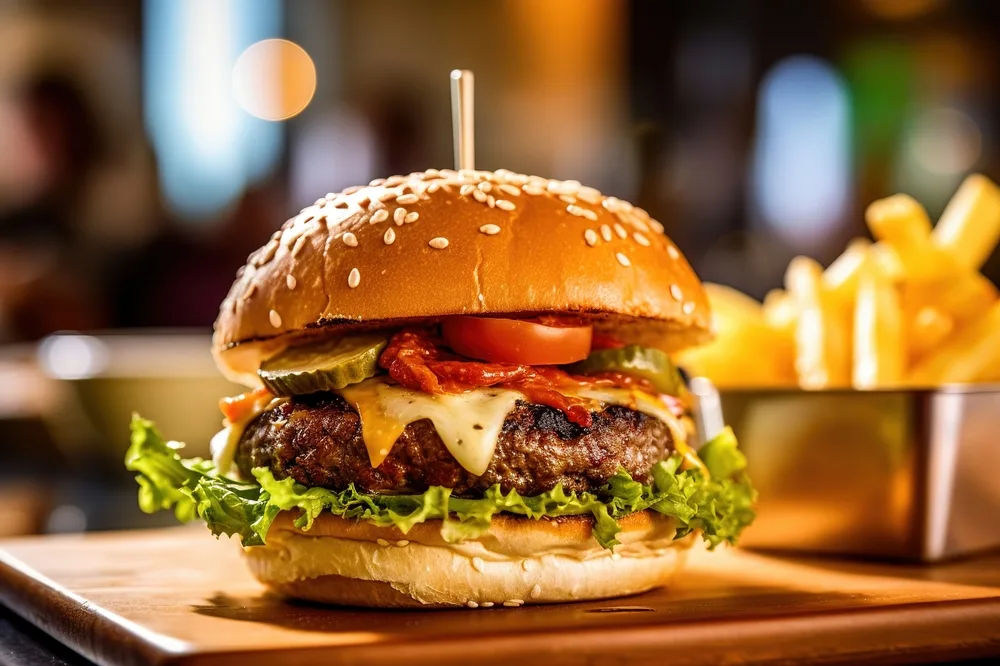
Few foods are as universally enjoyed as a hamburger. Whether it’s a backyard cookout, a quick drive-through, or a sit-down burger joint, this is a meal most people don’t want to give up when they’re trying to lose weight. The good news: you don’t have to.
A burger is really just a format. The patty can be beef, chicken, turkey, salmon, bison, black beans, or a plant-based blend. The bun can be white, whole grain, or skipped entirely. Condiments can add almost nothing or a few hundred calories. The nutritional range of what a “burger” actually is enormous—and that gives you a lot of control. Whether a burger works for your goals comes down almost entirely to how you build it.
✅ Quick answer
It depends—and mostly on how you build it. A burger made with a lean patty, a skipped or swapped bun, and simple condiments can be a solid weight loss meal. A beef burger with a refined-flour bun, cheese, and special sauce is more calorie-dense and may be harder to fit into a diet plan regularly. Red meat specifically is best eaten in moderation—most guidelines suggest 1 to 3 times per week—but the burger format itself is flexible enough to work for almost any approach to eating.
🚀 Weight-loss benefits
- Burgers are high in protein – Whatever protein you choose for your patty, burgers tend to be a strong protein source. Protein is especially important when you’re losing weight because it helps preserve lean muscle mass during a calorie deficit, takes more energy to digest than carbs or fat, and keeps you fuller between meals.
- Burgers are easily customizable – Few meals are as easy to modify as a burger. Swap the beef for turkey or black beans, ditch the bun, use mustard instead of mayo—and you’ve gone from a calorie-dense fast-food meal to a high-protein, lower-calorie option without giving up the format. That flexibility is useful for sustainable weight loss.
- Burgers are rich in key micronutrients – Beef is one of the best dietary sources of iron, zinc, and vitamin B12. These nutrients support energy levels, immune function, and metabolism—all of which matter when you’re staying active during weight loss. Salmon burgers add omega-3 fats, and bean-based patties bring fiber and plant protein.
⚠️ Things to be mindful of:
- The bun matters – A standard refined-flour hamburger bun adds around 120 to 150 calories and 24 to 30g of refined carbohydrates that digest quickly and don’t contribute much fiber or lasting fullness. It’s often the biggest single variable between a burger that fits into your day and one that doesn’t.
- Red meat frequency matters – Beef and bison are nutritious, but most dietary guidelines suggest limiting red meat to a couple of times a week. Rotating in chicken, turkey, fish, or plant-based patties on other days is a practical way to enjoy burgers more often.
- Fast-food sodium adds up – Fast-food burgers also tend to be much higher in sodium because salt is added at multiple stages—to season the meat, preserve ingredients, flavor sauces, and enhance processed toppings like cheese and pickles. Having these foods occasionally is completely fine, but making burgers at home gives you more control over how much sodium ends up in the meal.
🥗 Nutrients in a hamburger (beef, per burger: 4 oz patty + standard white bun, 170g)
| Nutrient | Amount | % RDA* |
|---|---|---|
| Calories | 430 calories | 21.5% |
| Protein | 25 g | 50.0% |
| Total carbs | 36 g | 13.1% |
| Fiber | 1.5 g | 5.4% |
| Sugars | 6 g | — |
| Total fat | 19 g | 24.4% |
| – Saturated fat | 7 g | 35.0% |
| – Monounsaturated fat | 8 g | — |
| – Polyunsaturated fat | 2 g | — |
| Omega-3 | 0.1 g | — |
| Omega-6 | 1.7 g | — |
*Recommended dietary allowance (RDA) is defined as the average daily amount of nutrients needed to meet the requirements of nearly all healthy people in a specific group.
At 430 calories, a basic hamburger can fit into a balanced diet—but the details matter. A big portion of those calories comes from the bun and higher-fat beef. High-fat toppings, sauces, fries, and drinks can quickly push the meal much higher.
New from Noom
Microdose GLP-1Rx Plus
An affordable way to start your GLP-1 journey with Compounded Tirzepatide.

*Initial 3 week subscription and 4 weeks of medication from $99 plus tax and $199 per month plus tax for 12 week subscription thereafter. Final pricing depends on program selection. Noom GLP-1Rx Plus Microdose Program involves medication (when appropriate), healthy diet, exercise and support. Individual results vary. Meds & personalization based on need as determined by a third-party clinician. Medications are not reviewed by FDA for safety, efficacy, or quality. No affiliation with Eli Lilly and Company, the only US source of FDA-approved tirzepatide. Not available in all 50 US states.
One standout here is the protein. With 25 grams per burger, it’s a filling option that can help support satiety and muscle maintenance during weight loss. On the other hand, the burger is relatively low in fiber, especially on a white bun, which means it may not keep you full as long as a meal that includes more vegetables or whole grains.
The fat content also depends heavily on the type of meat used. An 80/20 beef patty contains more saturated fat, while leaner beef, turkey, or even plant-based patties can significantly change the nutrition profile. That’s an important reminder with burgers in general: the overall health impact often comes down less to the “burger” itself and more to how it’s built.
💊 Vitamins & minerals in a hamburger (per beef burger: 4 oz patty + standard white bun, ~170g)
| Vitamin/Mineral | Amount | % RDA |
|---|---|---|
| Vitamin B12 | 2.7 µg | 112.5% |
| Selenium | 34 µg | 61.8% |
| Zinc | 5.8 mg | 52.7% |
| Niacin (B3) | 7.8 mg | 48.8% |
| Riboflavin (B2) | 0.38 mg | 29.2% |
| Iron | 3.9 mg | 21.7% |
| Sodium | 480 mg | 20.9% |
| Vitamin B6 | 0.32 mg | 18.8% |
| Phosphorus | 230 mg | 18.4% |
| Folate | 60 µg | 15.0% |
| Potassium | 400 mg | 8.5% |
| Magnesium | 36 mg | 8.6% |
| Calcium | 80 mg | 6.2% |
| Vitamin A | 19 µg | 2.1% |
| Vitamin C | 0.8 mg | 0.9% |
A hamburger brings more to the table nutritionally than many people expect. Beef is naturally rich in vitamin B12, and one burger provides more than a full day’s worth—an important nutrient for nerve function, red blood cell production, and energy metabolism. It’s also a strong source of selenium, zinc, iron, and niacin, all of which play roles in immune health, metabolism, and overall body function.
The iron in beef is especially well absorbed compared to plant-based iron, which can help support healthy energy levels. And the bun contributes nutrients too. Most standard white buns are enriched or fortified, meaning they contain added B vitamins and iron that help boost nutrients like folate, niacin, and riboflavin. But enrichment doesn’t replace the fiber lost during processing. White buns are typically low in fiber, which means they digest more quickly and may not keep you full as long as whole-grain versions.
At the same time, the overall nutrition profile depends heavily on how the burger is built. Leaner beef lowers saturated fat, while options like salmon burgers add omega-3 fats, and black bean burgers bring more fiber and folate.
Toppings and preparation matter too. Adding fresh vegetables like lettuce, tomato, and onion can boost fiber, vitamins, and overall volume without adding many calories. On the other hand, piling on lots of cheese, creamy sauces, and heavily sautéed toppings can push the meal into less balanced territory by increasing saturated fat, sodium, and overall calorie density.
🥩 Does beef fat percentage matter for weight loss?
Yes, significantly. The lean-to-fat ratio of your beef patty is one of the biggest levers you can pull when making a burger work for weight loss. Ground beef is sold in ratios like 80/20 (80% lean, 20% fat) or 90/10 (90% lean, 10% fat), and that percentage directly affects the calorie count of every patty you cook.
The difference between an 80/20 and a 90/10 patty isn’t just about fat—it’s about nearly 100 calories per burger. That gap adds up if burgers are a regular part of your week. Both ratios deliver essentially the same amount of protein, so choosing the leaner option is a straightforward way to reduce calories without sacrificing nutrition.
| Beef ratio | Calories | Protein | Fat | Saturated fat |
|---|---|---|---|---|
| 70/30 (regular) | 340 | 19 g | 28 g | 11 g |
| 80/20 (chuck) | 290 | 22 g | 22 g | 9 g |
| 85/15 (choice) | 240 | 25 g | 15 g | 6 g |
| 90/10 (lean) | 195 | 26 g | 10 g | 4 g |
| 95/5 (extra lean) | 155 | 24 g | 6 g | 2.5 g |
Per 4 oz cooked patty, no bun.
The 80/20 ratio is the most common in restaurants and grocery stores—it produces a juicier patty because of the higher fat content. For weight loss, 90/10 is the smarter default. You save nearly 100 calories per patty with almost identical protein, and you cut saturated fat by more than half compared to 80/20. The 95/5 option trims calories even further, though the patties can dry out more easily during cooking.

The Easy Way
to lose weight and get healthy.
See if you qualify

💡 Tip: If you can’t find 90/10 at your local store, 85/15 is a widely available middle ground that saves around 50 calories versus 80/20 while staying noticeably juicier than extra-lean options.
🔍 Nutrient breakdown
Glycemic index (GI) of a hamburger
Glycemic index: High (white bun) / Zero (beef patty)
💡 Tip: The white bun is what drives the blood sugar spike—the patty itself has essentially no glycemic impact. Removing the bun or swapping it for a whole-grain option significantly lowers the meal’s overall glycemic load, which can help keep blood sugar steadier and reduce post-meal cravings.
Is a hamburger high in protein?
✔️ Yes – a beef burger contains around 25g of protein per serving (4 oz patty + bun), covering half your daily value. Turkey and chicken patties come in even higher.
High-protein patty options: Turkey | Chicken | 90/10 lean beef | Bison
Is a hamburger high in fiber?
❌ Not usually – a standard beef burger on a white bun has just 1.5g of fiber. Bean-based and lentil patties are the exception, often providing 4–6g of fiber per patty.
💡 Tip: Swap the white bun for a whole-grain option to add 2–3g of fiber, or skip the bun and add a side salad to make up the difference.
Is a hamburger low in carbs?
❌ Not with a bun – a standard build has around 36g of carbs, almost entirely from the bun. Go bunless or lettuce-wrapped and the carb count drops to under 5g, making it suitable for low-carb eating.
💡 Tip: The patty itself—beef, chicken, turkey, fish, or bison—contributes almost zero carbs. The bun is the only meaningful carb source in a basic burger, which makes it easy to control.
Is a hamburger gluten-free?
❌ Not with a standard bun – white and whole-grain buns are wheat-based. Gluten-free buns are widely available at grocery stores, and a lettuce wrap is always a naturally gluten-free option. Some fast-food beef patties also contain fillers, so it’s worth checking at restaurant chains.
Is a hamburger good for fat loss?
✔️ Yes, depending on how you build it – a lean patty (turkey, chicken, 90/10 beef, bison, or a veggie option) with a bunless or whole-grain bun and low-calorie condiments can fit comfortably into a calorie deficit. A standard fast-food beef burger on a white bun with sauce is more calorie-dense, but even that can work occasionally if the rest of your day is balanced.
🍽️ Diet compatibility: Which diets include a hamburger?
| Diet | ✅/❌ | Why |
|---|---|---|
| Keto | ✅/❌ | The patty is keto-friendly regardless of protein type; it’s only the bun that’s a problem. Go bunless, and a beef, turkey, or salmon burger fits easily. |
| Paleo | ✅/❌ | A grass-fed beef or bison patty wrapped in lettuce with whole-food toppings works well for paleo. The standard white bun and processed condiments don’t. |
| Mediterranean | ✅ | A grilled fish burger (salmon, tuna, cod) or chicken burger on a whole-grain bun with olive oil, tomato, and greens fits the Mediterranean pattern well. Beef is fine occasionally. |
| Vegan | ✅/❌ | Bean, lentil, and many plant-based patties are fully vegan. Standard beef, turkey, chicken, and fish patties are not. |
| Gluten-free | ✅/❌ | Any patty type works; just swap the bun for a gluten-free version or a lettuce wrap, and verify patty ingredients at restaurant chains. |
The burger format is one of the more diet-adaptable meals out there once you separate the patty from the bun. A Mediterranean-style salmon burger on a whole-grain bun with greens and tzatziki is a very different nutritional proposition than a fast-food double cheeseburger—even though both are technically “a burger.” Most dietary patterns can accommodate a burger in some form; the question is which patty and which bun.
🌟 Is a hamburger healthy? What are the health benefits?
Metabolic health: Is a hamburger good for your metabolism?
- Boosts metabolism? ✔️ Partially – Burgers can help slightly here because protein takes more energy for your body to digest than carbs or fat. That’s known as the thermic effect of food. It’s not a dramatic metabolism “hack,” but higher-protein meals—whether made with beef, turkey, chicken, or beans—may help your body burn a few more calories during digestion while also helping with fullness.
- Improves insulin sensitivity? ⚠️ Depends on the bun – The patty itself has minimal impact on blood sugar, but a white-flour bun causes a rapid insulin spike. Choosing a whole-grain bun or skipping it makes a real difference over time.
- Effect on fat storage? Mixed – Excess calories from any source contribute to fat storage. The main concern with a high-fat beef patty on a refined-carb bun is that the combination is easy to overeat without feeling proportionally full.
Cholesterol impact: Does a hamburger affect cholesterol levels?
- Does it lower LDL (bad) cholesterol? ❌ No – Beef, especially higher-fat cuts, can raise LDL cholesterol in some people due to its saturated fat content. Leaner patties—turkey, chicken, fish, or extra-lean beef—have a more neutral effect.
- Does it raise HDL (good) cholesterol? ❔ Limited evidence – Some research suggests certain saturated fats can raise HDL, but the overall effect of a full fast-food burger on lipid profiles is generally neutral to mildly negative.
- Overall impact on heart health? Depends on the build – A grilled salmon or turkey burger on a whole-grain bun is genuinely heart-healthy. A daily fast-food double beef burger with cheese and sauce is not. Where yours lands depends on how it’s built and how often red meat features in the rotation.
💡 Tip: If heart health is a concern, the American Heart Association recommends limiting red meat and choosing fish or poultry more often. A salmon or tuna burger is a solid way to stay in the burger format while getting heart-healthy omega-3s.
Can I eat a hamburger in a calorie deficit?
✔️ Yes: A burger can absolutely fit within a calorie deficit. A bunless turkey or bison patty with mustard and vegetables might come in under 250 calories. Even a standard 80/20 beef burger on a white bun at 430 calories is manageable within a 1,500–2,000-calorie day as long as the rest of your meals are balanced.
💡 Tip: The most calorie-efficient build is a lean patty (90/10 beef, turkey, or chicken), bunless or lettuce-wrapped, with mustard or hot sauce. You keep all the protein and satisfaction, and cut roughly 200–250 calories compared to a full bun-and-sauce build.
Is a hamburger rich in antioxidants?
❌ Not significantly – Beef and poultry patties are low in plant-based antioxidants. Zinc and selenium in beef have antioxidant functions, but a burger won’t replace the phytonutrients you’d get from colorful vegetables and fruits. Bean or lentil patties offer a modest improvement here.
Does a hamburger support gut health?
⚠️ Depends on the patty – A standard beef burger on a white bun offers very little fiber and doesn’t meaningfully support gut bacteria. A black bean or lentil patty on a whole-grain bun, by contrast, can provide 6–8g of fiber, actively feeding your gut microbiome. This is one of the strongest arguments for rotating plant-based patties into your burger rotation.
Does a hamburger support digestion?
Mixed – The high fat content in beef burgers slows gastric emptying, which contributes to satiety but can cause heaviness or bloating in some people. Leaner patties (chicken, turkey, fish) tend to be easier to digest. Those with acid reflux or IBS may find greasy fast-food builds more aggravating than homemade, leaner versions.
Does a hamburger help you feel satiated and less hungry?
✔️ Yes, moderately – The protein and fat in any burger patty provides stronger satiety than a carb-heavy meal of the same calories. Adding vegetables or a side salad significantly improves this further.
Access GLP-1 Weight Loss with Noom
Explore a wide range of prescription medications supported by Noom’s program.Microdose GLP-1rx
Noom GLP-1rx
Noom GLP-1rx Plus
Wegovy®

Ozempic®

Metformin

Zepbound®
Mounjaro®
Liraglutide

Satiety level: Moderate
💡 Tip: Adding lettuce and tomato, choosing a whole grain bun, or pairing the burger with a salad instead of fries can help create a more balanced and satisfying meal.
Does a hamburger help with nighttime cravings?
⚠️ Depends – A lean, homemade burger earlier in the day can be satisfying without triggering later cravings. Fast-food burgers with high sodium content can increase thirst and spark cravings for sweet drinks or snacks later in the evening.
Does a hamburger help reduce inflammation?
Mixed – Processed fast-food beef burgers and refined buns are generally considered pro-inflammatory when eaten frequently. On the other end of the spectrum, a salmon burger with a whole-grain bun and vegetable toppings is actively anti-inflammatory, thanks to the omega-3 fatty acids in the fish.
Is a hamburger beneficial for brain health?
✔️ Yes – Beef burgers are a standout source of vitamin B12 and iron, both imporant for cognitive function and preventing mental fatigue. Salmon burgers add DHA and EPA omega-3 fats, which are directly linked to brain health. Both are strong options here.
Can a hamburger improve skin and hair health?
✔️ Yes – Zinc and protein in beef and poultry patties support collagen production and keratin synthesis—the building blocks of healthy skin, hair, and nails. These benefits apply across most patty types, as long as you’re eating enough protein overall.
Can a hamburger help balance hormones?
✔️ Within moderation – Cholesterol and fat are precursors for hormones including testosterone and estrogen, and a moderate intake of dietary fat—including from beef—supports hormonal health. That said, healthy fats from fish, avocado, and olive oil support hormone production just as effectively. Rotating your burger protein across the week covers more nutritional bases than sticking to one option.
💡 Tip: Varying your burger protein across the week—beef once or twice, fish, chicken, or a bean patty on other days—gives you a broader range of nutrients while keeping red meat within a reasonable frequency.
🍽️ Best ways to eat a hamburger for weight loss
- Rotate your patty – The single most impactful change you can make is broadening what goes in your burger. A beef burger two or three times a week is reasonable; filling in the rest with turkey, chicken, salmon, or a black bean patty gives you more variety, more fiber (with bean options), and less saturated fat without giving up the burger experience.
- Rethink the bun – Choosing a whole-grain option adds fiber and has a lower glycemic index than white bread, which helps keep blood sugar more stable. Going bunless or lettuce-wrapped saves 120 to 150 calories but it might not be as filling unless you add a salad on the side.
- Go easy on creamy condiments and special sauces – Mayo-based sauces and aiolis can add calories quickly, often with more saturated fat and sodium than people realize. Ketchup tends to be much lighter calorie-wise, while options like mustard, salsa, hot sauce, or a spoonful of tzatziki can add plenty of flavor without dramatically changing the nutrition profile of the meal.
National Hamburger Day is May 28. Try these healthy burger recipes:
- Mediterranean Turkey Burgers with Feta and Tzatziki – The Mediterranean Dish (Greek-inspired, high-protein, served with tzatziki instead of ketchup)
- Mediterranean Salmon Burgers – The Mediterranean Dish (fresh salmon patties with herbs and lemon—great bunless over a salad)
- Easy Black Bean Burgers – Love & Lemons (smoky, fiber-rich, comes together in one bowl in under 30 minutes)
🍏 Best burger alternatives & comparisons (per burger with 4 oz patty + standard white bun)
| Food | Calories | Carbs | Protein | Fat |
|---|---|---|---|---|
| Hamburger (80/20 beef) | 430 | 36 g | 25 g | 19 g |
| Hamburger (90/10 beef) | 365 | 36 g | 27 g | 11 g |
| Chicken burger (95/5 lean ground chicken breast) | 320 | 34 g | 30 g | 7 g |
| Turkey burger (93/7 lean ground turkey) | 340 | 34 g | 29 g | 9 g |
| Salmon burger | 365 | 30 g | 25 g | 16 g |
| Bison burger | 295 | 34 g | 24 g | 5 g |
| Black bean burger | 320 | 46 g | 14 g | 6 g |
| Beyond Burger (plant-based) | 385 | 40 g | 23 g | 17 g |
All values include one standard white bun (~57g) plus a 4 oz cooked patty.
The type of patty you choose can shift the balance of protein, fat, fiber, and calories quite a bit. The traditional 80/20 beef burger is one of the richer, higher-fat options, while a 90/10 beef blend cuts down significantly on saturated fat and calories while still providing plenty of protein.
Chicken and turkey burgers are often viewed as automatically “healthier,” but the nutrition depends heavily on the cut of meat used. Lean ground chicken breast or 93/7 turkey can be high in protein with relatively moderate fat, while darker meat blends or restaurant-style patties may be much richer.
Bison is one of the leanest red meat options on the list, while salmon burgers stand out for their omega-3 fats. Black bean burgers bring something many meat-based burgers lack: meaningful fiber. And plant-based burgers like the Beyond Burger can offer solid protein, though they’re often similar to beef burgers in calories and sodium.
Rather than thinking about one burger as the “best,” it can be more helpful to look at what each option contributes nutritionally. Rotating different protein sources throughout the week can help add more variety in nutrients, fats, and fiber.
Frequently asked questions about hamburgers and weight loss
How many calories are in a standard hamburger?
A burger made with a 4-ounce 80/20 beef patty and a standard white bun contains around 430 calories before any toppings. Adding cheese adds roughly 50–70 calories, and a tablespoon of mayo adds another 90–100. Fast-food versions like a McDonald’s hamburger come in lower (around 250 calories) because they use a smaller patty, while a Whopper or Big Mac ranges from 550–670 calories.
Can I eat a hamburger every day and still lose weight?
Yes, if you’re staying within your calorie target, the specific food doesn’t determine whether you lose weight. Nutritionally it’s best not to eat red meat every day. Rotating in a chicken, turkey, fish, or bean burger on other days is a practical way to have the burger experience regularly without overdoing red meat or calories.
How often should I eat red meat if I’m trying to lose weight?
Most major health organizations, including the American Heart Association and the World Cancer Research Fund, suggest limiting red meat (beef, bison, lamb, pork) to around 1 to 3 servings per week. Fll in the rest with chicken, turkey, fish, or plant-based patties.
What’s the best way to order a burger at a fast-food restaurant?
Order it bunless or lettuce-wrapped, skip the mayo and special sauce, go for mustard or salsa instead, and choose the smallest patty size available. Pair it with a side salad rather than fries. These changes alone can cut 300–400 calories from the meal.
Does beef fat percentage really make a difference?
Yes—more than most people expect. Swapping from an 80/20 patty to a 90/10 saves around 95 calories per burger with virtually the same protein content. Over a week of regular burger eating, that’s a meaningful difference.
Is a veggie or bean burger better for weight loss than a beef burger?
It depends on what you’re optimizing for. Bean and lentil burgers are lower in calories than 80/20 beef and significantly higher in fiber—which supports gut health and steadier blood sugar. They’re lower in protein, though, so if protein is your priority, turkey or chicken edges them out. For most people, rotating both into the week covers more nutritional ground than sticking to one.
Is a homemade burger better for weight loss than a fast-food one?
Often, yes—but it depends on how each burger is made. Homemade burgers give you more control over portions, cooking methods, toppings, and ingredients like sodium, sauces, and fat percentage. That can make it easier to build a burger that feels satisfying without becoming overly calorie-dense.
That said, not all fast-food burgers are automatically “worse,” and not all homemade burgers are light. Some fast-food chains now offer smaller burgers or simpler ingredient lists, while restaurant-style homemade burgers loaded with cheese, bacon, and sauces can easily end up just as calorie-heavy. The overall balance of the meal matters more than where the burger comes from.
🧠 The bottom line: Hamburgers can be part of a weight-loss plan
Whether a burger supports your goals depends less on the fact that it’s a burger and more on how it’s built overall. A salmon burger with plenty of vegetables and a lighter sauce has a very different nutrition profile than a double cheeseburger loaded with bacon, creamy sauces, and fries on the side—even though both fall under the same category.
Red meat can still have a place in a balanced diet, especially when portions and frequency feel sustainable for you. Mixing in other options like turkey, chicken, fish, or bean-based burgers throughout the week can add variety in nutrients, fats, and fiber while still keeping the meal satisfying.
The bun and toppings can shift the nutrition profile quite a bit too. Standard white buns are often low in fiber, while whole grain buns or extra vegetables may help make the meal more filling. Condiments, cheese, and sauces can also quietly add sodium, saturated fat, and calories depending on the amounts used.
Ultimately, burgers don’t have to be “off limits” for weight loss. Meals tend to work best when they’re satisfying enough to feel realistic long term—and burgers can absolutely be part of that.
📖 Scientific evidence
- Lean beef is nutrient-dense and fine in moderation. (Meat Science, 2010) A review found that lean, unprocessed red meat is a good source of protein, iron, zinc, and vitamin B12 — nutrients many people don’t get enough of.
- Eating lean beef as part of a high-protein diet worked just as well for weight loss as avoiding red meat entirely. (Obesity Science & Practice, 2017) In a 16-week study of 120 adults, those who ate lean beef at least four times a week lost the same amount of weight and body fat as those who ate no red meat at all — as long as total protein and calories were the same.
- Eating a lot of red and processed meat regularly is linked to a higher risk of colorectal cancer. (PLOS ONE, 2011) A large analysis of prospective studies found that people who ate the most red and processed meat had about a 22% higher risk of colorectal cancer than those who ate the least. The risk was highest with processed meats—another reason to keep portions reasonable and rotate in other proteins throughout the week.
- Swapping some red meat for fish, poultry, or plant proteins is associated with better heart health. (Circulation, 2019) A Harvard-led analysis of 36 trials found that replacing red meat with fish, chicken, or plant proteins like beans and nuts improved cholesterol levels. The takeaway: it’s less about eliminating beef and more about not eating it every day.
Editorial standards
At Noom, we’re committed to providing health information that’s grounded in reliable science and expert review. Our content is created with the support of qualified professionals and based on well-established research from trusted medical and scientific organizations. Learn more about the experts behind our content on our Health Expert Team page.