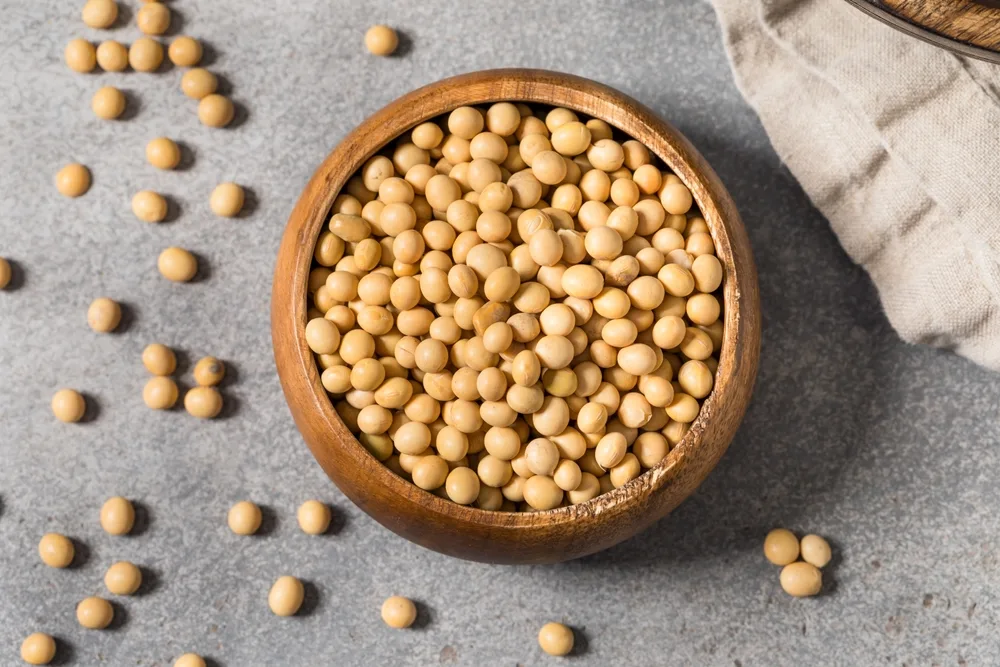
Soybeans are a type of legume, like lentils or chickpeas, that are used in a wide range of foods. You’ll see them in whole form (fresh edamame or dried and cooked), and they also show up as ingredients like tofu, tempeh, miso, and soy milk. These different forms come from processes like soaking, grinding, fermenting, or pressing the beans—each one changing the texture, flavor, and how your body digests them. For this article, we’re focusing on whole soybeans—fresh or cooked—rather than processed or fermented forms.
Nutritionally, soybeans stand out as one of the most protein-rich plant foods available. In their whole form, they deliver a mix of protein, fiber, vitamins, and minerals.
What makes soybeans different from most other beans is their fat content. While many legumes are primarily carbohydrates and protein, soybeans also contain a meaningful amount of healthy fat. That combination can make them more filling and slower to digest. A half-cup serving provides about 14 grams of protein and nearly 8 grams of fat—closer to the macronutrient balance of some animal proteins than typical beans.
From a weight loss standpoint, that mix can work in your favor. Protein is the most filling macronutrient, and soybeans also have a low glycemic index, meaning they digest more slowly and help keep blood sugar levels steady. Here’s how that translates into real benefits when you’re trying to lose weight.
✅ Quick answer
Yes, soybeans can be a great addition to a weight loss plan. Their combination of protein, fiber, and healthy fat makes them satisfying.

The Easy Way
to lose weight and get healthy.
See if you qualify
🚀 Weight-loss benefits
- They’re high in protein – Soybeans provide about 14 grams of protein per half cup, and unlike most plant foods, they’re considered a complete protein—meaning they contain all nine essential amino acids your body needs. Protein tends to be more filling than carbs or fat, and it takes slightly more energy for your body to digest.
- Their low glycemic index supports steady energy – With a glycemic index of around 15 to 20, soybeans lead to a slower, more gradual rise in blood sugar. That can help you avoid the sharp dips in energy that can lead to between-meal snacking.
- They’re high in fiber – Each half-cup serving provides about 5 grams of fiber. Fiber slows digestion, supports gut health, and helps you feel satisfied longer after eating—all of which can make your overall eating pattern feel more manageable.
⚠️ Things to be mindful of:
- Soybeans have more calories than most beans – Because soybeans contain fat, they have more calories per serving than lentils, kidney beans, or black beans.
- Raw or undercooked soybeans may cause digestive issues – Soybeans contain compounds called lectins and phytates that can cause stomach discomfort if the beans aren’t properly prepared. Soaking dried soybeans overnight and cooking them thoroughly takes care of most of this.
- Thyroid medication timing – If you take thyroid medication, large amounts of soy may affect how the medication is absorbed. For most healthy people, eating a varied diet, this isn’t a concern, but it’s worth mentioning to your doctor if you eat a lot of soybeans.
🥗 Nutrients in soybeans (per ½ cup cooked / 86g)
| Nutrient | Amount | % RDA* |
|---|---|---|
| Calories | 149 calories | 7% |
| Protein | 14.3 g | 29% |
| Total carbs | 8.5 g | 3% |
| Fiber | 5.2 g | 18% |
| Sugars | 2.6 g | — |
| Total fat | 7.7 g | 10% |
| – Saturated fat | 1.1 g | 6% |
| – Monounsaturated fat | 1.7 g | — |
| – Polyunsaturated fat | 4.4 g | — |
| Omega-3 | 0.5 g | — |
| Omega-6 | 3.9 g | — |
*Recommended dietary allowance (RDA) is defined as the average daily amount of nutrients needed to meet the requirements of nearly all healthy people in a specific group.
A half cup of cooked soybeans delivers a lot of nutrition for a relatively moderate number of calories.
The standout is the protein. With about 14 grams per serving, soybeans are one of the few plant foods considered a complete protein—meaning they provide all nine essential amino acids your body needs. That’s part of what makes them especially satisfying compared to many other plant-based options.
Carbohydrates are relatively low for a legume, especially once you factor in fiber. With about 5 grams of fiber per serving, the net carbs land closer to 3 grams, which is one reason soybeans can fit into lower-carb eating patterns.
The fat content is higher than most beans, but it’s mostly unsaturated fat, including polyunsaturated fats like omega-6 and a small amount of plant-based omega-3 (ALA). This mix of fat, fiber, and protein slows digestion and helps you feel full longer—something that can make a real difference when you’re trying to stay consistent with your eating habits.
💊 Vitamins & minerals in soybeans (per ½ cup cooked / 86g)
| Vitamin/Mineral | Amount | % RDA* |
|---|---|---|
| Copper | 0.34 mg | 38% |
| Manganese | 0.69 mg | 30% |
| Iron | 4.4 mg | 24% |
| Riboflavin (B2) | 0.26 mg | 20% |
| Phosphorus | 211 mg | 17% |
| Magnesium | 74 mg | 17% |
| Thiamin (B1) | 0.17 mg | 14% |
| Vitamin K | 16.4 mcg | 14% |
| Folate (B9) | 46.5 mcg | 12% |
| Zinc | 1.0 mg | 9% |
| Potassium | 443 mg | 9% |
| Calcium | 88 mg | 7% |
Soybeans bring more to the table than protein—they’re also packed with minerals that support how your body runs day to day.
Copper stands out, with nearly 40% of your daily needs in a half-cup serving. It plays a role in energy production and helps your body use iron effectively. Soybeans are also a solid source of iron, providing about 24% of your daily needs. Since this is plant-based (non-heme) iron, pairing soybeans with vitamin C–rich foods—like tomatoes, bell peppers, or a squeeze of lemon—can help your body absorb more of it.
Magnesium is another one to pay attention to. It supports muscle and nerve function, energy production, and blood sugar regulation—and many people don’t get enough. You’ll also get a boost of B vitamins like riboflavin and thiamin, which help your body convert food into usable energy.
And while soybeans aren’t a major calcium source, they do contribute a meaningful amount—about 7% of your daily needs per serving—which can add up, especially if you’re eating less dairy.
🔍 Nutrient breakdown
Glycemic index (GI) of soybeans
Glycemic index: 15–20 (Low)
💡 Tip: Soybeans have one of the lowest GI scores of any food. That means they digest slowly and cause only a small, gradual rise in blood sugar, which helps keep energy levels even and hunger quieter between meals. Pairing them with a non-starchy vegetable makes the glycemic impact of the whole meal even lower.
Are soybeans high in protein?
✔️ Yes – soybeans contain 14.3 g of protein per half cup.
And, again, they’re a complete protein with all nine essential amino acids are present. That’s rare for a plant food and puts soybeans in the same category as animal proteins for amino acid quality.
Better protein alternatives: Chicken breast | Canned tuna | Firm tofu
Are soybeans high in fiber?
✔️ Yes – soybeans have 5.2 g of fiber per half cup.
💡 Tip: Five grams of fiber per serving is a solid contribution toward the 25 to 28 grams recommended for most people daily. If you’re new to eating soybeans, increase your intake gradually and drink plenty of water. Your gut will adjust over time.
Are soybeans low in carbs?
✔️ Yes – soybeans have 8.5 g of total carbs per half cup, with only about 3 g of net carbs after fiber.
💡 Tip: Most other legumes, like black beans, lentils, and chickpeas, have 15 to 20 grams of net carbs per half cup. Soybeans’ unusually low net carb count makes them one of the only beans that fit comfortably into a keto eating pattern.
Are soybeans gluten-free?
✔️ Yes – soybeans are naturally gluten-free and safe for people with celiac disease or gluten sensitivity. Plain cooked soybeans are always safe. Just check labels on processed soy products like flavored soy nuts or soy sauce, which may contain wheat.
Are soybeans good for fat loss?
✔️ Yes, with portion awareness – the protein in soybeans helps preserve lean muscle during a calorie deficit, which keeps your metabolism running well. Their low glycemic index also supports steady insulin levels.
🍽️ Diet compatibility: Which diets include soybeans?
| Diet | ✅/❌ | Why |
|---|---|---|
| Keto | ✅ | With only about 3 grams of net carbs per half cup, soybeans are one of the very few legumes that fit within a keto carb limit. They’re a practical plant-based protein option for people eating low-carb. |
| Paleo | ❌ | Strict paleo excludes all legumes. Some more flexible versions allow soybeans when properly prepared, but traditional paleo does not. |
| Mediterranean | ✅ | Legumes are a core part of the Mediterranean diet, and soybeans fit right in as a plant-based protein source alongside vegetables, olive oil, and whole grains. |
| Vegan | ✅ | Soybeans are a cornerstone of plant-based eating. They’re one of the only plant foods that provide complete protein, plus reliable iron and zinc that can be harder to get without animal products. |
| Gluten-free | ✅ | Plain soybeans are naturally gluten-free. Check labels on processed soy products to be safe. |
Soybeans work well in most eating patterns. They’re a natural fit for vegan, Mediterranean, and gluten-free approaches, and their low net carbs make them one of the only legumes that also work for keto followers. Strict paleo is the exception—legumes are excluded from that framework regardless of preparation.
For anyone following a balanced eating approach, soybeans are flexible and affordable. They work as a meat substitute, a protein boost in soups and salads, or a satisfying roasted snack.
🌟 Are soybeans healthy? What are the health benefits?
Metabolic health: Are soybeans good for your metabolism?
- Boosts metabolism? ✔️ Modest benefit – Protein has a higher thermic effect than carbs or fat—your body burns more energy just digesting it. Soybeans’ high protein content gives them a modest but real metabolic edge. They won’t dramatically speed up your metabolism, but they support the conditions that keep it running efficiently.
- Improves insulin sensitivity? ✔️ Yes – The low glycemic load of soybeans keeps insulin demands low and supports steadier blood sugar over time. Research links regular legume consumption with improved insulin sensitivity, and soybeans are well-suited to that effect.
- Effect on fat storage? Positive – By keeping blood sugar and insulin stable, soybeans help reduce the hormonal signal that encourages your body to store energy as fat. Their protein and fiber combination also naturally reduces overall calorie intake by keeping you full.
Cholesterol impact: Do soybeans affect cholesterol levels?
- Does it lower LDL (bad) cholesterol? ✔️ Yes – Soy protein has an FDA-recognized health claim for reducing LDL cholesterol. Swapping out saturated fat sources for soy-based protein has a meaningful impact on overall lipid profiles over time.
- Does it raise HDL (good) cholesterol? ✔️ Possibly – The polyunsaturated fats in soybeans may have a modest positive effect on HDL when they replace saturated fat in the diet.
- Overall impact on heart health? Favorable – Soy protein, soluble fiber, and isoflavones—plant compounds with anti-inflammatory properties—work together to support a healthier cardiovascular profile.
💡 Tip: One of the most practical heart health benefits of soybeans is what they replace. Using them instead of higher-saturated-fat proteins like fatty ground beef in chili or tacos improves your lipid profile while keeping the meal filling and satisfying.
Can I eat soybeans for a calorie deficit?
✔️ Yes, with caution: Soybeans fit well in a calorie deficit—their protein and fiber content support fullness without a lot of calories. The main thing to watch is that they’re more calorie-dense than most other legumes, so a half cup is the right serving size to start with.
💡 Tip: Measure your soybeans with a measuring cup until you have a good feel for what a half-cup portion actually looks like. It’s smaller than most people expect.
Are soybeans rich in antioxidants?
✔️ Yes: Soybeans contain isoflavones—including genistein and daidzein—which are plant compounds that help protect cells from oxidative damage. Fermented soy foods like tempeh and natto have even higher concentrations of these compounds and better bioavailability if that’s a priority for you.
Do soybeans support gut health?
✔️ Yes: The soluble fiber in soybeans feeds beneficial gut bacteria, supporting a healthier microbiome. A well-balanced gut microbiome is linked to better metabolic health, steadier appetite, and stronger immunity. One thing to note: soybeans are high in FODMAPs, which can cause gas and bloating for people with IBS. Starting small and building up gradually helps.
Do soybeans support digestion?
Positive: The insoluble fiber in soybeans helps keep things moving and supports regular bowel movements. Just make sure dried soybeans are thoroughly soaked and cooked—undercooked soybeans can cause significant digestive discomfort due to their lectin content.
Do soybeans help you feel satiated and less hungry?
High: The combination of protein, fat, and fiber in soybeans is one of the most complete satiety packages available from a plant food. Protein triggers fullness hormones, fat slows digestion, and fiber adds physical bulk. A half-cup serving can keep you satisfied for several hours.
Satiety level: High
Access GLP-1 Weight Loss with Noom
Explore a wide range of prescription medications supported by Noom’s program.Microdose GLP-1rx
Noom GLP-1rx
Noom GLP-1rx Plus
Wegovy®
Ozempic®
Metformin
Zepbound®
Mounjaro®
Liraglutide
💡 Tip: Add soybeans to a broth-based soup or stew for maximum fullness. You get the satiety benefits of the beans plus the extra fullness that comes from eating a high-volume, liquid-based meal. You’ll naturally eat less without feeling deprived.
Do soybeans help with nighttime cravings?
✔️ Yes: Roasted soybeans—also called soy nuts—make a genuinely satisfying savory snack that can take the edge off evening cravings without spiking your blood sugar. The protein and fat in them digest slowly, which helps keep hunger at bay through the rest of the night.
💡 Tip: Pre-portion a quarter cup of roasted soybeans into a small bowl before you start snacking. The calorie density means it’s easy to eat more than intended straight from the bag.
Do soybeans help reduce inflammation?
✔️ Yes: The isoflavones and polyphenols in soybeans have anti-inflammatory properties. Regularly eating anti-inflammatory foods as part of a balanced diet is linked to lower levels of circulating inflammatory markers, which matters for long-term metabolic and heart health.
Are soybeans beneficial for brain health?
✔️ Yes, limited benefits: Soybeans are a solid source of choline—a nutrient that supports brain function and nerve signaling that most people don’t get enough of. They also provide folate, which supports cognitive health over time. These are meaningful contributions to brain health as part of a consistent, varied diet.
Can soybeans improve skin and hair health?
✔️ Yes, minor benefits: The protein in soybeans supports keratin production—the structural protein that makes up hair and nails. The isoflavones have also been linked to improved skin elasticity, particularly in postmenopausal women. These benefits build gradually rather than showing up overnight.
Can soybeans help balance hormones?
✔️ Yes, with nuance: Soybeans contain phytoestrogens—plant compounds that weakly mimic estrogen. For some people, particularly postmenopausal women, this may help ease symptoms like hot flashes. For most healthy adults eating typical amounts, research doesn’t support concerns about soy disrupting hormone balance.
💡 Tip: Eating soybeans as a whole food a few times a week is very different from taking large amounts of isolated soy supplements every day. Whole foods in reasonable amounts are what the research supports as both safe and beneficial.
🍽️ Best ways to eat soybeans for weight loss
- In soups and stews – Adding cooked soybeans to a vegetable soup or broth-based stew helps turn it into a more complete, satisfying meal. You can blend some into the broth for extra creaminess (without adding cream), while keeping some whole for texture and staying power.
- As a roasted snack – Soaked and dry-roasted soybeans become a crunchy, protein-rich snack. They work well on their own, sprinkled over salads, or mixed into a simple snack mix. At around 100 calories per quarter cup, they tend to be more filling than typical packaged snacks—so a small portion can go a long way.
- Tossed into salads – Adding a scoop of cooked soybeans to a salad is an easy way to boost protein and make it more filling. They pair well with leafy greens, chopped vegetables, and a vinaigrette, helping turn a lighter side into something that can actually hold you over.
- As a simple side – Seasoned with salt, olive oil, and spices, whole soybeans can work as a straightforward side dish alongside roasted vegetables or a protein. Keeping the preparation simple makes it easier to fit them into meals you’re already making.
- Made into a hummus – Blending cooked soybeans with garlic, lemon, olive oil, and tahini creates a higher-protein twist on traditional hummus. It’s a simple way to turn soybeans into something easy to portion and pair with crunchy vegetables like cucumbers, peppers, or celery.
Soybeans vs other soy products (per ½ cup)
| Food | Calories | Carbs | Fiber | Protein | Fat |
|---|---|---|---|---|---|
| Soybeans (whole, incl. edamame) | 130–150 | 8–10 g | 5–6 g | 11–14 g | 5–8 g |
| Tempeh | 160 | 9 g | 4 g | 15 g | 9 g |
| Firm tofu | 90–100 | 2–3 g | 0–1 g | 9–10 g | 5–6 g |
| Silken tofu | 60–70 | 2 g | 0 g | 5–6 g | 3–4 g |
| Soy yogurt (plain, unsweetened) | 80 | 4 g | 1 g | 5–6 g | 3–4 g |
| Soy milk (unsweetened)* | 40 | 2 g | 0–1 g | 3–4 g | 2 g |
At first glance, all soy foods come from the same place—but how they’re processed changes what you actually get from them.
Whole soybeans (and edamame) are the least processed options. They keep their natural mix of protein, fiber, and fat, which slows digestion and helps you feel full longer. That “intact” structure is part of why they tend to be more satisfying than more processed forms.
As soybeans are transformed into other foods, the nutrition starts to shift:
- Tempeh is made by fermenting whole soybeans. It’s one of the most protein-dense options and still retains some fiber, but it’s also more calorie-dense because it’s more compact.
- Tofu is made by pressing soy milk into curds. That process removes most of the fiber, so while tofu still provides solid protein, it’s less filling than whole soybeans for the same portion.
- Soy milk and soy yogurt are more diluted. They’re lower in calories and lighter overall, but also much lower in protein per serving unless fortified.
What this means for weight loss:
- If your goal is staying full and reducing snacking, whole soybeans and edamame have the edge because of their fiber + protein combination.
- If you’re trying to keep calories lower while still getting some protein, tofu or soy milk can be easier to fit in.
- If you want maximum protein in a smaller portion, tempeh is one of the most concentrated options.
There’s no single “best” choice—it depends on what you need in the moment. Whole soybeans are closest to the original food and offer the most balance. As you move toward more processed forms, you trade some of that fiber and volume for convenience, texture, and sometimes higher protein density.
🍏 Best alternatives & comparisons (per ½ cup cooked)
| Food | Calories | Carbs | Fiber | Protein | Fat |
|---|---|---|---|---|---|
| Soybeans | 149 | 8.5 g | 5.2 g | 14.3 g | 7.7 g |
| Chickpeas | 134 | 22.5 g | 6.3 g | 7.3 g | 2.1 g |
| Navy beans | 128 | 23.7 g | 9.6 g | 7.7 g | 0.6 g |
| Pinto beans | 122 | 22.2 g | 7.7 g | 7.7 g | 0.5 g |
| Lentils | 115 | 20.0 g | 7.8 g | 9.0 g | 0.4 g |
| Black beans | 114 | 20.4 g | 7.5 g | 7.6 g | 0.5 g |
| Kidney beans | 113 | 20.2 g | 5.7 g | 7.7 g | 0.4 g |
| Cannellini beans | 110 | 19.7 g | 6.2 g | 7.6 g | 0.4 g |
| Lima beans | 108 | 19.7 g | 6.6 g | 7.3 g | 0.4 g |
| Great Northern beans | 105 | 19.0 g | 6.3 g | 7.4 g | 0.4 g |
Soybeans stand out in this group—they’re higher in protein and lower in carbs than any other legume on the list. With about 14 grams of protein per half cup, they deliver nearly twice as much protein as options like black beans or chickpeas. That can make them especially helpful when your goal is staying full or maintaining muscle while losing weight.
The trade-off is calories. Because soybeans contain more fat, they’re slightly more calorie-dense than other beans. If your focus is eating a higher volume of food for fewer calories, lentils and black beans give you more room to build a bigger plate. But if protein density and lower net carbs are a priority, soybeans have a clear edge.
Frequently asked questions about soybeans and weight loss
How much soy can I eat per day?
In typical amounts (about 1–2 servings per day), soy is considered safe for most people. The phytoestrogens in soy (isoflavones) have much weaker effects than human estrogen and haven’t been shown to disrupt hormone balance in healthy adults. For thyroid health, soy doesn’t appear to cause problems as long as you’re getting enough iodine. The main exception is if you take thyroid medication—soy can interfere with absorption, so it’s best to space it a few hours away from your dose.
Are soybeans the same as edamame?
Essentially, yes. Edamame are young, green soybeans that are harvested before they fully mature, while the soybeans discussed here are the mature version—typically dried and then cooked.
Nutritionally, they’re very similar. Edamame are slightly lower in calories, fat, and protein per serving, but both provide a strong mix of protein, fiber, and key nutrients. For most purposes, they can be used interchangeably in a healthy eating pattern—the main differences come down to texture, flavor, and how they’re prepared.
Are soybeans keto-friendly?
Yes—they’re one of the very few legumes that are. With only about 3 grams of net carbs per half cup, soybeans fit comfortably within a ketogenic carb budget. Most other beans have 15–20 grams of net carbs per serving, which rules them out for strict keto. Soybeans are the exception.
Is soy protein as good as animal protein?
For most purposes, yes. Soy is one of the only plant proteins considered “complete”—it provides all nine essential amino acids in meaningful amounts. Research consistently shows soy protein supports muscle maintenance and satiety comparably to animal proteins like whey. It’s a dependable option whether you’re reducing meat intake or following a plant-based diet.
Do soybeans cause bloating?
They can, for some people, especially if you’re not used to eating high-fiber or high-FODMAP foods. Soybeans contain oligosaccharides that some digestive systems ferment more aggressively, producing gas. Starting with smaller portions, soaking dried beans thoroughly before cooking, and increasing intake gradually all help. Tolerance tends to improve with regular consumption.
Can soybeans help with menopausal symptoms?
Possibly. Soybeans contain phytoestrogens (isoflavones) that can weakly mimic estrogen, and some research suggests regular soy intake may modestly reduce hot flashes in postmenopausal women. The evidence is mixed, and not everyone notices a difference—but for women who enjoy soy foods, including them regularly is generally considered safe and may offer some benefit.
🧠 The bottom line: Soybeans are useful for weight loss
Soybeans are a little different from most beans—and that’s exactly why they can be so useful. They give you a mix of protein, fiber, and healthy fats that you don’t usually get in one place from a plant food. That combination tends to keep you full, support steady energy, and make meals feel more satisfying. Add in their low glycemic impact, solid mineral profile, and compounds like isoflavones, and you’re looking at a food that may supports everything from blood sugar control to heart health.
You can include them in a healthy diet in a variety of satisfying ways, like adding them to a soup, tossing them into a salad, or reaching for roasted soybeans instead of something more processed at night. They’re flexible, affordable, and easy to work into different eating styles, from plant-based to lower-carb. If you like them and your body tolerates them well, soybeans are one of those foods that can make your overall pattern feel a little more balanced.

See if your insurance
covers GLP-1s.
The form only takes 2 minutes to answer. We’ll handle the rest.
GET STARTED📖 Scientific evidence
- People who eat soy regularly may have better markers of metabolic health. (Molecules, 2019) A review of soy isoflavone research suggests these compounds may play a role in reducing fat accumulation—particularly visceral fat—and improving things like cholesterol levels and insulin sensitivity.
- Soy compounds may support metabolic and overall health—but most effects are modest. (Molecular and Cellular Endocrinology, 2009) Research on soy isoflavones suggests they may play a role in things like fat metabolism, blood sugar regulation, and even bone health, with some studies linking higher soy intake to lower body weight and improved metabolic markers.
- Higher-protein diets may help you feel fuller and eat less overall. (American Journal of Clinical Nutrition, 2015) A large review found that increasing protein intake—including from sources like soy—can improve satiety, reduce overall calorie intake, and help preserve lean muscle during weight loss.
- Eating more beans may help improve blood sugar control. (JAMA Internal Medicine, 2012) In a randomized controlled trial, people with type 2 diabetes who added more legumes—including soybeans—to a low-glycemic diet saw improvements in A1C (a key measure of long-term blood sugar) and a reduction in estimated cardiovascular risk.
- Soy protein may help lower LDL (“bad”) cholesterol. (The Journal of Nutrition, 2019 A large meta-analysis of 46 studies found that soy protein led to small but consistent reductions in LDL cholesterol, about 3–4% on average.
Editorial standards
At Noom, we’re committed to providing health information that’s grounded in reliable science and expert review. Our content is created with the support of qualified professionals and based on well-established research from trusted medical and scientific organizations. Learn more about the experts behind our content on our Health Expert Team page.