
What you’ll learn:
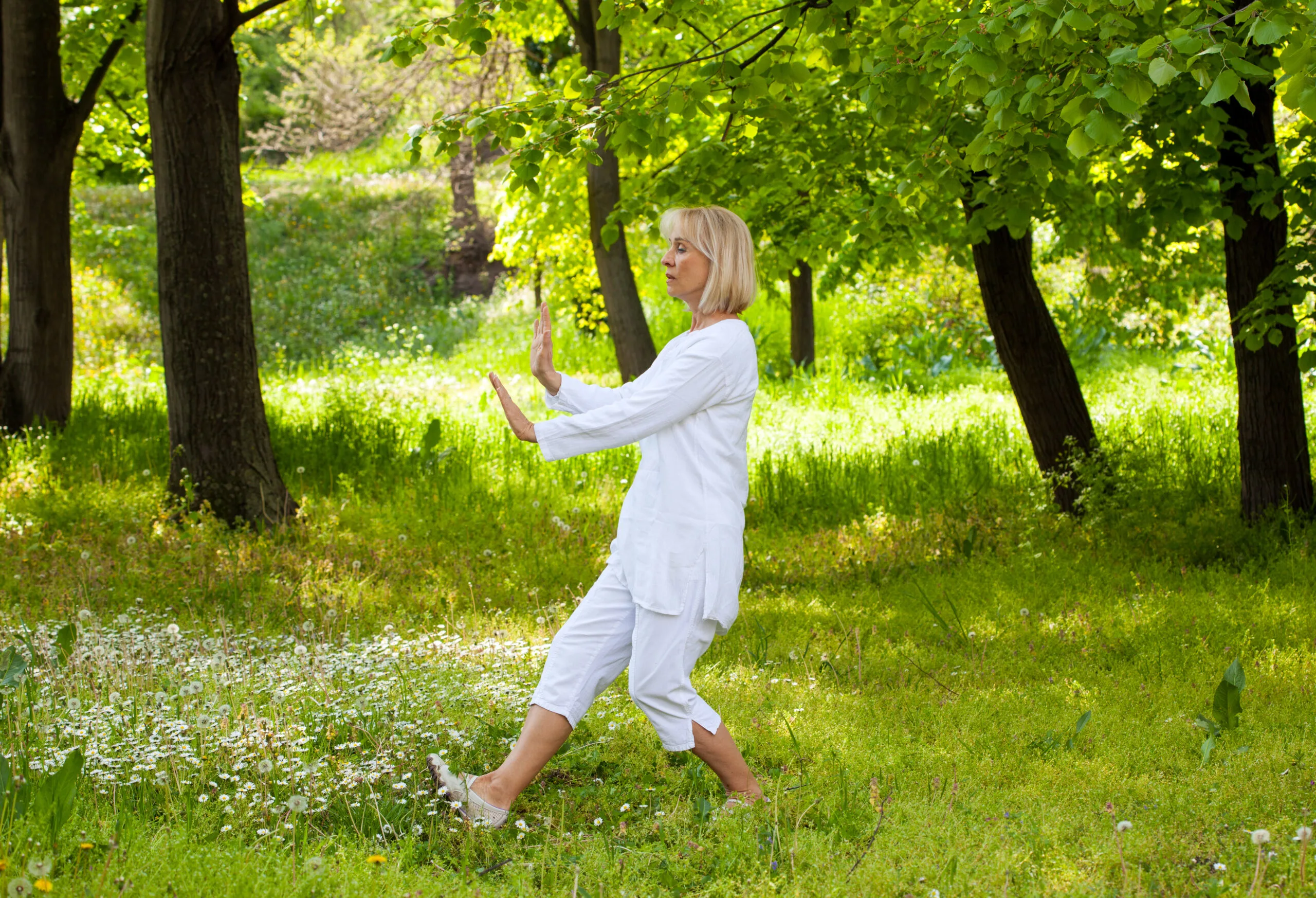
- Tai chi walking is a new trend that’s related to the ancient Chinese practice of tai chi.
- Unlike intense forms of exercise, it’s more about building balance, control, and consistency.
- Tai chi walking alone doesn’t burn many many calories, but it can help build the consistent habits that make long-term weight loss possible.
Walking is a great form of exercise, and we’ve covered it here many times. From longer walks for heart health to weighted walking and step goals, it’s a popular way to get moving.
Another way people are incorporating walking into their lifestyle is through tai chi walking.
It’s gained popularity on social media, with claims that it improves balance, reduces stress, and even supports weight loss. At first glance, it can look almost too simple—slow, controlled steps that don’t seem intense enough to “count” as exercise.
Part of that is because it’s based on a slower form of exercise called tai chi. Originally developed in ancient China as a martial art, tai chi is a gentle, flowing exercise that focuses on balance, breath, and mind-body connection. Tai chi walking is an evolution of that practice. It applies those same principles and creates a new way to take steps.
If it sounds simple, that’s why it’s appealing. As more people look for sustainable, low-impact ways to stay active, tai chi walking offers an alternative to high-intensity workouts—one that prioritizes control, awareness, and consistency over speed.

The Easy Way
to lose weight and get healthy.
See if you qualify

Let’s take a look at what tai chi walking is, the benefits, whether it works for weight loss, and who it’s best for. We’ll also hear from Maggie Hudspeth, Noom’s Senior Manager of Coaching, about how tai chi walking is one of many habits that can help you lose weight.
What is tai chi walking?
Before we talk about tai chi walking, it helps to understand what tai chi itself is. Short for tai chi chuan, tai chi dates back to the 17th century. It was originally practiced as an internal martial art, meaning it emphasized efficiency of movement, balance, and controlled power rather than strength. Early practitioners trained in slow, deliberate forms to develop coordination, stability, and the ability to generate force from precise body mechanics.
Over time, tai chi spread beyond martial arts communities and began to take on a broader role in health and wellness. Today, it’s practiced around the world, often less as a martial art and more as a form of low-impact exercise. While the original self-defense elements are still part of its foundation, most modern practitioners focus on its ability to improve balance, mobility, and mental wellbeing,
Tai chi walking applies these same principles. It’s not just slower walking—it’s a complete shift in how you move and how you think about your steps.
Instead of walking on autopilot, each step is intentional. You place your foot gently, shift your weight gradually, and stay fully aware of how your body is moving.
The key difference from regular walking is the absence of momentum. Rather than falling into your next step, you control the entire transition. This forces your muscles and balance systems to stay engaged throughout the movement, improving coordination and stability over time.
What are the key types of tai chi walking movements?
Tai chi walking isn’t just “slow walking”—it’s built from a few distinct movement patterns that train balance, coordination, and body awareness. Most styles layer these together into a flowing sequence.
1. Forward stepping (the foundation)
This is the core movement you’ll see in almost every practice. You:
- Shift your weight fully into one leg
- Step forward with the “empty” leg
- Place the foot gently, then transfer weight slowly
This “step → place → shift” pattern is what builds control and stability.
2. Backward walking (balance + coordination)


Walking backward in tai chi challenges your balance more directly. It:
- Trains proprioception (your awareness of where your body is in space)
- Forces slower, more deliberate movement
- Strengthens stabilizing muscles
It’s often taught alongside forward walking as a complementary drill.
3. Weight-shifting (empty vs. full leg work)
This is less about stepping and more about how you move between steps.
- One leg is always “full” (supporting your weight)
- The other is “empty” (free to move)
Avoiding “double-weighting” (splitting weight evenly between both legs) is key to staying stable and fluid.
4. Turning steps (directional control)
Once you have forward walking down, turns are added:
- Pivoting through the hips and torso
- Maintaining alignment and posture
- Coordinating upper and lower body
These movements help translate tai chi walking into real-world mobility—like changing direction without losing balance.
5. Continuous flow walking (meditative sequence)
This is where everything comes together:
- Smooth, uninterrupted steps
- Even rhythm and breathing
- Full-body awareness
The goal is continuous, unhurried motion, which may improve balance and reduce fall risk over time.
Tai chi walking is built from a handful of simple movements—but the depth comes from how you do them. Slow weight shifts, controlled steps, and continuous flow are what turn basic walking into a balance-building, low-impact practice you can actually stick with.
Who is tai chi walking best for?
Tai chi walking meets people where they are. It doesn’t require a certain fitness level, experience, or intensity threshold to get started. Instead, it adapts to your needs—whether you’re looking to stay mobile as you age, ease back into exercise, or simply find something you can do consistently.
Here are some different ways and people it can be best for.
Tai chi walking for beginners
For beginners, tai chi walking offers a low-pressure way to start moving. There’s no learning curve in terms of equipment or complex routines—just a shift in how you walk.
“If you’re just getting started with fitness or wellness, the hardest part is often feeling like it’s even possible. Small, manageable actions—like a few minutes of movement each day—can add up over time. From there, you can feel more confident and continue adding habits that will lead to meaningful progress,” explains Maggie Hudspeth, RDN, Senior Manager of Coaching at Noom.
Think of tai chi walking as a foundation—something you can stick with while gradually adding other forms of exercise over time.
Tai chi walking for seniors
This is one of the most practical applications of this practice. As balance naturally declines with age, controlled movement becomes more important. Tai chi walking for seniors helps train that control.
By practicing slow weight shifts and stable steps, older adults can improve their balance and reduce the risk of falls. Because it’s gentle on joints and doesn’t require equipment, it’s also easier to maintain over time.
Indoor versions make it even more accessible, especially for those who prefer to stay at home or avoid any risk of falling outdoors.
What is tai chi indoor walking?
Tai chi walking doesn’t require much space, which is why tai chi indoor walking has become especially popular. You can practice it in a hallway, living room, or any small open area without needing to cover distance.
Indoor tai chi walking tends to be even more controlled and repetitive than outdoor walking. Without the distraction of moving from one place to another, the focus stays entirely on technique—balance, posture, and breath.
Benefits of tai chi walking
Tai chi itself is linked to many benefits. A review study found that the practice is linked to improving balance and aerobic capacity in people with a lower level of fitness, increased strength in the lower limbs, and improved sleep. Another study also noted that tai chi was connected to an increased perception of quality of life in older adults.
Access GLP-1 Weight Loss with Noom
Explore a wide range of prescription medications supported by Noom’s program.Microdose GLP-1rx

Noom GLP-1rx

Noom GLP-1rx Plus
Wegovy®

Ozempic®

Metformin

Zepbound®

Mounjaro®

Liraglutide

Even though tai chi walking hasn’t been studied in the same way, people report a range of physical and mental benefits. Its slow, controlled nature makes it different from most forms of exercise—and that’s exactly where its value comes from.
Access GLP-1 Weight Loss with Noom
Explore a wide range of prescription medications supported by Noom’s program.Microdose GLP-1rx
Noom GLP-1rx
Noom GLP-1rx Plus
Wegovy®
Ozempic®
Metformin
Zepbound®
Mounjaro®
Liraglutide
- Improves balance and stability: The slow shifting of weight from one foot to the other trains your body to stay controlled and steady, which can reduce the risk of falls over time. Tai chi itself has been shown to improve balance and fall prevention in older adults.
- Enhances body awareness and posture: Moving deliberately helps you notice how your body is aligned and how you move, leading to better coordination and posture in everyday life. An experiment in a sports lab showed that people who regularly practiced tai chi had better balance than those who didn’t do tai chi regularly.
- Reduces stress and promotes calm: The combination of movement and focused attention can help quiet your mind, making it feel more like a moving meditation than a workout.
- Supports consistency and habit-building: Because it’s simple and low-pressure, it’s easier to stick with—helping you build a regular movement routine rather than starting and stopping.
- Applications to other forms of exercise: Tai chi could set the foundation for other types of low-impact exercise. Yoga, Pilates, and mobility work also emphasize control, awareness, and breath. A study found that tai chi is a good physical training strategy for improving walking function and in older adults with knee osteoarthritis.
Can you lose weight with tai chi walking?
If you’re looking to burn calories for weight loss, tai chi walking probably won’t deliver that on its own. It’s not a high-calorie-burning activity, and the pace is intentionally slow. It’s more similar to other activities that burn fewer calories than cardio workouts.
| Activity | Estimated calories burned (30 minutes) | Primary benefit |
|---|---|---|
| Tai chi walking | 80–150 | Balance, coordination, stress reduction |
| Gentle yoga | 100–180 | Flexibility, relaxation, mobility |
| Hatha yoga | 120–200 | Strength, flexibility, mindfulness |
| Pilates (beginner to moderate) | 150–220 | Core strength, posture, stability |
| Stretching / mobility work | 80–120 calories | Joint health, recovery, flexibility |
| Slow walking (2 mph) | 100–150 calories | Light movement, circulation |
For weight loss to happen, your body needs to be in a calorie deficit, meaning you’re burning more calories than you take in. Because tai chi walking burns relatively few calories, it’s unlikely to create that deficit by itself. That said, tai chi walking can still play a role in weight loss. “It’s important to remember that weight loss isn’t just about calories burned through exercise—calories from food matter just as much, if not more,” says Hudspeth. “The most effective approach combines both in a way that feels sustainable and works for your lifestyle.”
Tai chi walking might be helpful for building consistency. Over time, a reliable exercise practice can support weight loss more effectively than an intense activity that’s not enjoyable to continue with. “Consistency is an important factor for weight loss,” notes Hudspeth. “Gentler forms of movement like tai chi walking can help reduce stress and make it easier to stay active regularly—which often plays a big role in long-term weight loss.”
If weight loss is the goal, tai chi walking could be a good place to start, and then ramp up to more brisk walking that burns more calories.
| Activity (30 minutes) | Estimated Calories Burned |
|---|---|
| Tai Chi Walking | 80–150 calories |
| Slow Walking (2 mph) | 100–150 calories |
| Moderate Walking (3–4 mph) | 150–250 calories |
| Brisk Walking (4+ mph) | 250–350 calories |
Is tai chi walking safe?
For most people, tai chi walking is very safe. It’s low-impact and adaptable to different fitness levels.
That said, beginners may find the slow movement slightly challenging at first, especially when it comes to balance. Paying attention to form and starting gradually can help reduce any risk.
If you have existing health conditions or mobility concerns, it’s always a good idea to check with a healthcare provider before starting something new.
Frequently asked questions (FAQ) about tai chi walking
What’s the difference between tai chi walking and regular walking?
Tai chi walking is a slow, mindful walking practice rooted in traditional tai chi movements. Unlike regular walking, it focuses on controlled movement, balance, and body awareness rather than speed or distance. Each step is deliberate, helping improve coordination and stability over time.
What’s tai chi indoor walking?
Tai chi indoor walking is simply practicing this movement in a small space, like a living room or hallway. It removes the need for distance and keeps the focus on technique and control. This makes it especially accessible for beginners or people with limited mobility.
Can I lose weight with tai chi walking?
Tai chi walking is not a high-calorie-burning exercise, so it’s unlikely to lead to significant weight loss on its own. But it can support weight loss indirectly by helping you stay active, reduce stress, and build consistent habits. It works best as part of a broader routine that includes diet and other forms of exercise.
Does tai chi walking work?
Yes, tai chi walking is effective for improving balance, coordination, and overall body awareness. It can also help reduce stress by combining movement with mindfulness. But its benefits are gradual and come from consistent practice rather than intensity.
Where can I learn tai chi walking?
Most people learn tai chi walking through online videos or tai chi walking PDFs. Many tai chi walking videos break down the steps and pacing in a way that’s easy to follow at home.
The bottom line: Tai chi walking can improve balance and support long-term movement habits
Tai chi walking is a simple, low-impact way to improve balance, mobility, and mental well-being. It isn’t a quick fix—and it won’t drive weight loss on its own—but it can help you build something more important: consistency.
And when it comes to weight loss, that’s what actually matters. Sustainable progress comes from small, repeatable habits—moving regularly, managing stress, and making choices you can stick with over time.
If you’re trying to build those habits, having the right support can make a difference. Download the Noom app on iOS & Android for free tools and guidance to learn new behaviors, stay consistent, and make changes that last.
Editorial standards
At Noom, we’re committed to providing health information that’s grounded in reliable science and expert review. Our content is created with the support of qualified professionals and based on well-established research from trusted medical and scientific organizations. Learn more about the experts behind our content on our Health Expert Team page.