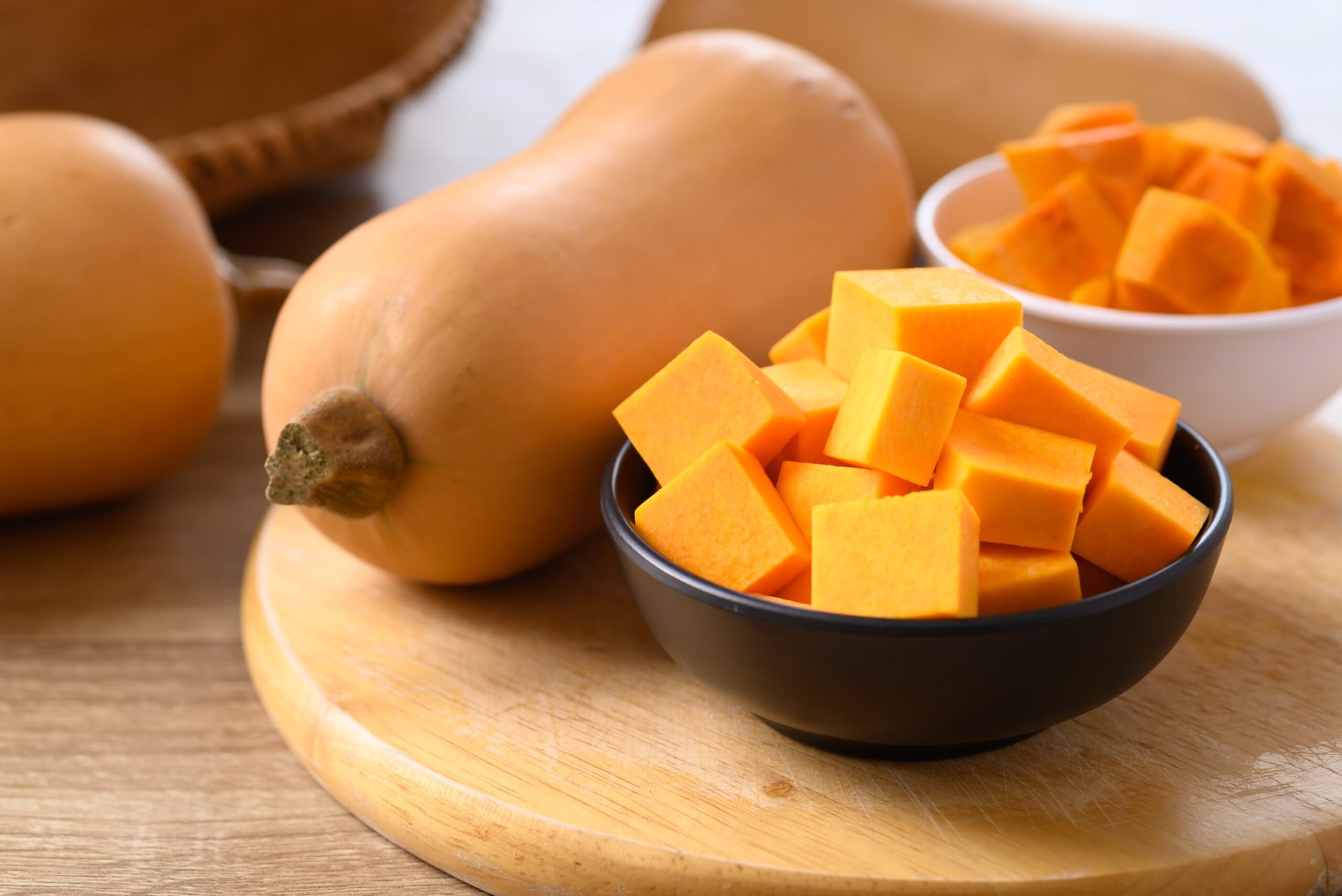
Butternut squash comes into season in early fall and stores well for months afterward, which is part of why it shows up in soups and side dishes through fall and winter. Its naturally sweet flavor and relatively low calorie count also make it an easy way to add more vegetables to a meal.
If you’re trying to lose weight, butternut squash has a lot going for it. One cooked cup has about 82 calories and 7 grams of fiber, along with more than a full day’s RDA for vitamin A. Those numbers can vary slightly depending on the variety and how it’s grown.
The familiar tan, bell-shaped butternut squash sold in most supermarkets is the type you’re most likely to encounter, though smaller, sweeter varieties such as Honeynut are also becoming more common. It’s also versatile enough to use in everything from sheet-pan dinners and grain bowls to smoothies and high-protein soups made with ingredients like cottage cheese or beans.
Here’s a closer look at butternut squash, its potential health and weight-loss benefits, and how it compares with other types of squash. Plus, we’ll cover the best ways to prepare it, what to pair it with, and practical questions like whether you can eat the skin and seeds.
✅ Quick answer
Yes. Butternut squash can be a good choice for weight loss. One cooked cup has about 82 calories and 7 grams of fiber, giving you plenty of volume for relatively few calories. It’s low in protein and fat, though, so pairing it with a protein source can make it more filling and help turn it into a satisfying meal.
Noom’s Most Powerful Program
A dual-pathway GLP-1 and behavior change for lasting results.
🚀 Weight-loss benefits of butternut squash
- It’s high in fiber. A cooked cup has close to 7 grams of fiber, or roughly a quarter of the recommended daily amount for women. Fiber slows digestion and can help you feel fuller after eating, which may make it easier to manage portions and overall calorie intake.
- It’s low in calorie density. At around 40 calories per 100 grams cooked, butternut squash gives you a relatively large portion for not many calories. Using it in place of some higher-calorie starches, such as rice or pasta, can lower the calories in a meal without necessarily making the portion smaller.
- It adds sweetness and volume for relatively few calories. Butternut squash has almost no fat and a naturally sweet flavor, so it can add body and creaminess to soups, mashes, and sauces without requiring much butter or cream. How it’s prepared still matters, but the squash itself is relatively low in calories.
⚠️ Things to be mindful of with butternut squash
- Preparation can change the calorie count quickly. Butternut squash itself is relatively low in calories, but many traditional preparations add butter, oil, cream, brown sugar, or maple syrup. You don’t need to avoid them, but if weight loss is your goal, keep an eye on how much you add.
- Some butternut squash soups can be surprisingly rich. A simple puréed squash soup can be relatively light, but recipes made with heavy cream, coconut milk, butter, or lots of oil can contain considerably more calories. Check the ingredients when ordering out, and when making it at home, use broth or blend in Greek yogurt or cottage cheese for creaminess with more protein
🥗 Butternut squash: Nutrition facts
(per 1 cup cooked, cubed — 205 g)
| Nutrient | Amount | % RDA* |
|---|---|---|
| Calories | 82 calories | 4% |
| Protein | 2 g | 4% |
| Total carbs | 22 g | 8% |
| Fiber | 7 g | 25% |
| Sugars | 4 g | — |
| Total fat | 0.2 g | 0% |
| – Saturated fat | 0 g | 0% |
| – Monounsaturated fat | 0 g | — |
| – Polyunsaturated fat | 0.1 g | — |
| Omega-3 | 0 g | — |
| Omega-6 | 0.1 g | — |
*Recommended dietary allowance (RDA) is the average daily amount of a nutrient needed to meet the needs of nearly all healthy people in a given group.
Fiber is the standout here. One cooked cup of butternut squash has about 7 grams of fiber for just 82 calories, giving you roughly a quarter of a day’s fiber in a generous serving. It also provides about 22 grams of carbohydrates, including just 4 grams of naturally occurring sugar, with very little fat.
But the nutrition benefits go beyond the macros. Butternut squash is especially rich in vitamin A from beta-carotene, the plant pigment responsible for its bright orange color, and it also provides vitamin C, potassium, and other important nutrients. For weight loss, though, its combination of fiber, volume, and relatively few calories is what makes it a strong choice.
💊 Vitamins & minerals in butternut squash (per 1 cup cooked, cubed — 205 g)
| Vitamin/mineral | Amount | % RDA* |
|---|---|---|
| Vitamin A | 1,144 mcg | 127% |
| Vitamin C | 31 mg | 34% |
| Vitamin B6 | 0.3 mg | 18% |
| Vitamin E | 2.6 mg | 17% |
| Copper | 0.1 mg | 15% |
| Pantothenic acid (B5) | 0.7 mg | 15% |
| Magnesium | 59 mg | 14% |
| Manganese | 0.3 mg | 13% |
| Niacin (B3) | 2 mg | 12% |
| Thiamin (B1) | 0.1 mg | 12% |
| Potassium | 582 mg | 12% |
| Folate | 39 mcg | 10% |
| Iron | 1.2 mg | 7% |
| Calcium | 80 mg | 6% |
| Phosphorus | 60 mg | 4% |
| Riboflavin (B2) | 0.03 mg | 3% |
Vitamin A is the clear standout. One cooked cup provides about 1,144 micrograms, or 127% of the RDA, largely from beta-carotene, the orange plant pigment that your body can convert into vitamin A. Vitamin A plays an important role in healthy vision and immune function, while beta-carotene also acts as an antioxidant.
Butternut squash is also a good source of vitamin C, providing about a third of the RDA per cooked cup. Vitamin C supports immune function and collagen production and helps your body absorb iron from plant foods.
Beyond those two standouts, you’ll get meaningful amounts of vitamin B6, vitamin E, copper, magnesium, manganese, potassium, and several other B vitamins. Altogether, that’s an impressive range of micronutrients for just 82 calories, adding to the fiber and volume that make butternut squash a useful choice when you’re trying to lose weight.
🔍 Nutrient breakdown
Glycemic index (GI) of butternut squash
Glycemic index: about 51 (low).
Butternut squash falls toward the upper end of the low-GI range, meaning its carbohydrates generally raise blood sugar more gradually than higher-GI foods.
💡 Tip: Pair butternut squash with protein, fat, and other fiber-rich foods to help make the meal more satisfying and slow digestion.

The Easy Way
to lose weight and get healthy.
Is butternut squash high in protein?
❌ No. One cooked cup has about 2 grams of protein. That’s not much compared with protein-rich foods such as chicken, lentils, eggs, or Greek yogurt.
💡 Tip: Think of butternut squash as the carbohydrate-and-vegetable portion of your meal, then add a protein source alongside it.
Is butternut squash high in fiber?
✔️ Yes. One cooked cup has about 7 grams of fiber, or roughly a quarter of the recommended daily amount.
💡 Tip: Roasting, steaming, or blending butternut squash doesn’t remove its fiber, so you can choose the preparation you enjoy most. Juicing or straining it, however, can remove some of the fiber.
Is butternut squash low in carbs?
❌ Not particularly. Butternut squash is a starchy vegetable with about 22 grams of carbohydrates per cooked cup. That’s more than most non-starchy vegetables, but it can still fit into a balanced eating plan.
💡 Tip: If you’re looking for a lower-carb squash, spaghetti squash has about 10 grams of carbohydrates per cooked cup.
Is butternut squash gluten-free?
✔️ Yes. Butternut squash is naturally gluten-free. Prepared soups, sauces, or side dishes may contain gluten-containing ingredients, however, so check the label if you need to avoid gluten.
Is butternut squash good for fat loss?
✔️ It can be. No individual food directly causes fat loss, but butternut squash can fit well into a calorie deficit. Its combination of fiber, volume, and relatively few calories can help you build a satisfying meal without adding a lot of calories.
💡 Tip: Pair it with a protein source and other filling foods to make the meal more satisfying.
🍽️ Diet compatibility: Which diets include butternut squash?
| Diet | ✅ / ❌ | Why |
|---|---|---|
| Keto | ❌ | With about 22 grams of carbohydrates per cooked cup, butternut squash can take up much of a strict keto diet’s daily carb allowance. A smaller portion may fit some lower-carb eating plans. |
| Paleo | ✅ | Butternut squash is a whole, minimally processed plant food and fits easily within a paleo eating pattern. |
| Mediterranean | ✅ | Butternut squash fits well with the Mediterranean diet’s emphasis on vegetables and plant foods, while adding fiber, beta-carotene, and other nutrients. |
| Vegan | ✅ | Butternut squash is entirely plant-based. Just watch for butter, cream, cheese, or meat in prepared squash dishes. |
| Gluten-free | ✅ | Butternut squash is naturally gluten-free. Check prepared soups, sauces, and other squash dishes for gluten-containing ingredients if you need to avoid gluten strictly. |
Butternut squash fits easily into most eating patterns. Keto is the main exception because a full cup contains about 22 grams of carbohydrates. If you’re following a lower-carb plan, you don’t necessarily have to skip it—a smaller portion, such as ½ cup, may be easier to fit into your daily carbohydrate target.
🌟 Is butternut squash healthy? The benefits
Metabolic health: Is butternut squash good for your metabolism?
- Boosts metabolism? ❌ No. Butternut squash doesn’t contain any known compounds that meaningfully increase metabolic rate or cause your body to burn more calories.
- Improves insulin sensitivity? 🤔 Possibly, but the evidence isn’t specific to butternut squash. Diets rich in vegetables, fiber, and carotenoids are associated with better metabolic health, but there isn’t strong evidence that eating butternut squash itself improves insulin sensitivity.
- Effect on fat storage? ➖ Neutral. There’s no evidence that butternut squash directly changes how your body stores or burns fat. Its potential benefit for weight management is much simpler: its fiber and low calorie density can help you build larger, satisfying meals while staying within a calorie deficit.
Cholesterol impact: Does butternut squash affect cholesterol levels?
- Lowers LDL? 🤔 Possibly as part of an overall high-fiber diet. Butternut squash provides about 7 grams of fiber per cooked cup, and higher-fiber eating patterns can support healthy cholesterol levels. There isn’t good evidence that butternut squash specifically lowers LDL cholesterol.
- Raises HDL? ➖ No known direct effect. There isn’t evidence that butternut squash itself meaningfully raises HDL cholesterol.
- Overall heart-health impact? ✔️ Favorable. Butternut squash provides fiber, potassium, vitamin C, and carotenoids while being naturally low in saturated fat. Those qualities make it easy to incorporate into a heart-healthy eating pattern.
Can I eat butternut squash in a calorie deficit?
✔️ Yes. At about 40 calories per 100 grams cooked, butternut squash gives you a generous portion for relatively few calories. One cooked cup has about 82 calories and 7 grams of fiber, making it an easy way to add volume to meals while keeping calories in check.
💡 Tip: Roast a batch at the beginning of the week and add it to salads, grain bowls, eggs, soups, or sheet-pan meals.
Is butternut squash rich in antioxidants?
✔️ Yes. Beta-carotene is the standout. Your body converts beta-carotene into vitamin A, and one cooked cup of butternut squash provides the equivalent of more than 100% of the RDA for vitamin A. It also contains vitamin C and vitamin E, two other nutrients with antioxidant activity.
These antioxidants help protect cells from oxidative stress, but that doesn’t mean eating butternut squash by itself prevents disease. Its benefits are best considered as part of an overall diet rich in fruits and vegetables.
Does butternut squash support gut health?
✔️ Potentially. One cooked cup provides about 7 grams of fiber. Some types of dietary fiber can be fermented by gut bacteria, producing short-chain fatty acids that help support the cells lining the colon and overall gut health.
Research on fiber and the microbiome is much broader than butternut squash specifically, however, so we can’t say that eating squash produces a particular change in gut bacteria.
Does butternut squash support digestion?
✔️ Yes. Its fiber adds bulk to stool and can help support regular bowel movements. Butternut squash also has a high water content, another feature that can support normal digestion.
If you’re not used to eating much fiber, increase your intake gradually and drink enough fluids to reduce the chance of bloating or gas.
Does butternut squash help you feel full and less hungry?
✔️ It can. Satiety level: Moderate.
Butternut squash combines fiber, water, and low calorie density, which means you can eat a substantial portion for relatively few calories. Research generally finds that foods and eating patterns with lower energy density can help increase fullness while reducing calorie intake.
Access GLP-1 Weight Loss with Noom
Explore a wide range of prescription medications supported by Noom’s program.
Microdose GLP-1rx
Noom GLP-1rx
Noom GLP-1rx Plus
Wegovy®
Ozempic®
Metformin
Zepbound®
Mounjaro®
Liraglutide
But squash isn’t especially high in protein, another nutrient strongly associated with satiety. For a more filling meal, pair it with a protein source such as chicken, beans, lentils, eggs, or Greek yogurt.
Does butternut squash help with nighttime cravings?
🤔 Not specifically. There’s no evidence that butternut squash has a special effect on nighttime cravings. But if you’re hungry in the evening, its fiber and relatively low calorie density can make it a more filling option than many calorie-dense snacks or desserts.
💡 Tip: If you like something sweet at night, try warm roasted butternut squash with cinnamon. For more staying power, pair it with Greek yogurt rather than relying on squash alone.
Does butternut squash help reduce inflammation?
🤔 Possibly, but the evidence is indirect. Butternut squash contains beta-carotene and vitamin C, both of which have antioxidant activity. Research has also found associations between higher blood levels or dietary intake of carotenoids and lower levels of some inflammatory markers.
That doesn’t establish that butternut squash itself reduces inflammation, however. Think of it as one of many colorful fruits and vegetables that can contribute antioxidants to an overall anti-inflammatory eating pattern.
Is butternut squash beneficial for brain health?
🤔 Possibly as part of a nutritious diet, but research isn’t squash-specific. Butternut squash provides vitamin B6 and folate, nutrients involved in normal nervous-system function, along with carotenoids and vitamin C. There isn’t evidence that eating butternut squash specifically improves memory, cognition, or other brain-health outcomes.
Can butternut squash improve skin and hair health?
🤔 It provides nutrients that support healthy skin, but don’t expect a dramatic effect. Its beta-carotene provides vitamin A, which is involved in normal skin-cell growth, while vitamin C is needed to produce collagen. Those nutrients contribute to normal skin health, but there’s no evidence that eating butternut squash specifically improves skin or hair.
Can butternut squash help balance hormones?
❌ There’s no evidence that it directly balances hormones. Butternut squash provides fiber, carbohydrates, vitamins, and minerals that can be part of a nutritious diet, but no research shows that it regulates reproductive, thyroid, stress, or other hormones.
💡 Tip: Rather than looking for individual “hormone-balancing” foods, aim for meals that include protein, fiber-rich carbohydrates, and healthy fats to provide a broader mix of nutrients and help keep meals satisfying.
🍽️ Best ways to eat butternut squash
- Roast it with a little olive oil. Roasting brings out butternut squash’s natural sweetness, so you don’t need to add sugar to make it flavorful. A small amount of oil also helps your body absorb beta-carotene and other fat-soluble carotenoids. Try it with cinnamon for a sweeter side or sage, rosemary, garlic, or smoked paprika for a savory version.
- Blend it into a higher-protein soup. Using vegetable or chicken broth instead of heavy cream can keep calories lower, while blending in cottage cheese, Greek yogurt, white beans, or lentils adds protein and makes the soup more satisfying. High-protein butternut squash soup made with cottage cheese has also become a popular way to give the classic fall soup a protein boost.
- Pair it with protein to build a complete meal. Butternut squash provides carbohydrates and fiber but only about 2 grams of protein per cooked cup. Try a sheet-pan dinner with squash, chicken, and green beans; a grain bowl with squash and black beans; or roasted squash with sausage and sautéed greens.
- Rethink the classic butter-and-brown-sugar mash. You don’t have to skip butter or sugar completely, but using several tablespoons can quickly increase the calories. For a lighter version, start with a smaller amount and bring out the squash’s natural sweetness with cinnamon, nutmeg, vanilla, or pumpkin pie spice.
🍏 Butternut squash vs. other fall vegetables (per 1 cup cooked)
| Food | Calories | Carbs | Fiber | Protein | Fat |
|---|---|---|---|---|---|
| Butternut squash | 82 | 22 g | 7 g | 2 g | 0 g |
| Sweet potato | 180 | 41 g | 7 g | 4 g | 0 g |
| Spaghetti squash | 42 | 10 g | 2 g | 1 g | 0 g |
| Pumpkin | 49 | 12 g | 3 g | 2 g | 0 g |
| Acorn squash | 115 | 30 g | 9 g | 2 g | 0 g |
Butternut squash falls somewhere in the middle. It has fewer calories and carbs than sweet potato or acorn squash, but more fiber than pumpkin or spaghetti squash.
If you’re looking for the lowest-calorie option, spaghetti squash comes out ahead at about 42 calories per cooked cup. Pumpkin is another lighter choice at about 49 calories. For fiber, acorn squash and butternut squash stand out, with about 9 and 7 grams per cup, respectively.
All five can fit into a weight-loss plan. The best choice comes down to the meal you’re making, the portion that satisfies you, and what you pair with it.
FAQs about butternut squash and weight loss
What are the different types of butternut squash?
There are many varieties of butternut squash, which can differ in size, sweetness, texture, and nutrient content. Waltham Butternut is the classic large, tan variety, while Honeynut is smaller and sweeter. Other varieties include Butterbush, Bugle, and Metro PMR.
Research has found that nutrient levels can vary by variety and growing conditions, including the amounts of beta-carotene, folate, vitamin E, and minerals. But the varieties studied were all good sources of important vitamins, minerals, and antioxidant compounds, so the exact type you choose matters less than simply finding one you enjoy.
Can you eat butternut squash seeds?
Yes. Butternut squash seeds are edible and can be roasted just like pumpkin seeds. Rinse off the pulp, dry them well, toss them with a little oil and seasoning, and roast until crisp. The seeds are more calorie-dense than the squash itself, so keep portions in mind if you’re tracking calories.
What’s the easiest way to peel butternut squash?
Cut off the top and bottom first so the squash sits flat, then use a sharp vegetable peeler to remove the skin in downward strokes. If the skin is especially tough, microwaving the whole squash for a few minutes can soften it slightly and make peeling and cutting easier. Pierce the skin in several places before microwaving.
Can you eat the skin of butternut squash?
Yes. Butternut squash skin is edible, and it softens considerably when roasted. You may still prefer to peel it for soups, mashes, or recipes where you want a smoother texture.
Do you have to peel butternut squash before roasting it?
No. You can roast butternut squash with the skin on, especially if you’re roasting halves or wedges. If you want cubes with browned edges on all sides, peeling it first generally works better.
How do you know when butternut squash is ripe?
Look for squash with firm, matte, evenly tan skin that feels heavy for its size. Avoid squash with soft spots, deep cuts, or green patches. The stem should be firm and dry rather than soft or moldy.
How long does butternut squash last?
Whole, uncut butternut squash can keep for weeks or even months when stored in a cool, dry, well-ventilated place. Once cut, refrigerate it in an airtight container and use it within several days. Cooked squash can also be refrigerated or frozen for later meals.
Is frozen butternut squash as healthy as fresh?
Yes. Frozen butternut squash still provides fiber, vitamins, and minerals and can be a convenient option when you don’t want to peel and cut a whole squash. Check the ingredient list for added sauces, sugar, or seasonings if you want plain squash.
Is butternut squash soup good for weight loss?
It can be. Butternut squash itself is relatively low in calories, so broth-based soups can be a lighter option. Calories can climb when recipes use large amounts of heavy cream, butter, coconut milk, or oil. Adding beans, lentils, Greek yogurt, or cottage cheese can also give squash soup more protein and make it more filling.
🧠 The bottom line: Butternut squash can be a smart choice for weight loss
Butternut squash can fit well into a weight-loss plan because you get a generous serving for relatively few calories. One cooked cup has about 82 calories and 7 grams of fiber, plus more than a full day’s RDA for vitamin A. Its combination of fiber and low calorie density can help make meals satisfying while keeping calories in check.
Make it the base of a soup, roast it for a sheet-pan meal, add it to grain bowls and salads, or blend cooked and cooled squash into a smoothie for extra fiber and natural sweetness. Pair it with protein-rich foods like chicken, beans, lentils, Greek yogurt, or cottage cheese to build a balanced meal that keeps you satisfied.
Whether you’re using it in a savory meal or adding it to something sweet, butternut squash is an easy way to add fiber, nutrients, and natural sweetness for relatively few calories.
Noom’s Most Powerful Program
A dual-pathway GLP-1 and behavior change for lasting results.
📖 Scientific evidence
- Butternut squash’s fiber may support fullness and weight management. (Critical Reviews in Food Science and Nutrition, 2024) A review of clinical trials found that higher fiber intake can reduce calorie intake and body weight while increasing feelings of fullness after meals. Butternut squash provides about 7 grams of fiber per cooked cup.
- Butternut squash fits the type of vegetable-rich eating pattern linked to weight loss. (American Journal of Clinical Nutrition, 2007) In a year-long trial, people who increased fruit and vegetable intake as part of a reduced-fat diet lost more weight and reported less hunger than those who focused on reducing fat alone.
- Frozen butternut squash still provides beneficial carotenoids. (Foods, 2024) Researchers analyzing organic butternut squash found that industrial freezing did not significantly reduce the bioaccessibility of alpha- or beta-carotene, suggesting frozen squash can still be a useful source of these compounds.
- Butternut squash is a rich source of beta-carotene and other nutrients. (Food Research International, 2020) Researchers comparing two butternut squash varieties grown conventionally and organically found that both variety and farming method influenced levels of beta-carotene, folate, vitamin E, and minerals like potassium and magnesium—though every sample remained a good source of these nutrients overall.
Editorial standards
At Noom, we’re committed to providing health information that’s grounded in reliable science and expert review. Our content is created with the support of qualified professionals and based on well-established research from trusted medical and scientific organizations. Learn more about the experts behind our content on our Health Expert Team page.