
At the start of this year, we completed a large analysis of the results our members achieved in 2025. It showed something powerful: for members on GLP-1 therapy, consistent engagement with the Noom app is associated with improved outcomes—and staying on medication longer. We also saw one of our biggest years of product launches translate into significant gains in engagement retention for all Noom users, and especially those in our new Microdose GLP-1Rx Program.
That progress didn’t happen by accident. It was built on years of investment to fully integrate clinical support with Noom’s uniquely effective approach to behavior change, culminating in the September 2024 launch of Noom GLP‑1Rx Program, our first-ever clinical weight loss plan to include GLP-1 medication (if prescribed), delivered to your door within 7 days, bundled with Noom’s GLP-1 Companion app. This launch was built around our core beliefs that:
- People want to be healthy
- The key to long-term health is to build better habits
- GLP-1s are powerful meds that make behavior change easier; and
- Pairing the Noom app with GLP-1s is the recipe for breakthrough results
Since the launch of Noom GLP-1Rx Program, we’ve helped many tens of thousands of people succeed at losing weight and building better health. Today, I’m excited to share a recap of what this has meant for our members—through the lens of our largest-ever internal analysis on how engagement with Noom’s GLP-1 Companion app is associated with success on GLP-1s, as well as how key product investments we made last year have increased the stickiness of our already highly engaging digital experience. These results are why we continue to invest heavily in the Noom app, with much more to come in the year ahead.
Finding #1: New 2025 features lifted engagement—especially engagement retention
2025 was a huge year for product releases—we had 105 Launch Announcements in our internal #product-announcements Slack channel. This included four entirely new plans: Noom + HRT, Microdose GLP-1Rx Program, Proactive Health Microdose GLP-1Rx Program, and Diabetes Management (for health plan and employer populations). But many of the biggest launches weren’t new SKUs. They were features designed to increase engagement in the Noom app—new health insights that catalyze motivation, new microhabits that make it easier to support your health on any given day, and rewards to help you sustain motivation to keep at it every day.
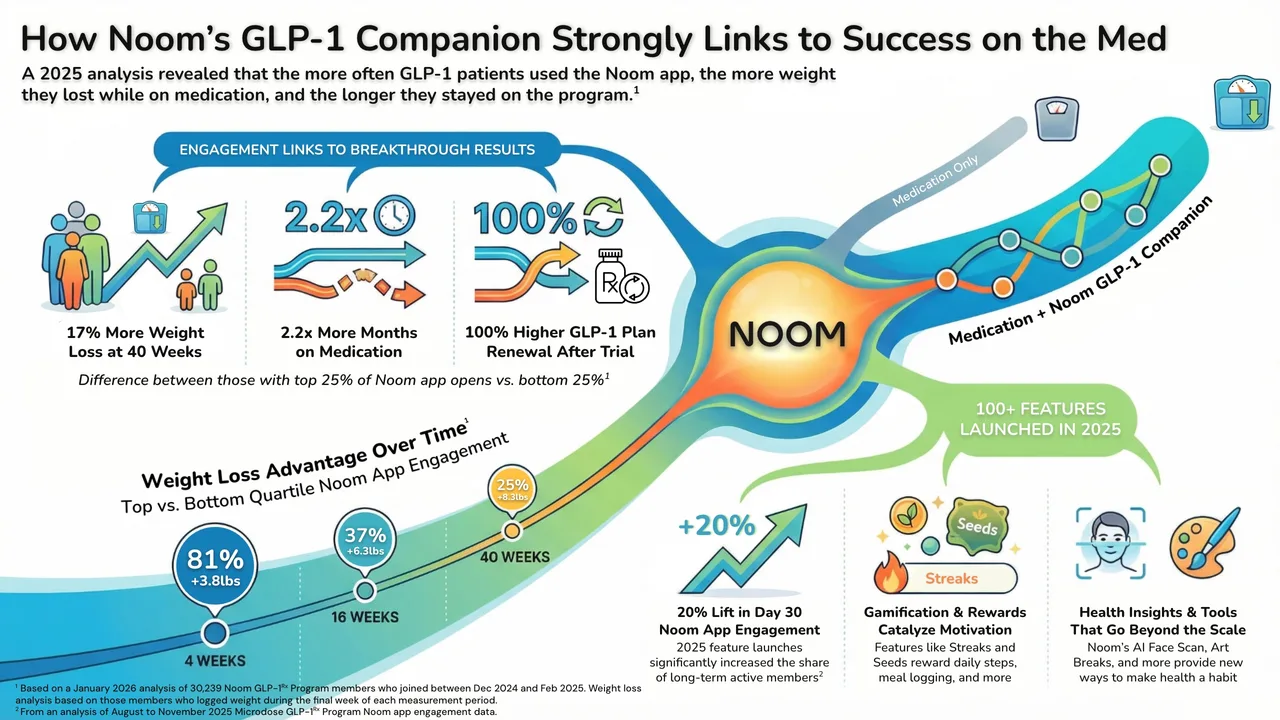
We initially launched a large set of these features in our free tier, then rolled them out next to our newer Microdose GLP-1Rx program members. There are many metrics that we look at when it comes to app engagement, but one key focus is D30 Engagement—the share of members who use Noom on their 30th day from signup. When we compared Microdose GLP-1Rx Program members who had the new features to those who didn’t (pre-post analysis), we saw the new features drove over 20% higher D30 engagement in our key app behaviors (completing a lesson, logging meals, etc.). In addition, the share of members who used the Noom app for at least 20 days in their first month increased by 23%. As of November 2025, nearly 80% (77.8%) of all Microdose GLP-1Rx users stayed engaged with the Noom app for 4 or more weeks, and D30 engagement for our December cohort was over 40% (43.6%),1 which is at least 10 times higher than average health, medical, and fitness app retention.
Finding #2: More Noom app use = over 25% more weight loss at 40 weeks
Rigorous studies have shown that higher levels of engagement in the Noom app drive higher weight loss, but what about for members on GLP-1 medication? With a large membership population now on Noom GLP-1Rx, we did a new real-world analysis that looked at the association between the frequency of usage of the Noom app and weight loss. We chose a simple metric—opening the Noom app—because we know that once a member is engaged in the app, they’re likely to use one of the many tools we’ve developed to promote mindful eating, movement, and self-efficacy.
For this analysis, we studied 14,210 subscribers who tracked their weight at weeks 4, 8, 16, and 40. We segmented them into groups by their frequency of using the Noom app, and we saw a consistent pattern: the more times they used the Noom app, the more weight loss at every milestone we measured. Noom GLP‑1Rx Program members in the top engagement quartile (top 25% of app opens) showed:
- 3.8 lbs more weight loss at 4 weeks
- 4.7 lbs more weight loss at 8 weeks
- 6.3 lbs more weight loss at 16 weeks
- 8.3 lbs more weight loss at 40 weeks
…compared to members in the lowest engagement quartile (bottom 25% of app opens)2.
This shows major potential benefits early on that also increase over time, even as members progress to higher doses of medication. In fact, at 40 weeks, members in the top 25% of Noom app opens achieved 25.2% more weight loss, on average, than those in the bottom 25%. We know from user research that seeing success is important to retention and renewal, so let’s dig into that in the next section.
Finding #3: More Noom app use = Higher subscription retention and medication persistence
Across our membership, we saw another huge association—between the frequency of Noom app usage and the likelihood to renew from one subscription period to the next. An analysis of 30,239 members showed that members in the top engagement quartile (top 25% of app opens) stayed on the program more than twice as long (2.2x more months), on average, compared to those in the bottom 25% of app opens.3
Because the Noom GLP-1Rx Program includes medication, this equates to more than twice the amount of time on their included GLP-1.
There is no requirement that you use the Noom app to receive medication, but we saw this association between using the Noom app and medication plan renewal in every subscription period. In fact, members in the top 25% of Noom app usage were:
- 100% more likely to renew following their trial month
- 44% more likely to renew again after that; and
- 33% more likely to renew again for another two times3
…compared to members in the lowest engagement quartile (bottom 25% of app usage).
Each subscription period following the trial was 12 weeks or three months, so this study followed members for about a year, showing the long-term linkage between digital program engagement and medication program persistence.3
The takeaway: Behavior change matters to people on GLP-1s, and the Noom app continues to be associated with stronger real-world GLP-1 outcomes
Taken together, these findings tell a clear story: people who pair GLP-1 medication with consistent engagement in the Noom app see more success at weight loss, and, independently, they stay with the program longer. The Noom app has one job: to help you build habits that support lasting health, and it’s the perfect companion to help people harness the power of increased self-efficacy from GLP-1s.
In 2025, our product investments meaningfully increased engagement, and engagement translates into better results at every stage of the journey. This is exactly what we set out to prove when we launched Noom GLP-1Rx: medication can accelerate progress, but behavior change sustains it.
Important note: These findings reflect observational analyses and report associations/correlations, not proof that engagement causes improved outcomes. Individual results vary.
- Engagement retention: D30 Engagement based on Noom app engagement data for December 2025 Noom Microdose GLP-1Rx Program users, based on their first-ever log-in date. At 30 days, 43.6% of users engaged with the app. Engagement rate for 4 or more weeks based on Noom app engagement data for November 2025 Noom Microdose GLP-1Rx Program users, based on their first-ever log-in date. As of January 31, 2026, 77.8% had engaged on or after week 4. 20% higher D30 engagement from new features launched September 22, 2025 is based on a pre-post analysis from August 22 to October 24, 2025 of D30 engagement in key in-app behaviours (completing any Home Screen Task, tapping the Bank button to bank rewards for steps, viewing the Health Report, logging medication, or reading an article). ↩︎
- Weight loss and engagement: January 2026 analysis of 14,203 Noom GLP-1Rx Program members who started a GLP-1Rx plan between December 2024 and February 2025 and logged weight during a measurement week (4, 8, 16, 40 weeks). Engagement quartiles compare the frequency of Noom app opens (capped at 20 app opens per day) among users who weighed in within the specified measurement week. Weight loss across this period was stratified by quartiles of engagement (Quartiles of average total app opens at 40 weeks: Q1 = 244.7 , Q4 = 2,162.2). Quartiles showed significantly different weight loss, p < 0.001. ↩︎
- Medication program persistence and engagement: January 2026 analysis of 30,239 Noom GLP-1Rx Program members who started a GLP-1Rx plan between December 2024 and February 2025, evaluating program persistence by engagement quartile. Results based on users stratified into engagement quartiles during a trial period and then tracking the duration of their paid program membership (Months of persistence by engagement quartile: Q1 = 2.8 , Q4 = 6.2). Quartiles showed significantly different persistence, p = < .001. ↩︎
Editorial standards
At Noom, we’re committed to providing health information that’s grounded in reliable science and expert review. Our content is created with the support of qualified professionals and based on well-established research from trusted medical and scientific organizations. Learn more about the experts behind our content on our Health Expert Team page.