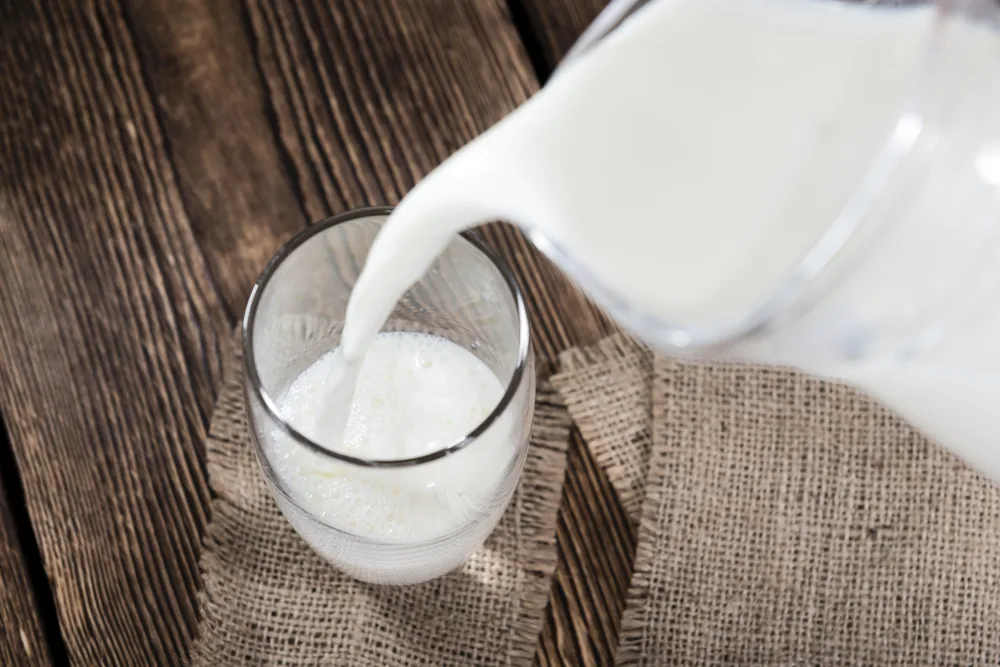
For a long time, lower-fat milk was seen as the “better” choice for weight loss because it has fewer calories and less saturated fat. More recently, some studies have suggested that full-fat dairy may not be as problematic as once thought.
But that doesn’t change a key point: whole milk is still more calorie-dense and higher in saturated fat than lower-fat options. For example, 1 cup of whole milk has about 150 calories and 8 grams of fat, compared to about 100 calories and 2.5 grams of fat in 1% milk.
Whole milk can feel more satisfying for some people because it contains both fat and protein, which can slow digestion. That may help you feel fuller in the moment. But when it comes to weight loss, calorie density tends to matter more over time—especially with drinks, which are easy to consume quickly and in larger amounts.
That’s why low-fat milk is often the more practical choice if your goal is weight loss. You get the same protein and key nutrients, with fewer calories and less saturated fat.
That said, whole milk isn’t “off-limits.” It can still fit into your routine—but it works best when used intentionally and in smaller portions, rather than as an everyday default.
✅ Quick answer
Yes, whole milk can fit into a weight loss plan, but you need to be mindful of portions. Whole milk is more calorie-dense than low-fat milk, and drinks can be easy to consume quickly without feeling quite as filling as solid foods.
🚀 Weight-loss benefits of whole milk
- Can feel more satisfying – Whole milk contains fat and protein, which can slow digestion and may help some people feel fuller in the moment.
- Provides high-quality protein – It contains complete protein that supports muscle maintenance during weight loss, though lower-fat milk provides the same protein with fewer calories.
- High in calcium and vitamin D – Whole milk provides calcium and is usually fortified with vitamin D, which supports bone health. Lower-fat milk offers the same nutrients with fewer calories.
⚠️ Things to be mindful of:
- It’s easy to pour more than you realize – Whole milk is more calorie-dense than lower-fat options, and because it’s a drink, it can be easy to consume without really noticing how much you’ve had. A little in coffee, cereal, smoothies, and cooking can add up over the course of a day.
- It’s higher in saturated fat – Whole milk has about 3-times more saturated fat than 1% milk. That doesn’t automatically make it unhealthy, but it may be something to keep in mind depending on your overall eating pattern and health history.
- It may not sit well for everyone – If you’re sensitive to lactose, any cow’s milk—including whole milk—can cause bloating, gas, or stomach discomfort. Lactose-free milk can be an easy alternative with similar nutrients.
🥗 Nutrients in whole milk (per 1 cup / 244g)
| Nutrient | Amount | % RDA* |
|---|---|---|
| Calories | 149 calories | 7% |
| Protein | 7.7 g | 15% |
| Total carbs | 11.7 g | 4% |
| Fiber | 0 g | 0% |
| Sugars | 12.3 g | — |
| Total fat | 7.9 g | 10% |
| – Saturated fat | 4.5 g | 23% |
| – Monounsaturated fat | 2.0 g | — |
| – Polyunsaturated fat | 0.5 g | — |
| Omega-3 | 0.2 g | — |
| Omega-6 | 0.3 g | — |
*Recommended dietary allowance (RDA) is defined as the average daily amount of nutrients needed to meet the requirements of nearly all healthy people in a specific group.
One cup of whole milk provides a mix of protein, fat, and carbohydrates. At about 150 calories per cup, it’s more calorie-dense than many other beverages, which is something to keep in mind if you’re drinking it regularly or in larger amounts.
The carbohydrates in whole milk come from lactose, the natural sugar in milk. While milk doesn’t spike blood sugar the same way sugary drinks can, it still contributes about 12 grams of sugar per cup. Because it doesn’t contain fiber, it’s usually more balanced when paired with fiber-rich foods like fruit or whole grains.
Whole milk also provides about 8 grams of protein per cup, along with fat, which can help with short-term fullness. But these same benefits are also available in lower-fat milk options, which provide similar protein with fewer calories and less saturated fat.
Overall, whole milk can fit into a balanced diet, but from a weight-loss perspective, it’s a more calorie-dense choice compared to lower-fat options—especially when used as an everyday drink rather than in small amounts
💊 Vitamins & minerals in whole milk (per 1 cup / 244g)
| Vitamin/Mineral | Amount | % RDA* |
|---|---|---|
| Vitamin B12 | 1.1 mcg | 46% |
| Riboflavin (B2) | 0.44 mg | 34% |
| Calcium | 276 mg | 21% |
| Vitamin D | 3.2 mcg | 16% |
| Phosphorus | 205 mg | 16% |
| Selenium | 9.0 mcg | 16% |
| Vitamin A | 112 mcg | 12% |
| Potassium | 322 mg | 7% |
| Zinc | 0.9 mg | 8% |
| Magnesium | 24.4 mg | 6% |
Whole milk provides several essential nutrients in meaningful amounts. One cup delivers about 46% of your daily vitamin B12 needs, 34% of riboflavin (B2), and about 21% of calcium.
Vitamin B12 supports nerve function, red blood cell production, and energy metabolism. Since it’s mostly found in animal-based foods, milk can be one way to help meet your needs—especially if you don’t eat much meat or fish.
Calcium is another key nutrient in milk, supporting bone health as well as muscle and nerve function. Whole milk also contains riboflavin (vitamin B2) and is typically fortified with vitamin D, which helps your body absorb and use calcium effectively.
These nutrients are part of what milk provides overall—but they’re also available in lower-fat milk options, which offer similar benefits with fewer calories and less saturated fat.
🔍 Nutrient breakdown
Glycemic index (GI) of whole milk
Glycemic index: 31 (Low)
💡 Tip: Whole milk’s low GI means it causes only a gradual rise in blood sugar, which helps keep energy levels stable and prevents the insulin spikes that can trigger cravings and promote fat storage. Pairing it with a fiber-rich food lowers the combined glycemic impact even further.
Is whole milk high in protein?
✔️ Yes – whole milk contains 7.7 g of protein per cup.
The protein quality is exceptional—a complete amino acid profile with both casein and whey, which together support muscle repair and sustained fullness.
Better protein alternatives: Greek yogurt | Cottage cheese | Whey protein isolate
Is whole milk high in fiber?
❌ No – whole milk has 0 g of fiber per cup.
💡 Tip: Milk contains no dietary fiber, which means it won’t contribute to gut health or digestive regularity on its own. Pair it with a high-fiber food to round out the nutritional picture.
Is whole milk low in carbs?
❌ No – whole milk has 11.7 g of carbs per cup, all from lactose.
💡 Tip: For most balanced diets, the lactose in milk is not a concern. If you’re following a strict low-carb or ketogenic diet, however, these carbs can chip away at your daily budget quickly — especially if you’re using milk in coffee, smoothies, or cooking throughout the day.
Is whole milk gluten-free?
✔️ Yes – pure cow’s milk is naturally gluten-free and safe for people with celiac disease or gluten sensitivity. As always, check labels on flavored or processed milk products, which occasionally contain additives that introduce gluten.
Is whole milk good for fat loss?
✔️ Yes, with portion control – whole milk’s high-quality protein supports lean muscle preservation during a calorie deficit, which is critical for maintaining a healthy metabolic rate while losing fat. The key is tracking it carefully, since the calories are easy to underestimate in a liquid form.
🍽️ Diet compatibility: Which diets include whole milk?
| Diet | ✅/❌ | Why |
|---|---|---|
| Keto | ❌ | The lactose content—about 12 grams of carbs per cup—is too high for most ketogenic diets, where the daily carb limit is typically 20–50 grams. |
| Paleo | ❌ | Strict paleo excludes dairy on the basis that it wasn’t part of pre-agricultural human diets. Some flexible or “primal” versions of paleo do allow high-quality dairy, but traditional paleo does not. |
| Mediterranean | ✅ | Dairy is included in the Mediterranean diet in moderation, though fermented options like yogurt and cheese tend to be emphasized over liquid milk. |
| Vegan | ❌ | Whole milk is an animal product and is entirely excluded from vegan diets. Plant-based alternatives like soy milk or oat milk are the standard substitutions. |
| Gluten-free | ✅ | Milk is naturally free of gluten and completely safe for people with celiac disease or gluten intolerance. Check labels on flavored varieties to be sure. |
Whole milk can fit into some eating patterns, including Mediterranean and more flexible, balanced approaches. But whether it’s the best choice depends on your goals.
From a weight-loss perspective, whole milk is more calorie-dense and higher in saturated fat than lower-fat options. You’ll get the same protein and key nutrients from options like 1% or 2% milk, with fewer calories, which is why those are often the more practical everyday choice.
That said, whole milk isn’t off-limits. It can still fit into your routine—but it works best when used intentionally and in smaller amounts.
🌟 Is whole milk healthy? What are the health benefits?
Metabolic health: Is whole milk good for your metabolism?
- Boosts metabolism? ✔️ Modest benefit – Calcium plays a role in energy metabolism and may support the breakdown of fat cells.
- Improves insulin sensitivity? ✔️ Yes — Despite containing lactose, the protein and fat in whole milk slow absorption and produce a more moderate insulin response than you’d expect from 12 grams of sugar. Some research also suggests dairy consumption is associated with improved insulin sensitivity over time.
- Effect on fat storage? Neutral – Whole milk can contribute to weight gain if it regularly pushes you above your overall calorie needs—but that’s true of any food or drink. At the same time, research on full-fat dairy has become more nuanced, and it doesn’t appear to affect body weight in the simple, one-to-one way people once assumed. In practice, how whole milk fits into your overall eating pattern matters more than whether it’s “high-fat” on paper.
Cholesterol impact: Does whole milk affect cholesterol levels?
- Does it lower LDL (bad) cholesterol? ❌ No – The saturated fat in whole milk may raise LDL cholesterol in some people, particularly those who are genetically predisposed to respond strongly to dietary saturated fat. But research suggests the LDL particles raised by dairy fat tend to be larger and less arterially damaging than the small, dense LDL associated with processed foods.
- Does it raise HDL (good) cholesterol? ✔️ Possibly – Saturated fats can increase HDL cholesterol, which may help maintain a healthier overall cholesterol ratio. The net cardiovascular impact of whole milk appears more neutral than previously assumed.
- Overall impact on heart health? Neutral to favorable – Current evidence is moving away from the view that dairy fat is harmful. Several large studies now show neutral or even mildly protective associations between whole dairy consumption and cardiovascular outcomes, including stroke risk.
💡 Tip: If you have elevated LDL or a personal or family history of heart disease, it’s worth monitoring how whole milk affects your individual lipid profile rather than making assumptions either way. A registered dietitian can help you assess this.
Can I drink whole milk for a calorie deficit?
✔️ Yes, with caution: Whole milk absolutely fits within a calorie deficit—as long as those calories are accounted for. One cup is 150 calories, and it’s easy to have two or three throughout the day without registering them as meaningful intake.
💡 Tip: Measure whole milk when you use it so that you don’t overpour.
Is whole milk rich in antioxidants?
❌ Limited: Whole milk isn’t a significant antioxidant source. It does contain small amounts of selenium and vitamin A, which support the body’s oxidative defense systems, but it doesn’t compare to plant foods in this regard.
💡 Tip: Blend whole milk with berries, cocoa powder, or a handful of spinach to significantly boost the antioxidant content of a milk-based smoothie.
Does whole milk support gut health?
❌ Limited: Regular whole milk doesn’t contain probiotics and lacks fiber to feed beneficial gut bacteria, so it doesn’t actively support gut health the way fermented dairy does. For gut health benefits from dairy, fermented options like kefir or yogurt are considerably more effective.
Access GLP-1 Weight Loss with Noom
Explore a wide range of prescription medications supported by Noom’s program.Microdose GLP-1rx
Noom GLP-1rx
Noom GLP-1rx Plus
Wegovy®

Ozempic®

Metformin

Zepbound®

Mounjaro®
Liraglutide

Does whole milk support digestion?
✔️Neutral to negative for some: For people with sufficient lactase enzyme activity, whole milk digests comfortably. For the significant portion of adults with lactose malabsorption, however, it can cause gas, bloating, and discomfort. Lactose-free whole milk is an easy solution that preserves all the nutritional benefits without the digestive downside.
Does whole milk help you feel satiated and less hungry?
✔️High: Whole milk contains protein and fat, which can slow digestion and may help you feel fuller in the short term. That said, this effect isn’t unique to whole milk—lower-fat milk provides similar protein with fewer calories. Like most liquids, milk is generally less filling than solid foods, so how it affects hunger depends on how and when you use it.
Satiety level: High
💡 Tip: Drink a glass of whole milk 20–30 minutes before a meal to take the edge off hunger and naturally reduce how much you eat at the meal itself.
Does whole milk help with nighttime cravings?
✔️ Yes: Whole milk contains tryptophan, an amino acid that supports the production of serotonin and melatonin, both of which promote relaxation and better sleep. A warm glass before bed can help curb late-night snacking urges while also supporting sleep quality — a two-for-one that’s genuinely useful for people who find evenings difficult.
💡 Tip: Warm the milk rather than drinking it cold at night — warm liquids tend to feel more soothing and filling, and the ritual itself can help signal to your body that the eating day is done.
Does whole milk help reduce inflammation?
✔️ Neutral to positive: Despite the popular perception that dairy is inflammatory, the evidence doesn’t support this for most people. Some studies suggest that regular dairy consumption is associated with reduced inflammatory markers, particularly in people without dairy allergies or intolerances. For those with sensitivities, the opposite can be true.
Is whole milk beneficial for brain health?
✔️ Yes, limited benefits: Vitamin B12 is essential for neurological function and the maintenance of the myelin sheath that protects nerve fibers. Whole milk is one of the better dietary sources of B12, making it a meaningful contributor to brain and nerve health—particularly for vegetarians who may struggle to get enough from diet alone. The healthy fats in whole milk also support general cognitive function.
Can whole milk improve skin and hair health?
✔️ Yes, minor benefits: The protein in whole milk supports the regeneration of skin cells and hair follicles, while vitamin A plays a role in skin cell turnover and maintaining healthy mucous membranes. These are indirect benefits that compound over time with consistent intake rather than producing dramatic short-term effects.
Can whole milk help balance hormones?
✔️ Yes, modest evidence: The fats in whole milk provide the structural building blocks for steroid hormone production—hormones like estrogen, testosterone, and cortisol are all synthesized from cholesterol and fat. Extremely low-fat diets can sometimes interfere with hormonal balance, and whole milk’s fat content may help prevent this.
💡 Tip: Hormonal balance is influenced by your overall dietary pattern far more than by any single food. Whole milk can be a useful fat source within a varied, nutrient-rich diet, but it’s not a targeted hormonal treatment on its own.
🍽️ Best ways to use whole milk for weight loss
- Use it intentionally and measure – Whole milk can add up quickly when it’s poured freely into coffee, cereal, or smoothies. Measuring portions (like 1/4–1/2 cup) helps you stay aware of how much you’re using.
- Use it to round out high-fiber meals – Adding a small amount of whole milk to something like high-fiber cereal or oatmeal can make it more satisfying without needing extra toppings.
- Consider where lower-fat swaps make sense – If you’re using milk regularly (in cereal or smoothies), switching to 1% or 2% can lower calories and saturated fat without changing protein or key nutrients.
🍏 Best alternatives & comparisons (per 1 cup / 244g)
| Food | Calories | Carbs | Fiber | Protein | Fat |
|---|---|---|---|---|---|
| Whole milk | 149 | 11.7 g | 0 g | 7.7 g | 7.9 g |
| 2% milk | 122 | 12.3 g | 0 g | 8.1 g | 4.8 g |
| 1% milk | 102 | 12.2 g | 0 g | 8.2 g | 2.4 g |
| Skim milk | 83 | 12.2 g | 0 g | 8.3 g | 0.2 g |
| Almond milk (unsweetened) | 37 | 0.7 g | 1.2 g | 1.2 g | 2.7 g |
| Soy milk | 105 | 7.3 g | 1.5 g | 8.1 g | 4.4 g |
| Oat milk | 117 | 15.9 g | 2.0 g | 2.4 g | 3.7 g |
Whole milk is the highest-calorie option in this group. Compared with 1% or 2% milk, it provides similar protein but more calories and fat, which is why lower-fat milk is often the more practical everyday choice for weight loss.
Compared with skim milk, whole milk has more calories and fat, while skim provides slightly more protein per cup. Some people may find whole milk more satisfying, but that varies from person to person and isn’t a consistent advantage for weight loss.
Unsweetened almond milk is much lower in calories, but it’s also much lower in protein, so it may not contribute as much to fullness or meal balance. Soy milk is the closest plant-based alternative nutritionally because it provides a similar amount of protein to dairy milk. Oat milk can also work, but it tends to be higher in carbohydrates and lower in protein than dairy milk.
Frequently asked questions about whole milk and weight loss
Is whole milk good for weight loss?
Whole milk can fit into a weight loss plan, but it’s not usually the most practical choice. It’s more calorie-dense and higher in saturated fat than lower-fat milk, while providing similar protein and nutrients.
For most people, options like 1% or 2% milk are easier to use regularly because they deliver the same nutritional benefits with fewer calories. Whole milk can still work in smaller portions, but it’s best treated as something that counts toward your daily intake—not a free add-on.
Is whole milk better than skim milk for weight loss?
Skim milk has significantly fewer calories, which can make it easier to stay in a calorie deficit. Whole milk is higher in calories and saturated fat, while providing similar protein and nutrients.
Some people may find whole milk more satisfying, but that effect isn’t consistent—and lower-fat options like 1% or 2% milk are often a more balanced middle ground. They offer the same protein and nutrients with fewer calories, without going as low-fat as skim.
Overall, if weight loss is the goal, lower-fat milk is typically the more practical everyday choice.
How much whole milk can I drink per day and still lose weight?
There isn’t a set limit, but portion size matters. Whole milk is calorie-dense, so even one cup (about 150 calories) can take up a meaningful part of your daily intake.
For most people, it works best as an occasional addition or in smaller amounts, rather than a daily default. If you’re using milk regularly, switching to 1% or 2% can make it easier to stay in a calorie deficit while still getting the same protein and nutrients.
The key is to treat milk as something that counts toward your daily intake—not something that goes unnoticed.
Does whole milk cause weight gain?
Not on its own. Weight gain happens when you consistently consume more calories than you expend.
Whole milk can contribute to weight gain because it’s relatively calorie-dense, and it’s easy to consume without noticing, especially in coffee, cereal, or smoothies. Over time, those extra calories can add up.
Some research has found associations between full-fat dairy intake and lower body weight, but these findings don’t show that whole milk causes weight loss. Overall calorie intake and eating patterns matter more.
Is whole milk inflammatory?
For most people without dairy allergies or intolerances, no. The current evidence suggests that whole dairy has neutral to mildly anti-inflammatory effects in the general population. People with lactose intolerance, dairy allergies, or certain autoimmune conditions may respond differently, but the idea that dairy is inherently inflammatory isn’t well supported by the research.
Can I drink whole milk on a keto diet?
Not easily. One cup of whole milk contains about 12 grams of carbohydrates from lactose, which can account for a substantial portion of a strict keto dieter’s daily carb budget. Heavy cream is the more keto-compatible option, but it’s very high in saturated fat. Unsweetened almond milk is another keto-friendly swap with minimal carbs.
What’s the best time of day to drink whole milk for weight loss?
There isn’t a specific “best” time. What matters more is how it fits into your overall calorie intake.
Because whole milk is calorie-dense, it’s best used in a way that replaces calories rather than adds extra ones—for example, as part of a meal or snack, not on top of what you’re already eating.
If you’re having milk regularly, using 1% or 2% milk can make it easier to stay within your calorie goals while still getting the same protein and nutrients.
🧠 The bottom line: Whole milk can fit, but lower-fat is usually the better choice
Whole milk can be included in a weight loss plan, but it’s not usually the most practical option. It’s more calorie-dense and higher in saturated fat than lower-fat milk, while providing similar protein and key nutrients.
For many people, using 1% or 2% milk makes it easier to stay in a calorie deficit without giving up those benefits. Whole milk can still fit, but it works best in smaller amounts and when it’s used intentionally rather than poured freely throughout the day.
A helpful way to think about it: milk isn’t just a drink—it contributes real calories. Using it as part of a meal or snack, rather than in addition to one, can help keep things balanced.
📖 Scientific evidence
- People who ate full-fat dairy didn’t have a higher rate of obesity. (Nutrition Research, 2014) A large review found that people who ate full-fat dairy as part of their usual diets were not more likely to gain weight, and in some cases had a lower risk of obesity.
- Dairy intake within a calorie-restricted diet may reduce body fat more than restriction alone. (Nutrition Reviews, 2020) This review found that regularly eating dairy doesn’t lead to weight gain on its own, and when it’s included as part of a calorie deficit, it may help support fat loss.
- Dietary calcium may slightly reduce fat absorption. (International Journal of Molecular Sciences, 2019) Some research suggests that higher calcium intake can bind to fat in the digestive tract, meaning a small amount may be excreted instead of absorbed.
- Milk proteins may support muscle maintenance and fullness. (Nutrients, 2026) Some research suggests that milk proteins—casein and whey—can help support muscle preservation and feelings of fullness during dieting. Because they digest at different speeds, they provide a more sustained release of amino acids, though these effects are not unique to whole milk.
- Whole dairy may affect the body differently than isolated saturated fat. (Nutrients, 2024) Some research suggests that saturated fat in whole dairy foods may affect health differently than saturated fat from more processed foods, likely because of the mix of nutrients they contain.
Editorial standards
At Noom, we’re committed to providing health information that’s grounded in reliable science and expert review. Our content is created with the support of qualified professionals and based on well-established research from trusted medical and scientific organizations. Learn more about the experts behind our content on our Health Expert Team page.