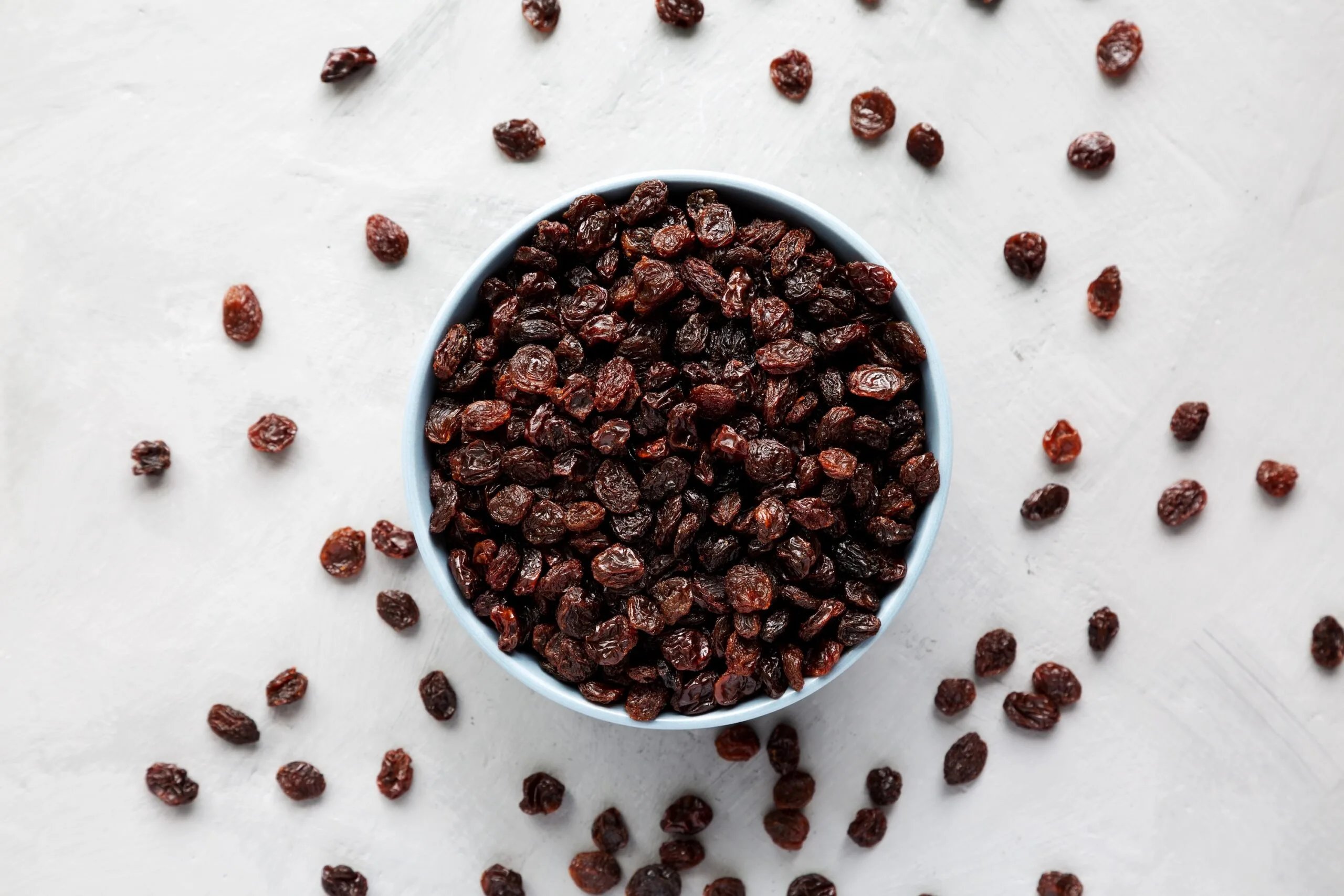
Raisins are basically grapes with all the water removed—and that one fact explains most of what you need to know about them when it comes to weight loss. When grapes dry out, everything concentrates: the sugar, the calories, and the nutrients all pack into a much smaller package. That’s why a small handful of raisins and a large bowl of grapes can have the same calorie count, even though one feels like a snack and the other feels closer to a meal.
That said, raisins aren’t a food to avoid—they’re just one to be thoughtful about. They’re naturally rich in minerals like copper, potassium, and iron, they provide a bit of fiber, and their sweetness makes them a good choice when you’re cutting back on refined sugar in cooking and baking. For people who are active, they’re also one of the better natural options for quick energy before a workout.
The challenge with raisins and weight loss really comes down to portion size. At around 120 calories for ¼ cup (40g) , they’re calorie-dense, and it’s very easy to eat more than you meant to if you don’t measure. Let’s go through the nutrition facts of raisins, how many are a good serving size, and how to use them in cooking to get the most out of their natural sweetness.
✅ Quick answer
Yes, raisins can absolutely fit into a weight loss approach—it just comes down to how you use them. Because they’re small and naturally concentrated, portions can add up quickly without much volume. That said, a little goes a long way. Used as a topping or mixed into yogurt, salads, or oatmeal, raisins can add natural sweetness along with fiber and nutrients—often replacing added sugar.
🚀 Weight-loss benefits
- They can help curb sugar cravings – Raisins are naturally sweet, which means a small amount can go a long way. Stirring a tablespoon into oatmeal or yogurt adds real sweetness without needing any added sugar.
- They provide fiber – Raisins have both soluble and insoluble fiber, which helps support digestion and slows things down a little after eating. It’s not a huge amount per serving, but it’s more than you’d get from most processed sweet snacks.
- They’re a solid pre-workout snack – The natural sugars in raisins digest quickly, giving your muscles a readily available source of energy before exercise. Research has even found them to be just as effective as commercial sports chews for keeping blood glucose steady during endurance workouts.
⚠️ Things to be mindful of:
- The calorie density is real – This is the main thing to watch with raisins. A small box (about 43 grams) contains around 130 calories and could disappear in a few bites. It’s easy to eat three or four times that without feeling like you’ve eaten much at all.
- The sugar concentration is high – About 60% of raisins by weight is sugar. It’s natural fruit sugar, not added sugar, but it’s high enough to cause a noticeable blood sugar response—especially if you eat them on their own without a source of protein, fiber, or healthy fat.
- Fresh grapes are almost always the better choice for weight loss – For the same calories as a ½ cup of raisins, you could eat nearly 3 cups of fresh grapes. That’s not a small difference—it’s the difference between a snack that barely registers and one that actually fills you up
🥗 Nutrients in raisins (per ¼ cup / 40g)
| Nutrient | Amount | % RDA* |
|---|---|---|
| Calories | 120 calories | 6% |
| Protein | 1.2 g | 2% |
| Total carbs | 31.7 g | 12% |
| Fiber | 1.5 g | 5% |
| Sugars | 23.7 g | — |
| Total fat | 0.2 g | <1% |
| – Saturated fat | 0.04 g | <1% |
| – Monounsaturated fat | 0.04 g | — |
| – Polyunsaturated fat | 0.04 g | — |
| Omega-3 | 0 g | — |
| Omega-6 | 0.04 g | — |
*Recommended dietary allowance (RDA) is defined as the average daily amount of nutrients needed to meet the requirements of nearly all healthy people in a specific group.
A quarter cup of raisins is a good place to start. It provides about 120 calories and 31.7 grams of carbohydrates, along with very little fat (0.2 g) and a small amount of protein (1.2 g). Raisins are virtually fat-free and offer more than just calories—they also deliver nutrients like potassium and antioxidants. They tend to work best as an ingredient, mixed into meals or snacks, rather than eaten by the handful.
Most of those carbohydrates come from natural sugars (23.7 g), and with just 1.5 grams of fiber, raisins on their own don’t do much to slow digestion.
That’s where pairing comes in. Adding a source of protein or fat—like nuts, cheese, or Greek yogurt—can help balance things out, supporting steadier blood sugar and helping you feel more satisfied. Raisins also show up naturally in more balanced dishes—like oatmeal with nuts, rice or grain-based dishes such as pilafs, or savory recipes like Moroccan tagines or Middle Eastern salads—where they’re combined with fiber, protein, and fat rather than eaten on their own.
💊 Vitamins & minerals in raisins (per ¼ cup / 40g)
| Vitamin/Mineral | Amount | % RDA* |
|---|---|---|
| Copper | 0.13 mg | 14% |
| Potassium | 300 mg | 6% |
| Manganese | 0.12 mg | 5% |
| Iron | 0.75 mg | 4% |
| Vitamin B6 | 0.07 mg | 4% |
| Magnesium | 12.8 mg | 3% |
| Phosphorus | 40.4 mg | 3% |
| Calcium | 20 mg | 2% |
| Vitamin K | 1.4 mcg | 1% |
| Vitamin C | 0.9 mg | 1% |
The standout mineral in raisins is copper—a quarter cup covers 14% of your daily needs, which is a meaningful amount for such a small food. Copper supports energy production and helps your body use iron properly, so it’s a useful nutrient even if it doesn’t get much attention. Potassium is also present in a helpful amount, supporting healthy blood pressure and helping your body manage fluid balance.
Iron is often mentioned as a reason to eat raisins, and it is there, but it’s plant-based (non-heme) iron, which the body doesn’t absorb as efficiently as the iron found in meat, poultry, or fish. Pairing raisins with a vitamin C-rich food can help improve absorption.
One thing worth noting: fresh grapes contain some vitamin C, but most of it is lost during the drying process, so raisins aren’t a reliable source. If you’re thinking about vitamin C specifically, fresh grapes will generally provide more, while raisins offer other nutrients in a more concentrated form.
🔍 Nutrient breakdown
Glycemic index (GI) of raisins
Glycemic index: 54–64 (Moderate)
💡 Tip: Raisins fall in the moderate GI range, which means they raise blood sugar at a noticeable pace—not as fast as candy, but faster than most whole fruits. Eating them alongside nuts, Greek yogurt, or another protein source helps slow that response down and keeps energy more stable.
Are raisins high in protein?
❌ No — raisins contain 1.2 g of protein per quarter cup.
That’s not enough to make much of a dent in hunger or support muscle maintenance on its own. Raisins pair well with protein-rich foods, but they’re not a protein source themselves.
Better protein alternatives: Greek yogurt | Pumpkin seeds | Cottage cheese
Are raisins high in fiber?
❌ No — raisins have 1.5 g of fiber per quarter cup.
💡 Tip: The fiber in raisins contributes something, but it’s not enough to meaningfully slow digestion or keep you full on its own. Pairing them with oats, nuts, or another higher-fiber food makes the overall snack more satisfying.
Are raisins low in carbs?
❌ No — raisins have 31.7 g of carbs per quarter cup.
💡 Tip: Raisins are one of the most carb-dense fruits available. Even a small portion adds up quickly, so if you’re keeping an eye on carbs, treat them as a flavoring rather than a main snack — a tablespoon goes a long way.
Are raisins gluten-free?
✔️ Yes — raisins are naturally gluten-free. Plain varieties are reliably safe for people with celiac disease or gluten sensitivity. As always, check labels on flavored or coated varieties.
Are raisins good for fat loss?
❌ Not ideally — raisins’ high calorie density makes them a tricky food when fat loss is the goal. They can fit into a calorie deficit with careful portioning, but the margin for error is small. For the same calories, fresh grapes give you dramatically more food and a much more satisfying experience.
🍽️ Diet compatibility: Which diets include raisins?
| Diet | ✅/❌ | Why |
|---|---|---|
| Keto | ❌ | Even a small portion of raisins contains more carbs than most keto budgets allow in a full day. They’re not a realistic fit for a ketogenic approach. |
| Paleo | ✅ | Raisins are a natural, unprocessed fruit and technically paleo-compliant. Most paleo eaters treat them as an occasional ingredient rather than a daily snack, given the sugar content. |
| Mediterranean | ✅ | Dried fruits, including raisins, have a place in Mediterranean cooking—think grain salads, stuffed vegetables, and baked goods. They’re used more as an ingredient than a snack. |
| Vegan | ✅ | Raisins are entirely plant-based and contribute useful minerals like iron and copper to plant-forward diets. They’re also a handy natural sweetener in vegan baking. |
| Gluten-free | ✅ | Raisins are naturally gluten-free and commonly used in gluten-free baking. Plain varieties are reliably safe; flavored or coated products are worth a label check. |
Raisins work well in most whole-food eating patterns—Mediterranean, vegan, paleo, and gluten-free approaches all have room for them. The exception is keto, where the carb count rules them out pretty definitively.
For most people, raisins are best used as an ingredient that adds sweetness and a bit of nutrition to other foods—a sprinkle over oatmeal, a handful in trail mix, a handful in a grain salad.
🌟 Are raisins healthy? What are the health benefits?
Metabolic health: Are raisins good for your metabolism?
- Boosts metabolism? ❌ No — Raisins don’t have any direct effect on metabolic rate. Their main metabolic role is as an energy source — specifically, a fast-digesting one that’s useful around exercise.
- Improves insulin sensitivity? ❌ Not in large amounts — The moderate GI means the blood sugar response isn’t extreme, but the high sugar concentration can be challenging for insulin sensitivity if raisins are eaten frequently in larger portions. After exercise, when muscles are ready to absorb glucose, this matters less.
- Effect on fat storage? Neutral — In a calorie deficit, raisins don’t cause fat storage on their own. The issue is that their density makes it easy to accidentally eat more than you intended, which can push you out of a deficit without realizing it.
Cholesterol impact: Do raisins affect cholesterol levels?
- Does it lower LDL (bad) cholesterol? ✔️ Yes — The soluble fiber in raisins binds to cholesterol in the digestive tract and helps carry it out of the body. The effect per serving is modest but consistent with what we know about dietary fiber and heart health.
- Does it raise HDL (good) cholesterol? ❌ Data limited — There’s no strong evidence that raisins directly raise HDL cholesterol. The cardiovascular benefit is mainly through LDL reduction and blood pressure support.
- Overall impact on heart health? Favorable — Raisins’ potassium helps regulate blood pressure, and research has found that people who snack on raisins regularly have meaningfully lower blood pressure than those eating other common snack foods.
💡 Tip: For a heart-healthy breakfast, try pairing raisins with oats — both contribute soluble fiber that helps lower LDL cholesterol, and the combination is more satisfying than either alone.
Can I eat raisins for a calorie deficit?
✔️ Yes, with caution: Raisins can absolutely fit within a calorie deficit—but they require more attention to portions than most other fruits. The calorie density is high enough that eating even a slightly larger portion than planned can cost you more than you’d expect.
💡 Tip: Pre-portion raisins into small bags of around 20 grams (about 2 tablespoons) before you need them, and never eat directly from the box or bag. Knowing what you’re eating before you start makes a real difference.
Are raisins rich in antioxidants?
✔️ Yes: Raisins contain phenolic compounds — including ferulic acid and quercetin — that help protect cells from oxidative damage. Darker raisins tend to have more antioxidant capacity than golden ones. That said, some antioxidants present in fresh grapes (including vitamin C) are partially lost during the drying process.
Do raisins support gut health?
✔️ Yes: Raisins contain tartaric acid and prebiotic fibers that feed beneficial gut bacteria and support a healthier digestive environment. Research has specifically identified fructooligosaccharides in raisins as compounds that promote the growth of beneficial bacteria in the gut.
Do raisins support digestion?
Positive: The insoluble fiber in raisins adds bulk and supports regular bowel movements. One thing to keep in mind: raisins are high in FODMAPs—a type of carbohydrate that can cause gas and bloating in people with IBS or fructose sensitivity. If raisins tend to leave you uncomfortable, that’s likely why, and starting with smaller amounts can help.
Do raisins help you feel satiated and less hungry?
Moderate: Raisins provide more staying power than soft candy or liquid sugar — the fiber and the act of chewing do contribute something. But their small physical volume means they don’t fill up your stomach in any real way, and the sugar can sometimes leave you wanting more shortly after.
Satiety level: Moderate
💡 Tip: Always pair raisins with a protein source like Greek yogurt or nuts. Eating them alone doesn’t do much for hunger, but the combination makes for a noticeably more satisfying snack.
Do raisins help with nighttime cravings?
✔️ Yes, possibly: A small portion — a tablespoon or so — can satisfy a sweet craving in the evening without the blood sugar spike that comes with processed desserts. The key is keeping the portion genuinely small, since the calorie density doesn’t reward generous late-night snacking.
💡 Tip: Mix a tablespoon of raisins into a bowl of Greek yogurt in the evening. The protein in the yogurt helps stabilize blood sugar and keeps you fuller through to morning.
Access GLP-1 Weight Loss with Noom
Explore a wide range of prescription medications supported by Noom’s program.Microdose GLP-1rx
Noom GLP-1rx
Noom GLP-1rx Plus
Wegovy®

Ozempic®

Metformin

Zepbound®
Mounjaro®
Liraglutide

Do raisins help reduce inflammation?
✔️ Yes: The polyphenols in raisins — including quercetin — have anti-inflammatory properties. A diet that regularly includes polyphenol-rich foods is associated with lower inflammatory markers over time, and raisins contribute to that in their own modest way.
Are raisins beneficial for brain health?
✔️ Yes, limited benefits: Some animal research suggests the antioxidants in raisins may help protect against age-related cognitive decline. The human evidence is limited, and brain health isn’t a primary reason to eat raisins — but it’s a secondary benefit of their antioxidant content.
Can raisins improve skin and hair health?
✔️ Yes, minor benefits: Copper plays a role in melanin production and collagen formation, and raisins are a decent source of it. These benefits are gradual and indirect rather than dramatic, but they’re real over the course of a consistently varied diet.
Can raisins help balance hormones?
✔️ Yes, modest evidence: Raisins contain boron, a trace mineral that plays a role in estrogen and testosterone metabolism. It’s not widely talked about, but raisins are actually one of the better dietary sources of it. This isn’t a targeted hormonal treatment, but it’s a real and somewhat unique nutritional benefit.
💡 Tip: For hormonal health, your overall dietary pattern matters much more than any individual food. Raisins can be a useful part of a varied, balanced diet, but they’re not a substitute for medical guidance if you’re managing a hormonal condition.
🍽️ Best ways to eat raisins for weight loss
- As a topping – A tablespoon of raisins sprinkled over oatmeal, yogurt, or a salad adds natural sweetness and a few useful minerals without a lot of calories.
- Mixed into trail mix with nuts — Combining raisins with almonds or walnuts slows down how quickly the sugar absorbs, which keeps energy more stable. Aim for a mix that’s heavier on nuts than raisins — the nuts do most of the satiety work. Keep in mind that this can be calorie-dense, so factor that into your daily calorie needs.
- Added to baked goods — Raisins add moisture and natural sweetness to oatmeal cookies, muffins, scones, and bread pudding, often helping reduce the need for added sugar.
🍏 Best alternatives & comparisons (per ¼ cup)
| Food | Serving | Calories | Carbs | Fiber | Protein | Fat |
|---|---|---|---|---|---|---|
| Raisins | ¼ cup (40g) | 120 | 31.6 g | 1.5 g | 1.2 g | 0.2 g |
| Fresh grapes | ¼ cup (38g) | 26 | 6.8 g | 0.3 g | 0.3 g | 0.1 g |
| Prunes | ¼ cup (45g) | 108 | 28.8 g | 3.2 g | 1.0 g | 0.2 g |
| Dried apricots | ¼ cup (33g) | 79 | 20.8 g | 2.4 g | 1.1 g | 0.2 g |
| Dates (Medjool) | ¼ cup (45g) | 125 | 33.8 g | 3.0 g | 0.8 g | 0.1 g |
| Sweetened dried cranberries | ¼ cup (30g) | 92 | 24.6 g | 1.7 g | 0.03 g | 0.4 g |
Fresh grapes are the standout swap — same sweet flavor as raisins but only 26 calories per quarter cup versus 120. That’s a big difference for something that tastes so similar. Among the dried fruits, apricots and prunes are slightly lower in calories than raisins and higher in fiber, making them a bit more filling per serving. Dates and sweetened cranberries are the ones to watch — both are high in sugar and easy to overeat in small portions.
Frequently asked questions about raisins and weight loss
Are raisins good for weight loss?
Raisins can absolutely fit into a weight loss approach—especially when you use them intentionally. Their naturally concentrated sweetness means a small amount can go a long way, making them a helpful way to add flavor without reaching for added sugar.
Because they’re more calorie-dense than fresh fruit, portion size matters. Using raisins as a measured topping or ingredient—rather than eating them by the handful—helps you get the benefits while staying on track.
If you’re looking for more volume, fresh grapes offer a similar flavor in a more filling form. Both can have a place—it just depends on what you need in the moment.
How many raisins should I eat per day for weight loss?
There’s no set “right” amount—it really depends on how raisins fit into your overall day. Because they’re naturally concentrated, even a small portion, roughly 2–3 tablespoons (about 1/8 to 1/6 cup), can go a long way in adding sweetness and flavor.
If you’re eating raisins regularly, it can help to measure them a few times (or weigh them on a kitchen scale), so you have a clear sense of what that portion looks like. From there, you can adjust based on your goals and what helps you feel satisfied.
Why are fresh grapes better than raisins for weight loss?
It comes down to water content. Fresh grapes are about 81% water, which means a large, filling portion contains relatively few calories. You can eat nearly 3 cups of grapes for the same calories as ½ cup of raisins. The volume difference has a real impact on how full you feel. Many of the same nutrients are present in both—you just get more volume for the same calories with fresh grapes.
Are raisins high in sugar?
Yes. About 24 grams of every quarter cup of raisins is sugar — one of the highest concentrations of any fruit. It’s natural fruit sugar rather than added sugar, but the amount is high enough to cause a noticeable blood sugar response, especially eaten alone.
Can I eat raisins on a keto diet?
Not really. A quarter cup of raisins contains over 30 grams of carbohydrates, which would exceed most people’s daily carb limit on strict keto in a single snack. There’s no practical way to fit raisins into a standard ketogenic approach.
Are raisins a good pre-workout snack?
Yes—this is actually one of the better uses for them. The fast-digesting sugars provide quick energy to muscles before exercise, and research has found raisins to be as effective as commercial sports chews at maintaining blood glucose during endurance activity. A 30-gram (about 3 tablespoons) portion about 30 minutes before a workout is a simple, natural option.
Do raisins cause bloating?
They can, particularly for people with IBS or fructose sensitivity. Raisins are high in FODMAPs—a type of fermentable carbohydrate that some digestive systems struggle with. Starting with smaller portions and gradually increasing gives your gut time to adjust. If discomfort is consistent, a different dried fruit or fresh grapes may suit you better.
🧠 The bottom line: Raisins are good for weight loss when measured carefully
Raisins can absolutely be part of a healthy, weight-conscious routine—they just work best when you’re intentional with them. They bring minerals like copper and potassium, along with some fiber and antioxidants, and they’re a useful way to add natural sweetness in cooking and baking.
Because they’re concentrated, a small amount goes a long way. Using raisins as a flavor boost—a tablespoon over oatmeal, a small handful in trail mix, or a sprinkle on a salad—helps you get the taste and nutritional benefits without needing a large portion.
If you’re looking for something more filling, fresh grapes offer a similar flavor with more volume. Both can have a place—it just depends on what you need in the moment and how they fit into your day.
📖 Scientific evidence
- Regularly snacking on raisins is linked to lower blood pressure. (Journal of the American College of Cardiology, 2012) A study found that people who snacked on raisins regularly had lower blood pressure after 12 weeks compared with people eating other common packaged snacks.
- Children who ate raisins as a snack ate fewer calories throughout the day. (Journal of Food Science, 2013) A study found that children who ate raisins as a snack consumed fewer calories afterward than those who ate other snack foods.
- People who regularly eat dried fruit tend to have lower BMIs and better overall diet quality. (Nutrition Research, 2011) An analysis found that people who regularly ate dried fruit, including raisins, tended to have lower body weight, smaller waistlines, and better overall diet quality than those who didn’t.
- Raisins are as effective as commercial sports products for fueling endurance exercise. (Journal of Strength and Conditioning Research, 2011) A study found that raisins worked just as well as sports jelly beans for maintaining blood sugar during endurance exercise.
- Raisins contain fiber and compounds with prebiotic potential. (Nutrition Journal, 2019) In one study, raisin intake led to modest changes in certain gut bacteria, though the overall effect was limited.
Editorial standards
At Noom, we’re committed to providing health information that’s grounded in reliable science and expert review. Our content is created with the support of qualified professionals and based on well-established research from trusted medical and scientific organizations. Learn more about the experts behind our content on our Health Expert Team page.