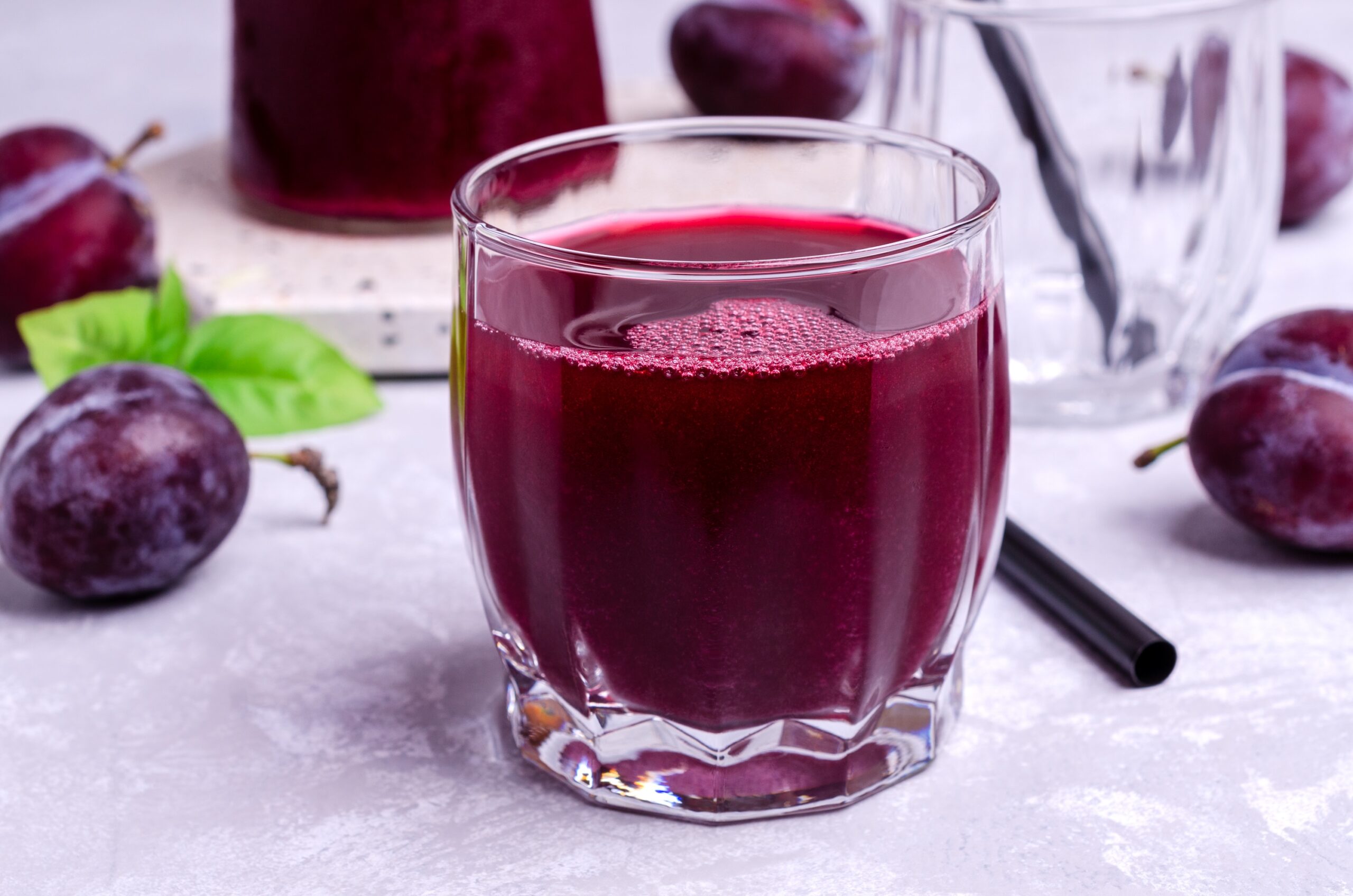
Prune juice is turning up in gut-health corners of social media, where people drink it warm as a morning ritual, mix it with lime or butter as a constipation hack, or use it as a mocktail base. That’s a change from its old reputation as something mostly kept in a grandparent’s fridge for occasional constipation, not sipped as a daily wellness drink.
At the most basic level, prunes are simply dried plums. Drying removes much of the fruit’s water, concentrating its natural sugars and nutrients while leaving its fiber intact. Turning those prunes into juice changes things again: much of the fiber is removed, while the naturally occurring sugars, vitamins, minerals, and sorbitol—a sugar alcohol that contributes to prunes’ laxative effect—remain in the liquid.
That helps explain why prune juice has such a strong association with constipation. And unlike many “natural remedies” that circulate online without much evidence behind them, this one has clinical research to support it. Studies have found that prune juice can improve constipation symptoms and stool consistency. A typical 4-ounce serving also provides about 354 milligrams of potassium and close to a fifth of the daily value for vitamin B6.
But prune juice gets more complicated when weight loss enters the conversation. That same small serving has about 90 calories and 21 grams of naturally occurring sugar, with very little of the fiber that helps make whole prunes or fresh plums filling. And while getting constipation moving may leave you feeling lighter or less bloated, that isn’t the same thing as losing body fat.
So, can prune juice still fit into a weight-loss plan? Yes—but what it can realistically do for your goals is much more about digestive health than burning fat or speeding up weight loss.
Noom’s Most Powerful Program
A dual-pathway GLP-1 and behavior change for lasting results.
✅ Quick answer
Prune juice isn’t a weight-loss drink, but it can fit into a weight-loss plan. A typical 4-ounce serving has about 90 calories and 21 grams of sugar with very little fiber, so it’s unlikely to keep you as full as whole prunes or other fiber-rich foods. Its clearest benefit is for constipation: research suggests prune juice can help improve bowel movements, which may reduce bloating or make you feel lighter but doesn’t represent a loss of body fat. If fullness is your goal, whole prunes are generally the better choice.
🚀 Weight-loss benefits of prune juice
- It can relieve constipation that affects the scale. Constipation can temporarily increase scale weight and make you feel bloated or heavier. In a randomized, placebo-controlled trial, prune juice significantly reduced hard stools and constipation complaints over eight weeks. Getting things moving may change how you feel—and sometimes what you see on the scale—but that shouldn’t be confused with losing body fat.
- A small serving can satisfy a sweet craving. Prune juice is naturally sweet, so a measured 4-ounce serving can be an alternative to soda, sweetened juice drinks, or other higher-calorie beverages. The key is what it replaces: adding prune juice on top of your usual intake won’t create the same calorie-saving benefit.
- It can be an easy way to add fruit-derived nutrients. A 4-ounce serving provides about 354 milligrams of potassium along with vitamin B6 and other nutrients. That doesn’t make prune juice a fat-burning drink, but it can contribute nutrients while you’re following an overall balanced eating pattern for weight loss.
⚠️ What to watch out for
- It’s relatively calorie-dense for a drink. At about 90 calories per 4 ounces, prune juice can add up quickly if you pour a full glass instead of measuring a smaller serving. An 8-ounce glass would bring you to roughly 180 calories, making portion size especially important if you’re trying to maintain a calorie deficit.
- Most of its carbohydrates come from natural sugar. Of the roughly 22 grams of carbohydrates in a 4-ounce serving, about 21 grams come from sugar. Juicing also removes most of the fiber found in whole prunes, so prune juice is less filling than eating the fruit itself. People managing their blood sugar may also need to account for those carbohydrates.
- Too much can cause gas, bloating, or diarrhea. Prune juice contains sorbitol, a naturally occurring sugar alcohol that helps draw water into the intestines and contributes to its laxative effect. But sorbitol is also a FODMAP, and larger amounts can trigger gas, cramping, bloating, or loose stools—particularly if you’re sensitive to it. Starting with a small serving can help you see how your digestive system responds.
🥗 Prune juice: Nutrition facts (per 4 fl oz, ½ cup)
| Nutrient | Amount | % RDA* |
|---|---|---|
| Calories | 90 calories | 5% |
| Protein | 1 g | 2% |
| Total carbs | 22 g | 8% |
| Fiber | 1 g | 5% |
| Sugars | 21 g | — |
| Total fat | 0 g | 0% |
| – Saturated fat | 0 g | 0% |
| – Monounsaturated fat | 0 g | — |
| – Polyunsaturated fat | 0 g | — |
| Omega-3 | 0 g | — |
| Omega-6 | 0 g | — |
*Recommended dietary allowance (RDA) is defined as the average daily amount of nutrients needed to meet the requirements of nearly all healthy people in a specific group.
Prune juice, like other fruit juices, is pressed from fruit. That process leaves much of the pulp and fiber behind, so what ends up in the bottle is mostly water, naturally occurring sugars, and vitamins and minerals that remain in the liquid. That’s why most of the 22 grams of carbohydrates in a 4-ounce serving come from sugar—about 21 grams—with very little of the fiber found in whole prunes. For context, that’s roughly as much sugar as you’d get in half a 12-ounce can of regular cola, although the sugar in prune juice occurs naturally in the fruit rather than being added as a sweetener.
There’s also very little protein or fat, and the 1 gram of fiber in a typical serving is much less than you’d get from eating whole prunes. That makes prune juice less filling than the whole fruit and easier to consume quickly, which matters if you’re drinking it regularly while trying to lose weight.
💊 Vitamins & minerals in prune juice (per 4 fl oz, ½ cup)
| Vitamin/Mineral | Amount | % RDA* |
|---|---|---|
| Vitamin B6 | 0.4 mg | 21% |
| Copper | 0.1 mg | 9% |
| Manganese | 0.2 mg | 9% |
| Iron | 1.5 mg | 8% |
| Potassium | 354 mg | 8% |
| Magnesium | 18 mg | 4% |
| Phosphorus | 32 mg | 3% |
Vitamin B6 is the standout here, providing about a fifth of your daily needs in a 4-ounce serving. It plays a role in protein metabolism and red blood cell formation. Prune juice also provides smaller amounts of copper, manganese, and iron; the iron is particularly notable for a fruit juice.
Potassium is another nutrient worth noting, with 354 milligrams per serving. Magnesium and phosphorus are present in smaller amounts, and both play roles in bone and muscle health. None of these nutrients are unique to prune juice, however, and choosing whole prunes instead gives you many of the same nutrients along with substantially more fiber.
🔍 Prune juice nutrient breakdown
Glycemic index (GI) of prune juice
Glycemic index: about 43 (Low)
💡 How can prune juice be high in sugar but relatively low on the glycemic index? GI measures how quickly the carbohydrates in a food raise blood sugar, not how many grams of sugar it contains. Prune juice contains sorbitol, a naturally occurring sugar alcohol that is absorbed differently from sugars like glucose. That helps explain why its GI can be relatively low despite having about 21 grams of sugar per 4-ounce serving.
Is prune juice high in protein?
❌ No: Four ounces has about 1 gram of protein, so it isn’t a meaningful source. Better protein alternatives: Greek yogurt | a smoothie made with milk
Is prune juice high in fiber?
❌ No: A typical 4-ounce serving has about 1 gram of fiber because much of the fiber in whole prunes is lost during processing. 💡 If fiber is your priority, eating whole prunes gives you more than drinking the juice.

The Easy Way
to lose weight and get healthy.
Is prune juice low in carbs?
❌ No: Four ounces has about 22 grams of carbohydrates, most of which come from naturally occurring sugars. That can add up quickly if you’re following a lower-carb eating pattern, so portion size matters.
Is prune juice gluten-free?
✔️ Yes: Plain prune juice is naturally gluten-free. If you have celiac disease or need to strictly avoid gluten, check the label for any additional ingredients or cross-contamination warnings.
Is prune juice good for fat loss?
❌ Not directly: Prune juice doesn’t have any special fat-burning properties, and its calories can make maintaining a calorie deficit harder if you drink large amounts. Its main potential benefit during weight loss is relieving constipation, which can reduce bloating and temporary scale weight—but that isn’t the same as losing body fat.
🍽️ Diet compatibility: Which diets include prune juice?
| Diet | ✅ / ❌ | Why |
|---|---|---|
| Keto | ❌ | At about 22 grams of carbs in just 4 ounces, even a small serving can use up a large share of a strict ketogenic plan’s daily carb allowance. |
| Paleo | ❌ | Paleo emphasizes whole, minimally processed foods, and pressing removes the fiber that would make this closer to eating the actual fruit. |
| Mediterranean | ✅ | The Mediterranean pattern includes moderate fruit and fruit juice, and prune juice’s potassium content fits its emphasis on plant foods over processed snacks. |
| Vegan | ✅ | It’s made entirely from plant material with no animal-derived ingredients or processing aids. |
| Gluten-Free | ✅ | Prunes and water contain no gluten, making this naturally compliant. |
Prune juice works within plant-forward eating patterns like Mediterranean and vegan diets, where fruit and fruit juices in moderation are already part of the framework. It’s a harder fit for diets built around minimizing processed carbohydrates or maximizing whole-food fiber, since the juicing process works against both goals.
If you’re following a diet that restricts carbs or emphasizes whole foods, whole prunes deliver the same flavor and most of the same nutrients with several times the fiber per calorie. Save the juice for when the digestive benefit specifically calls for it.
Prune juice: What to know about constipation relief
Constipation relief is probably what prune juice is best known for—and unlike many digestive-health remedies, this one has research behind it.
Does prune juice make you poop?
Yes. Prune juice contains sorbitol, a naturally occurring sugar alcohol that draws water into the intestines and can help soften stool. It also contains small amounts of pectin and polyphenols that may contribute to its digestive effects.
A study in people with chronic constipation found that drinking prune juice daily led to fewer hard, lumpy stools and more normal stools compared with a placebo. Improvements in hard stools showed up after about three weeks, and people also reported fewer constipation symptoms by the end of the eight-week study.
How long does prune juice take to work?
There isn’t a reliable number of hours you can count on. You’ll often see claims that prune juice works within a few hours, but studies haven’t established a specific timeline for producing a bowel movement.
How quickly you notice an effect can depend on how constipated you are, how much you drink, and how your digestive system responds to sorbitol. If you’re trying it for the first time, start with a small amount rather than drinking a large glass hoping for faster results.
How much prune juice should you drink for constipation?
Start with about 4 ounces (½ cup). If that sits well but you still need more help, you can try another 4 ounces later in the day. More isn’t necessarily better: larger amounts of sorbitol can cause gas, bloating, cramping, or diarrhea.
💡 Tip: Start with 4 ounces and see how your body responds before pouring more. If constipation keeps coming back or isn’t improving with changes to your diet, fluids, and routine, talk with your doctor about what else might be contributing.
🌟 Is prune juice healthy? What are the health benefits?
Prune juice can be a healthy addition to your diet, especially if you’re drinking it for constipation relief. But many of its other proposed benefits come from research on whole prunes, so we don’t know whether the juice has the same effects.
Metabolic health: Is prune juice good for your metabolism?
- Boosts metabolism? ❌ No: There’s no evidence that prune juice speeds up your metabolism or increases calorie burn. Its benefits during weight loss are more about digestive health than burning more calories.
- Improves insulin sensitivity? 🤔 Maybe: Prunes contain polyphenols, including chlorogenic acid, that have been studied for potential effects on glucose metabolism. But a year-long study of whole prunes found no significant improvements in measures of blood sugar control. Prune juice hasn’t been studied as extensively, so there isn’t enough evidence to say it improves insulin sensitivity.
- Reduces fat storage? ❌ Not proven: A year-long study found that eating prunes daily didn’t significantly change body weight or overall body fat. And there’s no good evidence that drinking prune juice prevents fat storage.
Cholesterol impact: Does prune juice affect cholesterol levels?
- Lowers LDL (“bad”) cholesterol? 🤔 Not proven: Research on whole prunes hasn’t consistently shown meaningful improvements in cholesterol, and there’s even less research on prune juice.
- Raises HDL (“good”) cholesterol? 🤔 Not enough data: There isn’t enough research to show that prune juice meaningfully raises HDL cholesterol.
- Overall impact on heart health? 👍 Potentially supportive: Prune juice provides potassium, which plays an important role in blood pressure regulation. But that’s different from saying prune juice itself prevents heart disease or lowers cholesterol.
💡 Tip: If you enjoy prune juice, keep the serving small and pair it with a meal that contains protein and fiber. That combination will generally be more filling than drinking juice on its own.
Can you drink prune juice in a calorie deficit?
✔️ Yes. A 4-ounce serving has about 90 calories, so prune juice can fit into a calorie deficit as long as you account for it in your daily intake. Portion size matters, though: pouring 8 ounces instead doubles that to about 180 calories. 💡 Think of prune juice as a small serving for digestive benefits rather than something to sip when you’re thirsty.
Is prune juice rich in antioxidants?
✔️ Yes. Prune juice contains antioxidant polyphenols, including neochlorogenic and chlorogenic acids. Processing can reduce some of these compounds, so whole prunes generally provide more of what you started with in the fruit. 💡 If antioxidants and fiber are your priorities, whole prunes have an advantage over the juice.
Does prune juice support gut health?
✔️ Yes, particularly when it comes to regularity. Its sorbitol and other compounds can help soften stool and improve constipation symptoms. Research on whole prunes has also found potential effects on the gut microbiome, but we don’t yet know whether prune juice has the same effect.
Does prune juice support digestion?
✔️ Yes, especially if you’re constipated. Sorbitol draws water into the intestine, helping soften stool and make it easier to pass. A study in adults with chronic constipation found that drinking prune juice improved stool consistency and constipation symptoms.
Is prune juice safe for a sensitive stomach?
⚠️ It depends. Sorbitol is a FODMAP, so prune juice can cause gas, bloating, cramping, or diarrhea in people who are sensitive to it or drink too much at once. 💡 If you’re sensitive to FODMAPs, start with a small amount and see how your digestive system responds.
Does prune juice help you feel full and less hungry?
❌ Probably not much. Prune juice contains very little fiber or protein, two nutrients that can help with fullness. Whole prunes retain their fiber and require chewing, making them the better option when appetite control is the goal. Satiety level: Low. 💡 If you’re hungry, eating whole prunes will generally be more satisfying than drinking the juice.
Access GLP-1 Weight Loss with Noom
Explore a wide range of prescription medications supported by Noom’s program.
Microdose GLP-1rx
Noom GLP-1rx
Noom GLP-1rx Plus
Wegovy®
Ozempic®
Metformin
Zepbound®
Mounjaro®
Liraglutide
Does prune juice help with nighttime cravings?
❌ There’s no evidence that it does. Prune juice can satisfy a craving for something sweet, but with about 90 calories and 21 grams of sugar per 4 ounces, it isn’t particularly filling. 💡 If you’re genuinely hungry at night, a snack that includes protein or fiber is likely to keep you satisfied longer.
Does prune juice help reduce inflammation?
🤔 Maybe. Whole-prune studies have found potential effects on some markers of inflammation, but that doesn’t mean prune juice will have the same effect. More research specifically on the juice is needed.
Is prune juice beneficial for brain health?
🤔 Not enough evidence. Prunes contain polyphenols that are being studied for their potential health effects, but there isn’t good clinical evidence showing that drinking prune juice improves memory, cognition, or other measures of brain health.
Can prune juice improve skin and hair health?
🤔 Not directly. Prune juice provides some vitamins, minerals, and antioxidant compounds, but there’s no good evidence that drinking it specifically improves your skin or hair.
Can prune juice help balance hormones?
❌ There’s no good evidence that it can. Prune juice provides nutrients that contribute to overall health, but it hasn’t been shown to “balance” hormones.
🍽️ Best ways to drink prune juice for weight loss
- Start with a 4-ounce serving. That keeps the portion to about 90 calories while still giving you enough to see how your digestive system responds. Measure it at first—a full 8-ounce glass doubles the calories and sugar.
- Drink it for a reason. Prune juice makes the most sense when constipation is the problem you’re trying to solve. It doesn’t burn fat or boost your metabolism, so there’s no weight-loss advantage to adding it to your day if you don’t need or enjoy it.
- Keep it simple. Mixing prune juice with apple or pear juice may sound like an easy way to make it more appealing, but it also adds more calories and sugar. If you want to tone down the strong flavor, try diluting it with water instead.
- Choose whole prunes when hunger is the issue. If you’re looking for a snack rather than constipation relief, whole prunes are the better choice. You’ll get more fiber and something to chew, making them more filling than the juice.
🍏 Prune juice vs. other juices
| Juice (½ cup/4 fl oz) | Calories | Carbs | Fiber | Protein | Fat |
|---|---|---|---|---|---|
| Prune juice | 91 | 23 g | 1.5 g | 1 g | 0 g |
| 100% apple juice | 57 | 14 g | 0.3 g | 0 g | 0 g |
| 100% orange juice | 56 | 13 g | 0.3 g | 1 g | 0.3 g |
| Pear juice | 75 | 20 g | 0.8 g | 0.1 g | 0.2 g |
| 100% grape juice | 76 | 19 g | <1 g | <1 g | 0 g |
| Pineapple juice | 66 | 16 g | <1 g | <1 g | 0 g |
| Cranberry juice cocktail | 55 | 14 g | 0 g | 0 g | 0 g |
Prune juice is more calorie- and carb-dense than apple or orange juice, although it also provides more fiber than most juices. What really sets it apart, though, is its sorbitol content and the research supporting its use for constipation.
If constipation relief is your goal, prune juice has the clearest advantage. If you simply want juice with fewer calories, apple or orange juice comes in lower per ½ cup. And whichever juice you choose, portion size matters: juice is easy to drink quickly and generally much less filling than eating whole fruit.
🍑 Prune juice vs. prunes vs. plums
Prunes are dried plums, but drying and juicing change their nutrition in different ways. Drying removes water, concentrating the fruit’s calories and natural sugars while keeping most of its fiber. Turning prunes into juice removes much of that fiber but keeps compounds like sorbitol that contribute to its digestive effects.
| Food (serving) | Calories | Carbs | Fiber | Protein | Fat |
|---|---|---|---|---|---|
| Prune juice (4 fl oz, ½ cup) | 90 | 22 g | 1 g | 1 g | 0 g |
| Whole prunes (¼ cup, 40 g) | 96 | 26 g | 3 g | 1 g | 0 g |
| Fresh plum (1 medium, 66 g) | 30 | 8 g | 1 g | <1 g | 0 g |
Fresh plums are the lowest-calorie option. Because they still contain all their original water, you get more volume for fewer calories. One medium plum has only about 30 calories, making fresh plums a good choice when you want something sweet and juicy without adding many calories.
Whole prunes offer more fiber in a small serving. Drying removes water and concentrates the fruit, so prunes have more calories and carbs ounce for ounce than fresh plums. But the fiber stays with the fruit: ¼ cup provides about 3 grams, giving prunes an advantage over prune juice when fullness and appetite control are the goal.
Prune juice has the least fiber for its calories. Processing removes much of the fiber found in whole prunes, but the juice retains sorbitol and other compounds that contribute to its digestive effects. Studies have found that both prunes and prune juice can help with constipation.
Which should you choose? For weight loss, fresh plums give you the most volume for the fewest calories, while whole prunes offer more concentrated fiber and may be more satisfying than juice. Prune juice makes the most sense when constipation relief is your main goal rather than hunger.
FAQs about prune juice and weight loss
Does prune juice help you lose weight fast?
No. Prune juice may help relieve constipation, which can temporarily change the number on the scale or make you feel less bloated. But that isn’t the same as losing body fat, and prune juice hasn’t been shown to speed up fat loss.
Is prune juice good for a weight-loss cleanse or detox?
No special cleanse or detox is needed—your liver and kidneys already handle your body’s detoxification processes. What prune juice can do is help relieve constipation, which may reduce bloating and that backed-up feeling without directly affecting body fat.
How much prune juice should I drink a day to lose weight?
There’s no amount of prune juice that’s been shown to cause weight loss. If you’re drinking it for constipation, start with about 4 ounces (½ cup) and see how your body responds. Larger amounts mean more calories and sugar and may increase the chance of gas, cramping, or diarrhea.
Is it better to drink prune juice in the morning or at night for weight loss?
Neither. There’s no evidence that drinking prune juice at a particular time of day changes its effect on weight loss. If you’re using it for constipation, choose a time that works with your routine and lets you see how your digestive system responds.
Does prune juice help with belly fat specifically?
No. Prune juice doesn’t target belly fat—or fat anywhere else on the body. Relieving constipation may make your stomach feel or look less bloated, but that’s different from losing abdominal fat.
Is prune juice or whole prunes better for weight loss?
Whole prunes generally have the advantage. For about the same number of calories, they provide roughly three times as much fiber as prune juice. That extra fiber, along with eating rather than drinking the fruit, can make whole prunes more filling.
Can you drink prune juice every day and not gain weight?
Yes. No single food or drink automatically causes weight gain. A 4-ounce serving has about 90 calories, so it can fit into your daily calorie target. Just keep portion size in mind, especially if you’re adding prune juice to your usual intake rather than using it in place of another food or drink.
Does prune juice cause bloating?
It can. Prune juice contains sorbitol, a FODMAP that can cause gas, bloating, cramping, or diarrhea in some people, particularly in larger amounts. Starting with a smaller serving can help you see how your digestive system responds.
Can people with diabetes drink prune juice?
Prune juice can fit into some eating plans for people with diabetes, but its carbohydrate content still matters. A 4-ounce serving has about 22 grams of carbohydrates, including 21 grams of naturally occurring sugar, despite its relatively low glycemic index. If you monitor your carbohydrate intake or take blood-sugar-lowering medication, talk with your doctor or dietitian about how prune juice fits into your plan.
Noom’s Most Powerful Program
A dual-pathway GLP-1 and behavior change for lasting results.
🧠 The bottom line: Prune juice can fit into a weight-loss plan, but it won’t cause weight loss
Prune juice can be part of a weight-loss plan, but there’s no evidence that it directly increases fat loss. Its clearest benefit is constipation relief. Studies show that it can help soften stool and improve constipation symptoms, which may reduce bloating or temporarily change the number on the scale. That’s digestive relief, not body-fat loss.
If weight loss is your main goal, whole prunes generally have the advantage. For about the same number of calories, they provide roughly three times as much fiber, which can help with fullness. Prune juice makes more sense when constipation relief is what you’re after.
If you enjoy prune juice or find it helpful for digestion, there’s no reason you need to avoid it while losing weight. Keep the portion modest—about 4 ounces is a good place to start—and account for its roughly 90 calories as part of your overall intake.
📖 Scientific evidence on prune juice and weight loss
- Prune juice can help relieve constipation. (American Journal of Gastroenterology, 2022) A study of adults with chronic constipation found that drinking prune juice daily for eight weeks reduced hard stools and improved constipation symptoms compared with a placebo.
- Prunes can fit into a weight-loss plan. (Nutrition Bulletin, 2021) People who ate prunes during a 12-week weight-loss program lost slightly more weight than a control group, though the difference wasn’t statistically significant. Prunes also increased fullness and reduced food intake in an earlier phase of the study.
- Prunes may help with fullness. (Eating Behaviors, 2010) People who ate prunes before a meal reported less hunger and consumed fewer calories at the meal than when they ate an equal-calorie bread snack.
- Prunes didn’t cause weight gain compared with another snack. (Nutrition Research, 2019) Adults with overweight who ate prunes daily for eight weeks had no significant differences in body weight or body composition compared with those eating a calorie-matched muffin snack.
- Eating prunes daily didn’t increase body weight or fat. (American Journal of Clinical Nutrition, 2022) Postmenopausal women who ate 50 grams of prunes daily for a year maintained their body weight and fat mass while also preserving more hip bone density than women who ate no prunes.
- Prunes didn’t significantly improve blood sugar or cholesterol. (Journal of Nutrition, 2024) A year-long study found no significant improvements in blood sugar or cholesterol markers with daily prune intake. Researchers did find some evidence that the higher prune intake may help prevent increases in central body mass, but more research is needed.
Editorial standards
At Noom, we’re committed to providing health information that’s grounded in reliable science and expert review. Our content is created with the support of qualified professionals and based on well-established research from trusted medical and scientific organizations. Learn more about the experts behind our content on our Health Expert Team page.