Eggplant is one of those vegetables that can feel a little intimidating at first. It’s big, glossy, and oblong. You might wonder: What does it taste like? Do you need to peel it? And how do you cook it without it turning soggy or soaking up half a bottle of oil?
The good news: eggplant is much easier to work with than it looks. Once it’s cooked, its spongy, slightly bitter flesh turns soft, creamy, and mild. It also takes on the flavors around it, which is why it works just as well with garlic and olive oil as it does with curry spices, tomato sauce, or soy sauce.
It’s also a naturally low-calorie vegetable with fiber, so it can add volume and comfort to a meal without needing to be the whole meal on its own. The key is to start off strong by knowing how to handle it. A light coating of oil and enough room to brown can give eggplant golden edges and a silky middle; too much oil or an overcrowded pan can leave it greasy and soft.
Below, you’ll find the basics for buying, prepping, and cooking eggplant, plus eight healthy eggplant recipes to put it all into practice.
Is eggplant good for you?
Eggplant is a great example of a vegetable that adds a lot to a plate for relatively few calories. One cup of cooked, cubed eggplant has about 35 calories, 2.5 grams of fiber, and 123 milligrams of potassium. Here’s a closer look.
Noom’s Most Powerful Program
A dual-pathway GLP-1 and behavior change for lasting results.
Eggplant nutrition facts (per 1 cup cooked, cubed)
| Nutrient | Amount |
|---|---|
| Calories | 35 |
| Protein | 0.8g |
| Carbohydrates | 8.6g |
| Fiber | 2.5g |
| Potassium | 123mg |
| Vitamin K | 3mcg |
Here are some other health benefits of this purple plant:
- It can work well in lower-carb meals. A cup has about 6 grams of net carbs once you subtract fiber, which is one reason eggplant shows up so often in lower-carb recipes. In a small randomized crossover trial, cooked eggplant also lowered the overall glycemic index of a rice-based meal.
- The purple skin brings plant compounds, too. Eggplant provides potassium, which supports fluid balance and muscle function. Its deep-purple skin contains nasunin, an antioxidant that has been studied in lab and animal research. That’s interesting, but it doesn’t mean eggplant can prevent disease on its own.
- It’s one helpful part of an overall balanced eating pattern. A review of research suggests eggplant’s fiber and plant compounds may support healthy blood sugar and cholesterol patterns, though the human studies are small and mixed. Think of it as a flavorful way to get more vegetables, not a cure-all.
Read more: Is eggplant good for weight loss?
What does eggplant taste like?
Cooked eggplant is soft, creamy, and mild. It doesn’t have a strong flavor of its own, which means it takes on whatever you cook it with—garlic and olive oil, tomato sauce, soy sauce, curry spices, and more. That’s what makes it so versatile.
Raw eggplant is a different story: it’s spongy and can taste a little bitter. Cooking mellows that bitterness and transforms the texture. That’s why the way you cook it can affect how much you enjoy it.
How to select the right eggplant
Start with an eggplant that feels firm, looks glossy, and feels heavy for its size. Skip ones with soft spots, bruises, or wrinkled skin. In general, smaller eggplants have fewer seeds and less bitterness than very large, mature ones.
The large, deep-purple globe eggplant is the one you’ll see most often at U.S. grocery stores. You may also find long, slender Japanese or Chinese eggplants, which tend to have thinner skins, fewer seeds, and a slightly sweeter flavor. Graffiti and white eggplants work similarly, too.
How to prep eggplant
The way you start your eggplant prep can make a big difference in how the dish turns out. The first step is to cut it based on what you’re making.
Options for cutting eggplant:
- Cubes work well for roasting, stir-fries, and curries.
- Planks or rounds (about ½-inch thick) are best for grilling, pan-frying, or layering into dishes like lasagna or moussaka.
- Halves are the starting point for stuffed eggplant recipes.
Size: No matter which cut you choose, cut your eggplant into even pieces. This is important so that the pieces cook evenly without some being burnt while others are still raw.

The Easy Way
to lose weight and get healthy.
Salting (optional): You don’t need to salt eggplant before every recipe. But salting can be worth the extra step when you’re frying eggplant or layering it into a dish like eggplant parmesan, since it draws out some moisture and helps keep the pieces from absorbing as much oil. For slow-cooked dishes like ratatouille or curry, feel free to skip it.
To salt eggplant, sprinkle sliced pieces with salt, let them sit for 20 to 30 minutes, then rinse and pat dry. Go a little lighter on salt in the rest of the recipe afterward.
How to cook eggplant
Here’s where all the prep pays off to make a great dish. Eggplant is very forgiving once you know one thing: don’t crowd the pan. Giving the pieces space helps moisture escape so they can brown instead of steam.
Here’s how the most common cooking methods work:
- Roasting: Toss cubes or planks with oil, salt, and pepper, and roast at 400°F for 25–35 minutes, flipping halfway through, until deep golden and tender all the way through.
- Baking: For whole baked eggplant (great for dips like baba ganoush), pierce the skin a few times and bake or broil at high heat until it’s charred and completely collapsed. For breaded or sliced eggplant, bake at 375–400°F for 20–30 minutes, depending on thickness.
- Grilling: Slice into ½-inch planks, brush with oil, and grill over medium-high heat for 3–5 minutes per side, until charred and tender.
- Pan-frying (stovetop): Heat a couple tablespoons of oil in a skillet over medium-high heat and cook eggplant slices in batches — don’t crowd the pan — for 3–4 minutes per side, until golden brown.
- Sautéing: Cut into smaller cubes and cook in a hot skillet with a bit of oil, stirring occasionally, for 8–10 minutes, until softened and lightly browned; this is the base for dishes like ratatouille.
Eggplant can absorb a surprising amount of oil, especially when it’s fried. Roasting, grilling, baking, or sautéing with a light hand lets you keep the texture you want without turning a low-calorie vegetable into a heavy dish.
How to store raw and cooked eggplant
If you’re not eating it right away, keep whole, uncut eggplant in your refrigerator’s crisper drawer and aim to use it within five to seven days. If the skin is wrinkled, the flesh feels mushy, or it smells sour, it’s time to skip it.
For freezing, don’t freeze raw slices straight from the cutting board—they’ll be watery and mushy when thawed. Instead, slice and blanch the eggplant first, or roast it, let it cool, and freeze it in an airtight container. Roasted eggplant is especially handy to have ready for soups, sauces, or eggplant parmesan.
8 healthy eggplant recipes to try
1. Crisp Oven-Baked Eggplant Fritters
A crunchy, panko-and-sesame-crusted eggplant slice that’s baked instead of deep-fried, so you get the crisp texture without the oil-soaked result.
Time to make: 35 minutes | Serves: 2 | Calories: 546 per serving
Ingredients
- 1 eggplant, cut into 5-mm thick slices
- 4–5 tbsp olive oil
- Sea salt, to serve (optional)
- 4 tbsp plant-based milk
- 4 tbsp cornflour (cornstarch)
- 40g panko breadcrumbs
- 2 tbsp sesame seeds
- ½ tsp garlic powder
- ½ tsp onion powder
Instructions
- Preheat the oven to 180°C (350°F). Put a roasting pan large enough to hold all the eggplant slices in a single layer into the oven to heat up.
- Set up three dipping bowls: plant milk in one, cornflour in the next, and a mixture of the panko, sesame seeds, garlic powder, and onion powder in the third.
- Dip each eggplant slice first in the milk, then the cornflour, then the panko mix, coating generously.
- Carefully pour the olive oil into the hot roasting pan, then use tongs to place the coated eggplant slices into the oil, turning to coat both sides. Bake for about 20 minutes, turning halfway through, until crisp and golden brown. Sprinkle with sea salt before serving, if desired.
2. Ratatouille
This French classic layers thin rounds of eggplant, squash, zucchini, and tomato over a garlicky tomato-pepper base — nothing but vegetables and a bit of olive oil doing the work, which is exactly why it’s satisfying without being heavy.
Time to make: 1 hour, 50 minutes | Serves: 8 | Calories: 131 per serving
Ingredients
- 2 tbsp olive oil
- 1 onion, diced
- 4 cloves garlic, minced
- 1 red bell pepper, diced
- 1 yellow bell pepper, diced
- Salt, to taste
- Pepper, to taste
- 28 oz can crushed tomatoes
- 2 tbsp chopped fresh basil, plus ¼ cup basil
- 1 eggplant
- 1 squash
- 1 zucchini
- 1 tbsp thyme
Instructions
- Preheat the oven to 375°F.
- Slice the eggplant, tomatoes, squash, and zucchini into approximately ¹⁄₁₆-inch rounds; set aside.
- Heat the olive oil in a 12-inch oven-safe pan over medium-high heat.
- Sauté the onion, garlic, and bell peppers until soft, about 10 minutes.
- Season with salt and pepper, then stir in the crushed tomatoes until fully incorporated.
- Remove from heat, stir in the 2 tbsp basil, and smooth the surface of the sauce with a spatula.
- Arrange the sliced vegetables in alternating patterns (eggplant, tomato, squash, zucchini) on top of the sauce, working from the outer edge to the middle of the pan.
- Season with salt and pepper. In a small bowl, mix the remaining basil with garlic, parsley, thyme, salt, pepper, and olive oil, and spoon over the vegetables.
- Cover the pan with foil and bake for 40 minutes. Uncover and bake for another 20 minutes, until the vegetables are softened.
3. Eggplant Burgers
A quick spin in the microwave softens the eggplant slices before they hit the skillet, which is how this vegetable-forward take on a burger — topped with melted cheddar — gets from counter to plate in 15 minutes.
Time to make: 15 minutes | Serves: 4 | Calories: 368 per serving
Ingredients
- 1 eggplant, peeled and sliced into rounds
- 2 tbsp ghee
- 4 oz cheddar cheese
- 4 burger buns
- 6 oz lettuce
- 1 red bell pepper, sliced
- 1 onion, sliced
- 1 cup spinach
- 4 tbsp mustard
- 1 cup sliced mushrooms
Instructions
- Place the eggplant slices on a plate and microwave for about 5 minutes, until the centers are cooked.
- Meanwhile, melt 1 tbsp ghee in a large skillet over medium-high heat.
- Cook the mushrooms for 3 minutes, then set aside.
- Melt the remaining ghee and fry the eggplant slices until lightly toasted on each side, then place a slice of cheese on each one.
- Cook until the cheese melts, then remove from the skillet.
- Place the eggplant on hamburger buns and top with lettuce, bell pepper, onion, and mustard.
4. Eggplant, Tomato, and Feta Rolls
Grilled eggplant strips rolled around feta, sun-dried tomatoes, and basil — a Mediterranean-style appetizer or light lunch that comes together with almost no active cooking time.
Access GLP-1 Weight Loss with Noom
Explore a wide range of prescription medications supported by Noom’s program.
Microdose GLP-1rx
Noom GLP-1rx
Noom GLP-1rx Plus
Wegovy®
Ozempic®

Metformin
Zepbound®
Mounjaro®
Liraglutide

Time to make: 15 minutes | Serves: 4 | Calories: 268 per serving
Ingredients
- 2 eggplants
- 3 tbsp olive oil
- 125g feta cheese, roughly diced
- 12 sun-dried tomatoes in oil, drained
- 15–20 basil leaves
- Salt
- Pepper
Instructions
- Trim the ends of the eggplants, then cut a thin slice lengthways from either side of each (discard these, mostly skin). Cut each eggplant lengthways into 4 slices. Heat a grill or griddle pan until very hot.
- Brush both sides of the eggplant slices with oil, then cook for 3 minutes on each side, until browned and softened.
- Lay the eggplant slices on a board and divide the feta, sun-dried tomatoes, and basil between them. Season with salt and pepper. Roll each slice from a short end and secure with a cocktail stick. Serve immediately, or set aside in a cool (not refrigerated) place and serve at room temperature.
5. Stuffed Eggplant
Halved eggplants are hollowed out, baked until tender, then filled with a cinnamon-spiced lamb, rice, and pine nut mixture — a Middle Eastern–inspired dish that turns eggplant into the main event.
Time to make: 55 minutes | Serves: 4 | Calories: 457 per serving
Ingredients
- 4 eggplants
- 10 oz ground lamb
- 2 pinches ground cinnamon
- 1 tbsp olive oil
- 1 onion, chopped
- ⅓ cup cooked long-grain rice
- ¼ cup pine nuts
- 2 tbsp finely chopped mint leaves
- 2 tbsp finely chopped parsley
- Salt and pepper
Instructions
- Rinse and dry the eggplants, cut them in half lengthwise, and hollow out some of the flesh with a small spoon.
- Place the shells in a baking dish in a preheated 350°F oven for about 10 minutes.
- Season the ground lamb with cinnamon, salt, and pepper.
- Heat the olive oil in a nonstick saucepan.
- Cook the chopped onion until golden, then add the lamb, rice, pine nuts, mint, and parsley, and mix well.
- Fill the eggplant halves with the mixture and return to the oven for about 15 minutes. Add a little water to the bottom of the dish if needed so they don’t stick. Serve warm or cold.
6. Stuffed Roasted Eggplant Rolls
A lighter, no-meat take on stuffed eggplant: roasted eggplant slices rolled around a feta and sun-dried tomato filling, at just 174 calories a serving.
Time to make: 45 minutes | Serves: 3 | Calories: 174 per serving
Ingredients
- 1 eggplant, sliced lengthwise
- ½ cup feta cheese, crumbled
- Salt, to taste
- Freshly ground black pepper, to taste
- 1 tbsp olive oil
- ½ cup sun-dried tomatoes
Instructions
- Preheat the oven to 350°F.
- Sprinkle the eggplant with salt, drizzle with olive oil, and toss to coat well.
- Arrange on a baking tray, loosely cover with foil, and roast for 15 minutes.
- Combine any smaller eggplant rounds with the feta, sun-dried tomatoes, salt, and pepper, and stir well.
- Arrange the filling over one end of each roasted eggplant slice.
- Roll the slices to enclose the filling and serve immediately.
7. Lamb Moussaka
Layers of broiled eggplant and a slow-simmered lamb-tomato ragù, topped with a light feta-and-egg custard instead of a heavy béchamel — a lighter spin on the Greek classic.
Time to make: 1 hour, 52 minutes | Serves: 8 | Calories: 458 per serving
Ingredients
- 1 tbsp olive oil
- 1 large onion, chopped
- 3 garlic cloves, minced
- 1.75 lb ground lamb
- 1 can (15 oz) crushed tomatoes
- 1.5 tsp dried oregano
- 1 tsp ground allspice
- 1 tsp salt
- ½ tsp ground black pepper
- 2 eggplants (32 oz), peeled and sliced lengthwise into ¼-inch slabs
- 3 large eggs, at room temperature
- 1 cup half-and-half, at room temperature
- ½ cup (2 oz) finely crumbled feta cheese
- ⅓ cup (about 1½ oz) grated Parmesan cheese
- ⅛ tsp ground nutmeg (optional)
Instructions
- Heat the oil in a large skillet over medium heat. Cook the onion, stirring occasionally, until softened and lightly browned, 6–8 minutes. Add the garlic and lamb; increase heat to medium-high and cook, stirring to crumble, until no longer pink, 7–8 minutes. Drain excess fat. Stir in the tomatoes, oregano, allspice, ½ tsp salt, and ¼ tsp pepper. Reduce heat to very low, partially cover, and simmer until very thick, 25–30 minutes.
- Meanwhile, preheat the broiler. Coat the eggplant slices with cooking spray on a baking sheet (work in batches if needed) and sprinkle with the remaining ½ tsp salt and ⅛ tsp pepper. Broil 5 inches from the heat until beginning to brown, 2–3 minutes per side.
- In a bowl, lightly beat the eggs and half-and-half, then stir in the feta, Parmesan, nutmeg (if using), and remaining pepper.
- Reduce the oven to 350°F. Layer eggplant, then meat mixture, then eggplant, then meat mixture, then a final layer of eggplant in a shallow 2½-quart baking dish. Poke several holes through the layers with a fork and pour the egg mixture evenly over the top. Bake until the egg is set and lightly browned, 30–35 minutes. Let stand 15–20 minutes before cutting and serving.
8. Eggplant “Lasagna”
Breaded, oven-baked eggplant slices stand in for pasta between layers of tomato sauce and mozzarella — a lower-carb way to get the same comforting effect as a classic lasagna.
Time to make: 90 minutes | Serves: 4 | Calories: 309 per serving
Ingredients
- ¾ cup breadcrumbs
- 2 tbsp grated Parmesan cheese
- 2 tsp dried oregano
- 2 eggs
- 2 medium eggplants, peeled and cut crosswise into ¼-inch slices (about 2 lb)
- 1¾ cups tomato and fresh basil sauce
- 1 cup shredded 2% mozzarella cheese
Instructions
- Preheat the oven to 400°F.
- In a shallow dish, combine the breadcrumbs, Parmesan, and oregano. In a second shallow dish, beat the eggs with 2 tbsp water.
- Dredge the eggplant slices first in the egg mixture, then in the breadcrumb mixture. Place on a baking sheet and bake, turning once, 20–30 minutes, until browned. Let cool slightly.
- Spread ¾ cup of the tomato sauce on the bottom of a 9×9-inch casserole dish. Arrange half of the eggplant slices on top. Cover with ½ cup tomato sauce and ½ cup mozzarella.
- Repeat with the remaining eggplant, tomato sauce, and mozzarella.
- Cover and bake 30 minutes. Uncover and bake an additional 15 minutes.
Frequently asked questions about cooking eggplant
What is the best cooking method for eggplant?
There’s no single best method — it depends on what you’re making. But if you want deep flavor without a lot of oil, roasting or grilling at high heat tends to be the standout choice: dry heat caramelizes eggplant’s natural sugars and gives it a golden, slightly charred edge that frying doesn’t produce the same way.
What is the trick to cooking eggplant like a restaurant?
Beyond salting, one trick worth knowing is pressing the eggplant after salting it: lay the salted slices between paper towels on a baking sheet, set a second sheet on top, and weigh it down with something heavy, like a few full cans. The added pressure squeezes out extra moisture that salting alone leaves behind, which gives you a creamier interior and a crisper, less greasy exterior once it’s cooked.
Do you need to salt eggplant before cooking?
Not always. Salting mainly firms up the texture and cuts down on oil absorption when you’re frying eggplant or layering it into a dish like parmesan. Whether you salt it matters less for roasting, grilling, or slow-cooked dishes like ratatouille.
Can you eat eggplant raw?
Technically, yes, but raw eggplant is bitter and spongy. Cooking is what breaks down its texture and mellows that bitterness in the first place.
Can you eat eggplant skin?
Yes — and it’s actually where most of the antioxidant nasunin lives, so leaving it on is the better nutritional choice when you can. The skin on very large or older eggplants can get tough, though, so it’s fine to peel those if texture matters more to you than the antioxidant content in a given dish.
Can you eat eggplant seeds?
Yes, eggplant seeds are edible and not toxic. In young or smaller eggplants, they’re barely noticeable. In larger, more mature eggplants, the seeds can be tougher and taste more bitter, which is part of why smaller eggplants are often preferred.
How can you tell if eggplant has gone bad?
Look for wrinkled or shriveled skin, soft or mushy spots, brown discoloration inside the flesh, or a sour smell — all signs that it’s already lost too much moisture and started to break down. Any of those mean it’s time to toss it rather than cook with it.
Is eggplant parmesan healthy?
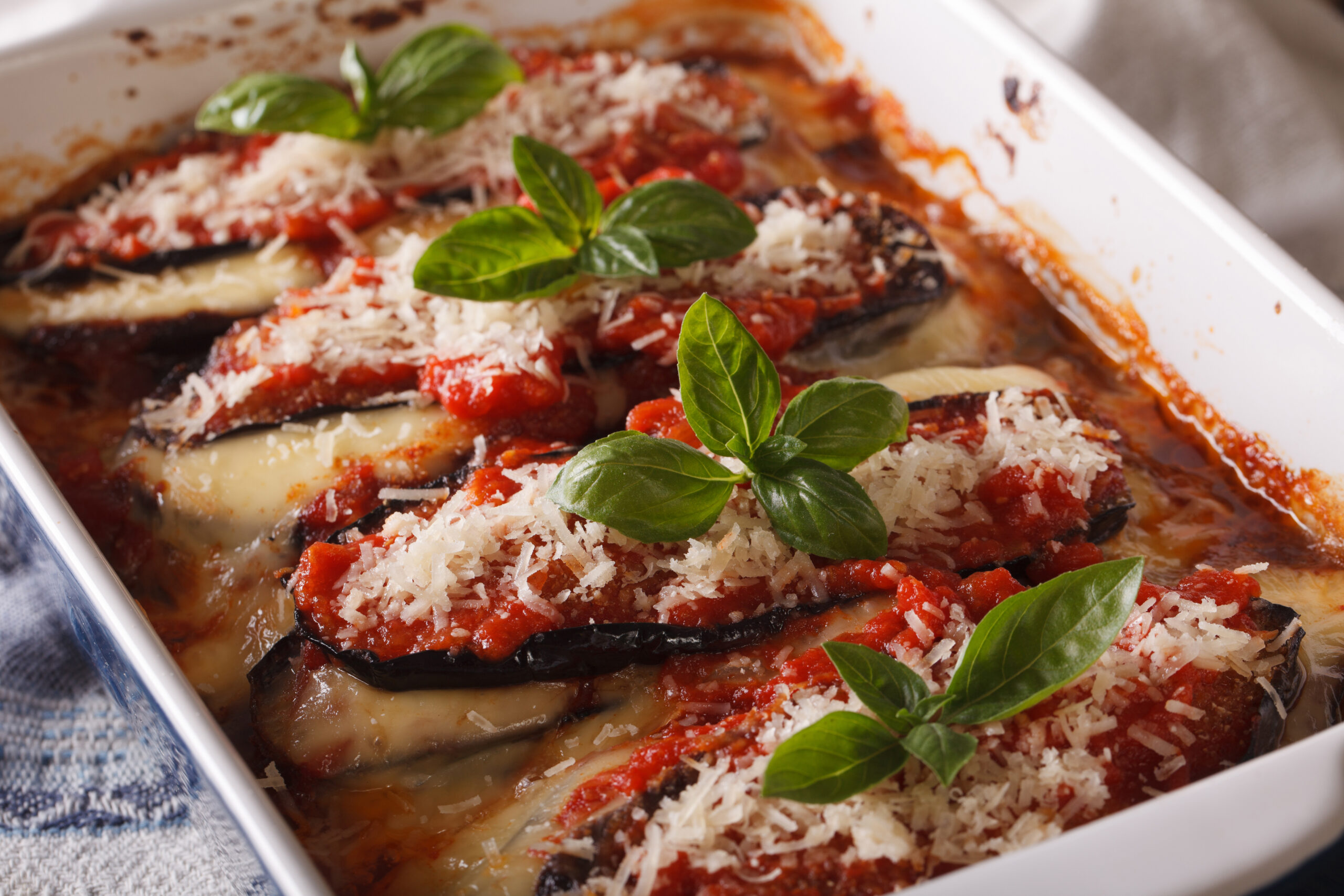
It depends on how it’s made. A traditional version — breaded, deep-fried, and layered with a generous amount of cheese — ends up calorie-dense. Bake the eggplant instead (like in the Eggplant “Lasagna” recipe above) and go a little lighter on the cheese. That can keep most of the flavor without as much saturated fat.
What should you serve with eggplant parmesan?
Because eggplant parmesan is already rich, it pairs best with something lighter to balance it out: a green salad with a bright vinaigrette, steamed or roasted green vegetables, or — if you want to lean fully into the Italian theme — a side of whole-grain pasta.
What can you make with eggplant besides parmesan?
Eggplant works well roasted as a simple side dish with olive oil and garlic, blended into a smoky dip like baba ganoush, diced into pasta sauce or chili, or grilled and layered onto a sandwich.
The Easy Way
to lose weight and get healthy.
Find more healthy eggplant recipes with Noom
Once you look past the initial learning curve, eggplant can be easy and healthy to make. It’s naturally low in calories and carbs, delivers about 2.5 grams of fiber for roughly 35 calories a cup, and carries plant compounds like nasunin that researchers are still studying for their broader health effects.
Once you know how to pick a firm one, cut it for the method you’re using, and cook it with a light hand on the oil, eggplant becomes an easy, inexpensive vegetable to cook confidently year-round.
If you’re looking for more eggplant recipes, start your free trial of Noom. You’ll get access to thousands of recipes plus a food tracker, easy lessons for learning how to eat and move healthier, and a dedicated community to help you reach your goals.
Editorial standards
At Noom, we’re committed to providing health information that’s grounded in reliable science and expert review. Our content is created with the support of qualified professionals and based on well-established research from trusted medical and scientific organizations. Learn more about the experts behind our content on our Health Expert Team page.