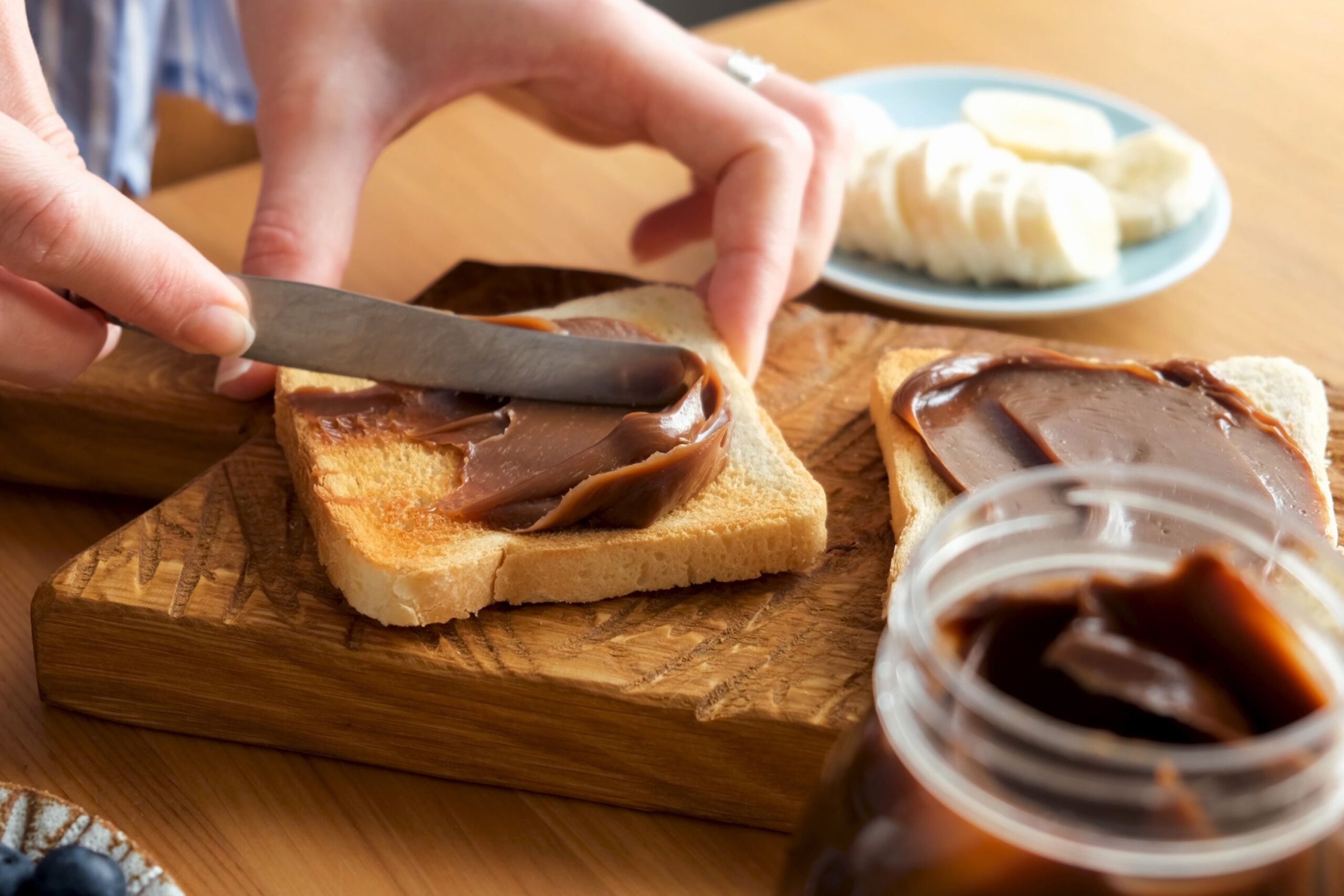
Nutella is one of the world’s most popular spreads. It’s sold in 170 countries, and a jar sells about every two seconds. Its combination of chocolate and roasted hazelnut—and the fact that you can spread it straight from the jar—makes it an easy way to add something sweet to fruit, toast, pancakes, Greek yogurt, oatmeal, and more.
But if you’re trying to lose weight, you might wonder whether something that tastes this dessert-like can still fit into your plan.
It can. You don’t have to give up the foods you enjoy to lose weight. In fact, research suggests that a more flexible approach to eating, rather than rigidly restricting certain foods, can make healthy habits easier to stick with over time. What matters more is understanding what a food provides, how much you’re eating, and how it fits into your overall eating pattern.
Nutella is relatively calorie-dense and high in added sugar: Two tablespoons have 200 calories and 19 grams of added sugar. It also doesn’t provide much protein or fiber, which can help you feel full. But that doesn’t mean Nutella has to be off-limits. A smaller amount paired with more filling foods—like fruit, whole-grain toast, or Greek yogurt—can give you the chocolate-hazelnut flavor you want while making your meal or snack more satisfying.
Ahead, we’ll break down Nutella’s calories and nutrition, what’s actually in it, and practical ways to enjoy it if weight loss is your goal.

The Easy Way
to lose weight and get healthy.
✅ Quick answer: Is Nutella good for weight loss?
- Nutella isn’t specifically a weight-loss food, but you don’t have to give it up to lose weight. One tablespoon has about 100 calories and 10 grams of added sugar, so portion size can make a meaningful difference. Measuring out a tablespoon rather than eating it straight from the jar can help you see how much you’re having, while pairing it with foods that contain protein or fiber can make it part of a more filling meal or snack.
🚀 How Nutella can fit into a weight-loss plan
Nutella won’t directly help you lose weight, but you don’t have to give it up. Here are a few ways to enjoy it while working toward your goals:
- You can make room for foods you love – Trying to completely avoid favorite foods can be hard to maintain. In one survey of 223 adults, people who were more flexible about what they ate reported less overeating and lower body weight than those who followed rigid food rules. One tablespoon of Nutella has 100 calories, so measuring out a portion can help you enjoy it while keeping track of your daily intake.
- Pair it with more filling foods – Nutella adds a lot of flavor in a small amount. Try a tablespoon with strawberries, banana slices, oatmeal, or Greek yogurt to add sweetness while getting more fiber, protein, or volume. A tablespoon spread on a medium apple, for example, comes to about 195 calories and gives you around 4 grams of fiber.
- A little can go a long way – Nutella is sweet and rich, so you may find that you don’t need a lot to get the flavor you’re looking for. Start with a measured tablespoon and see if that feels satisfying.
⚠️ Things to be mindful of when eating Nutella
- It’s calorie-dense – Two tablespoons have 200 calories, about the same as two medium bananas. The difference? Two bananas give you much more food for those calories. If weight loss is your goal, measuring Nutella rather than scooping it straight from the jar can make portions easier to keep track of.
- It’s low in protein and fiber – Two tablespoons have 2 grams of protein and 1 gram of fiber, along with 19 grams of added sugar, or 38% of the RDA. Pairing Nutella with fruit, Greek yogurt, or another source of protein or fiber can make it more filling.
- It contains saturated fat – Two tablespoons have 4 grams of saturated fat, or 20% of the RDA, much of it from palm oil. Research suggests palm oil can raise LDL cholesterol compared with oils lower in saturated fat. You don’t need to avoid Nutella because of this, but it’s another reason to be mindful of how much you eat, especially if it’s something you have often.
🥗 Nutella: Nutrition facts (per 2 tablespoons, 37 grams)
Nutella is made with sugar, palm oil, hazelnuts (13%), skim milk powder (8.7%), cocoa (7.4%), soy lecithin, and vanillin, an artificial flavor. Ingredients are listed by weight, so you’ll see that sugar and palm oil make up the biggest share of the jar, with hazelnuts and cocoa much smaller. Here’s what that adds up to in a serving:
| Nutrient | Amount | % RDA* |
|---|---|---|
| Calories | 200 calories | 10% |
| Protein | 2 g | 4% |
| Total carbs | 22 g | 8% |
| Fiber | 1 g | 4% |
| Sugars | 21 g | — |
| – Added sugars | 19 g | 38% |
| Total fat | 11 g | 14% |
| – Saturated fat | 4 g | 20% |
| – Monounsaturated fat | Not listed | — |
| – Polyunsaturated fat | Not listed | — |
| Omega-3 | Not listed | — |
| Omega-6 | Not listed | — |
*Recommended dietary allowance (RDA) is defined as the average daily amount of nutrients needed to meet the requirements of nearly all healthy people in a specific group.
The biggest thing to notice is that Nutella packs 200 calories into a relatively small serving without much protein or fiber to help with fullness. That doesn’t make it off-limits, but it does make what you pair it with more important.
Try using Nutella as a flavor boost rather than the main part of a snack. A tablespoon with fresh fruit, Greek yogurt, or whole-grain toast gives you the chocolate-hazelnut flavor while adding more protein, fiber, or volume. Measuring it can also help: A tablespoon has about 100 calories, so you can start there and add more if you want it.
💊 Nutella: Vitamins & minerals (per 2 tablespoons, 37 grams)
Nutella contains small amounts of a few vitamins and minerals, mainly from ingredients like hazelnuts, cocoa, and skim milk powder.
| Vitamin/Mineral | Amount | % RDA* |
|---|---|---|
| Iron | 1 mg | 6% |
| Calcium | 40 mg | 4% |
| Potassium | 170 mg | 4% |
*Recommended dietary allowance (RDA) is defined as the average daily amount of nutrients needed to meet the requirements of nearly all healthy people in a specific group.
Nutella provides some iron, calcium, and potassium, but not enough to make it a significant source of these nutrients. Think of them as a small nutritional bonus rather than a reason to eat Nutella.
If you enjoy Nutella, pair it with foods that bring more nutrition to the mix. Fruit can add fiber, vitamins, and minerals, while Greek yogurt can add protein and calcium. That way, Nutella brings the chocolate-hazelnut flavor while the foods you pair it with do more of the nutritional heavy lifting.
🔍 Nutrient breakdown of Nutella
Glycemic index (GI) of Nutella
Glycemic index: About 33 (low)
The Easy Way
to lose weight and get healthy.
💡 Tip: Nutella has a relatively low GI, meaning it tends to raise blood sugar more gradually than high-GI foods. The figure comes from an Australian version of Nutella, so consider it an estimate. And remember: A low GI doesn’t necessarily make a food better for weight loss—calories, portions, and what you eat with it still matter.
Is Nutella high in protein?
❌ No: Nutella has 2 grams of protein per two-tablespoon serving, mainly from ingredients like skim milk powder and hazelnuts.
Higher-protein alternatives: Peanut butter | Almond butter | Greek yogurt
Is Nutella high in fiber?
❌ No: Nutella has 1 gram of fiber per serving. Hazelnuts and cocoa contain fiber, but they make up a relatively small portion of the spread.
💡 Tip: Pair it with a higher-fiber food. Raspberries, for example, have about 8 grams of fiber per cup.
Is Nutella low in carbs?
❌ No: Nutella has 22 grams of carbohydrates per serving, including 21 grams of sugar.
💡 Tip: If you’re watching your carbohydrate intake, portion size matters. One tablespoon has about half the carbs and calories of the two-tablespoon serving.
Is Nutella gluten-free?
✔️ Yes: Nutella has no gluten-containing ingredients, and Ferrero lists it as gluten-free. It does contain milk, soy, and hazelnuts. If you have celiac disease or a gluten allergy or sensitivity, check the current label before eating it.
Is Nutella good for fat loss?
✔️ It can fit: No single food causes fat loss, but Nutella can fit into a calorie deficit. One tablespoon has about 100 calories, so measuring a portion can make it easier to account for while still enjoying a food you like.
🍽️ Diet compatibility: Which diets include Nutella?
Nutella can fit some eating patterns more easily than others. Its added sugar and milk make it less compatible with keto, paleo, and vegan diets, while gluten-free and Mediterranean-style eating leave more room for it.
| Diet | ✅ / ❌ | Why |
|---|---|---|
| Keto | ❌ | A serving has about 21 grams of net carbs, while many keto plans limit net carbs to about 20 to 50 grams per day. Even a small amount can take up a significant share of that total. |
| Paleo | ❌ | Paleo diets generally avoid refined sugar, dairy, and highly processed foods. Nutella contains sugar, skim milk powder, palm oil, and soy lecithin, although hazelnuts and cocoa themselves can fit a paleo pattern. |
| Mediterranean | ✅ | Mediterranean-style eating focuses on an overall pattern rather than eliminating sweets. Nutella can fit occasionally in a smaller portion, although foods like nuts, fruit, whole grains, and olive oil are emphasized more often. |
| Vegan | ❌ | Nutella contains skim milk powder, so standard Nutella isn’t vegan. Dairy-free chocolate-hazelnut spreads are available if you want a vegan alternative. |
| Gluten-free | ✅ | Nutella doesn’t contain gluten-containing ingredients. If you have celiac disease, check the current label and make sure foods you pair it with, such as bread or waffles, are also gluten-free. |
If Nutella doesn’t fit the eating pattern you follow, you have options. Almond or hazelnut butter can work with keto, paleo, and vegan eating patterns, while peanut butter can work for keto and vegan diets. Check the label for added sugar if that’s something you’re limiting.
Nut butters generally offer more protein and fiber than Nutella, but they also taste very different. If what you really want is chocolate-hazelnut spread, choosing an alternative you don’t enjoy may not feel like much of a swap.
🌟 Is Nutella healthy? The health benefits
Nutella contains hazelnuts, cocoa, and milk, which provide small amounts of protein, vitamins, minerals, and other nutrients. But those ingredients make up a relatively small portion of the spread, while sugar and palm oil are the first two ingredients.
That doesn’t mean Nutella is “unhealthy” or that you need to avoid it. It just means there isn’t much evidence that Nutella itself provides specific health benefits. If you enjoy it, think of it primarily as a sweet spread that can fit into an overall balanced diet rather than a food you need to eat for its health effects.
Metabolic health: Is Nutella good for your metabolism?
- Boosts metabolism? ❌ No – There’s no evidence that Nutella boosts metabolism or meaningfully increases how many calories you burn. Protein requires more energy to digest than carbohydrates or fat, but Nutella has just 2 grams per serving.
- Improves insulin sensitivity? ❌ Not proven – Nutella has a relatively low GI, meaning it tends to raise blood sugar more gradually than higher-GI foods. But Nutella itself hasn’t been shown to improve insulin sensitivity, and a serving contains 19 grams of added sugar.
💡 Tip: Instead of focusing on whether Nutella can boost your metabolism, think about how it fits into the bigger picture. Portion size and what you pair it with will matter more for weight management than any potential metabolic effect.
Cholesterol impact: Does Nutella affect cholesterol levels?
- Does it lower LDL (bad) cholesterol? ❌ Not likely – Hazelnuts have been associated with lower LDL cholesterol in studies, but the amounts studied are much larger than what you get from Nutella. A serving of Nutella contains only about 5 grams of hazelnuts.
- Palm oil is also a major ingredient. A review of clinical trials found that palm oil raised LDL cholesterol compared with vegetable oils lower in saturated fat.
- Does it raise HDL (good) cholesterol? ⚠️ Possibly, but that doesn’t tell the whole story – The same review found a small increase in HDL cholesterol with palm oil, but Nutella itself hasn’t been studied for this effect. An increase in HDL also doesn’t cancel out the importance of keeping LDL cholesterol in a healthy range.
- Overall impact on heart health? Nutella has 4 grams of saturated fat per two-tablespoon serving. The American Heart Association recommends limiting saturated fat to about 6% of daily calories for people trying to lower cholesterol—about 13 grams per day on a 2,000-calorie diet.
💡 Tip: You don’t need to avoid Nutella because it contains saturated fat. If you enjoy it regularly, pay attention to how it fits with other sources of saturated fat in your day and get most of your fats from unsaturated sources like nuts, seeds, avocado, and olive oil.
Can you eat Nutella in a calorie deficit?
✔️ Yes: Nutella can fit into a calorie deficit just like any other food. One tablespoon has about 100 calories, so measuring a portion can help you see how much you’re adding to a meal or snack.
💡 Tip: Start with a tablespoon and see if that gives you enough chocolate-hazelnut flavor. You can always add more if you want it.
Is Nutella rich in antioxidants?
⚠️ It contains some: Cocoa contains polyphenols and hazelnuts provide vitamin E, both of which have antioxidant properties. But cocoa makes up about 7% of Nutella and hazelnuts about 13%, so you’ll get more of these compounds by eating cocoa and hazelnuts themselves.
💡 Tip: Pair Nutella with strawberries or raspberries for a sweet snack that also adds fiber, vitamin C, and antioxidants from the fruit.
Access GLP-1 Weight Loss with Noom
Explore a wide range of prescription medications supported by Noom’s program.
Microdose GLP-1rx
Noom GLP-1rx
Noom GLP-1rx Plus
Wegovy®
Ozempic®
Metformin
Zepbound®
Mounjaro®
Liraglutide
Does Nutella support gut health and digestion?
⚠️ Not significantly: Nutella has just 1 gram of fiber per serving and doesn’t contain probiotics, and research hasn’t looked at whether Nutella affects the gut microbiome. Foods you pair with it—such as berries, oats, or whole-grain bread—can contribute much more fiber.
Nutella also contains skim milk powder, so people who are sensitive to lactose may want to pay attention to how they feel after eating it.
Does Nutella help you feel full?
⚠️ Not on its own: A two-tablespoon serving has 2 grams of protein and 1 gram of fiber, so Nutella isn’t particularly high in two nutrients associated with fullness.
💡 Tip: You don’t have to eat Nutella by itself. Pair it with protein- or fiber-rich foods like Greek yogurt, fruit, or whole-grain toast to make a more filling snack.
Can Nutella help with nighttime cravings?
⚠️ It might satisfy a craving: If you’re craving something sweet or chocolatey, including a food you genuinely enjoy may be more satisfying than trying to avoid it or substituting something that doesn’t hit the spot. Nutella hasn’t been specifically studied for nighttime cravings, though, and it isn’t especially filling on its own.
💡 Tip: Decide how much you want and pair it with something more filling, like fruit or Greek yogurt. That gives you the flavor you’re craving while turning it into a more substantial snack.
🍽️ Best ways to eat Nutella for weight loss
If you love Nutella, there’s no reason to give it up when you’re trying to lose weight. Instead, think about what you eat it with and how you can add protein, fiber, or volume to make it more filling.
- Spread it on toast with fruit: Try a tablespoon of Nutella on whole-grain toast topped with sliced strawberries or banana. You still get Nutella in every bite, while the whole grains and fruit add fiber and make it a more substantial snack.
- Use it as a dip for fruit: Strawberries, banana slices, and apple wedges all pair well with Nutella. A cup of strawberries has about 50 calories and 3 grams of fiber; add a tablespoon of Nutella, and you have a sweet snack for about 150 calories.
- Swirl it into Greek yogurt: Mix a teaspoon or two of Nutella into plain Greek yogurt for chocolate-hazelnut flavor plus plenty of protein. Three-quarters of a cup of nonfat Greek yogurt with a teaspoon of Nutella has roughly 130 calories and 17 grams of protein.
🍏 Nutella vs. nut butters
Nutella is often compared with nut butter because they’re used in many of the same ways—spread on toast, paired with fruit, or added to oatmeal. But nutritionally, they’re pretty different. Here’s how they compare in a typical serving of about 2 tablespoons each:
| Food | Calories | Carbs | Fiber | Protein | Fat |
|---|---|---|---|---|---|
| Nutella (37 g) | 200 | 22 g | 1 g | 2 g | 11 g |
| Peanut butter, smooth (32 g) | 190 | 8 g | 2 g | 7 g | 16 g |
| Almond butter, plain (32 g) | 196 | 6 g | 3.3 g | 6.7 g | 17.8 g |
| Hazelnut butter, unsweetened (32 g)* | 201 | 5.3 g | 3.1 g | 4.8 g | 19.4 g |
The calories are surprisingly similar. Nutella has less total fat than the nut butters, but it has more sugar and less protein and fiber.
That doesn’t make one spread universally “better” than another. If you’re looking for more protein and fiber with less sugar, peanut, almond, or unsweetened hazelnut butter may be a better fit. If what you really want is chocolate-hazelnut flavor, Nutella can fit, too.
You can also combine them. Try a little Nutella with peanut or almond butter to get the chocolate flavor along with more protein and fiber.
Frequently asked questions about Nutella and weight loss
How many calories are in Nutella?
One tablespoon (about 19 grams) has about 100 calories, while the two-tablespoon serving listed on the jar (37 grams) has 200 calories. Per 100 grams, Nutella has about 540 calories. Measuring it occasionally can help you get a sense of how much you’re using.
How much Nutella can you eat a day when trying to lose weight?
There’s no set amount of Nutella you can or can’t eat when trying to lose weight. What matters is how it fits into your overall calorie and nutrient needs. One tablespoon has about 100 calories and 10 grams of added sugar, so portion size can make a difference if you eat it regularly.
The American Heart Association recommends limiting added sugar to 25 grams per day for women and 36 grams for men. That doesn’t mean you need to avoid Nutella, but it can help put the added sugar in a serving into context.
Does Nutella have more calories than peanut butter?
Yes, but not by much. Two tablespoons of Nutella have 200 calories, compared with about 190 calories in two tablespoons of peanut butter. The bigger difference is the nutrition they provide. Peanut butter typically has more protein and fiber and much less added sugar.
If weight loss is your goal, either can fit. Peanut butter may be more filling because of its higher protein and fiber content, while Nutella can make sense when what you really want is chocolate-hazelnut flavor.
Does Nutella cause weight gain?
Not on its own. Weight gain generally happens when you consistently take in more calories than your body uses over time. Nutella is calorie-dense, so larger portions can add a significant number of calories, but no single food automatically causes weight gain.
Can you eat Nutella every day and still lose weight?
Yes. You can eat Nutella regularly and still lose weight if your overall eating pattern keeps you in a calorie deficit. If you have it frequently, consider how its calories, added sugar, and saturated fat fit into the rest of your day rather than thinking of Nutella as something you need to eliminate.
Is Nutella okay for people with diabetes?
Nutella has a relatively low glycemic index, but a two-tablespoon serving still has 22 grams of carbohydrates and 19 grams of added sugar. If you have diabetes, portion size and what you eat with Nutella can affect your overall carbohydrate intake and blood sugar response. Your healthcare provider or registered dietitian can help you determine how it fits into your individual eating plan.
What allergens are in Nutella?
Nutella contains hazelnuts, milk, and soy. Hazelnuts are tree nuts, so Nutella isn’t suitable for people with a hazelnut allergy. People with milk or soy allergies should also avoid it.
If you have a food allergy, always check the ingredient and allergen statements on the current jar, since formulations and manufacturing information can change.
Is Nutella gluten-free?
Yes. Nutella doesn’t contain gluten-containing ingredients, and it’s listed as gluten-free. If you have celiac disease or need to strictly avoid gluten, check the current label and make sure anything you eat it with—such as bread, waffles, or pancakes—is gluten-free too.
Is there a healthier alternative to Nutella?
It depends on what you want from your spread. Peanut, almond, and unsweetened hazelnut butters generally provide more protein and fiber and less added sugar than Nutella, but they have about the same number of calories.
If what you want is chocolate-hazelnut spread, compare labels to find one that works for you. And if Nutella is the one you actually enjoy, you don’t necessarily need to replace it—portion size and what you pair it with can help it fit into an overall balanced diet.
🧠 The bottom line: Nutella can fit into a weight-loss plan
Nutella isn’t a food that directly promotes weight loss, but you don’t have to give it up if you’re trying to lose weight. Two tablespoons have 200 calories, 19 grams of added sugar, 2 grams of protein, and 1 gram of fiber, so it packs quite a few calories into a relatively small serving without much protein or fiber.
The key is to think about how Nutella fits into your overall eating pattern. Try spreading it on whole-grain toast, dipping fruit into it, or swirling some into Greek yogurt. Pairing it with foods that provide protein, fiber, or volume can make your meal or snack more filling while still giving you the chocolate-hazelnut flavor you want.
And remember, weight loss doesn’t require eating perfectly or eliminating favorite foods. What you eat consistently over time matters more than any single food. If Nutella is something you enjoy, there’s room for it in a balanced eating pattern that supports your goals.
Noom’s Most Powerful Program
A dual-pathway GLP-1 and behavior change for lasting results.
📖 Scientific evidence
Nutella itself hasn’t been studied specifically for weight loss or most of its potential health effects, but research on Nutella, its ingredients, and broader eating patterns can help put its nutrition into context.
- Nutella’s added sugar matters mostly because of the calories it adds. (BMJ, 2013) A large review found that adults who ate less sugar lost about 1.8 pounds on average, while those who ate more gained about 1.7 pounds. But when researchers compared diets with the same number of calories, changing the amount of sugar didn’t significantly affect weight. For Nutella, that means its 19 grams of added sugar are worth keeping in mind, but your overall calorie intake matters more for weight loss.
- You don’t necessarily need to cut out foods like Nutella to lose weight. (Journal of Nutrition in Gerontology and Geriatrics, 2018) In a six-month weight-loss study of 61 women with an average age of 69, those who became more flexible about what they ate—and relied less on strict food rules—tended to lose more weight. The study wasn’t about Nutella specifically, but it suggests that you don’t necessarily have to cut out foods you enjoy to make progress toward your weight-loss goals.
- The hazelnuts in Nutella are nutritious, but there aren’t enough to provide the benefits seen in hazelnut studies. (Nutrients, 2016) A review of nine studies found that hazelnut-enriched diets were associated with lower LDL and total cholesterol without significant changes in BMI. But the studies used about 29 to 69 grams of hazelnuts per day, while a two-tablespoon serving of Nutella contains only about 5 grams.
- The palm oil in Nutella makes your overall saturated fat intake worth considering. (The Journal of Nutrition, 2015) A review of clinical trials found that palm oil raised LDL (“bad”) cholesterol more than oils that are lower in saturated fat. The research wasn’t on Nutella itself, so we can’t say Nutella has the same effect. But since two tablespoons contain 4 grams of saturated fat, it’s worth considering how much saturated fat you’re getting from other foods throughout the day, too.
- Nutella raised blood sugar more than a lower-sugar chocolate spread in people with type 1 diabetes. (Nutrition & Diabetes, 2026) In a study of 30 adults ages 18 to 28 with type 1 diabetes, researchers compared what happened to blood sugar after participants ate Nutella or a similar chocolate spread with much less sugar. Blood sugar rose less after the lower-sugar spread. Participants didn’t take insulin before eating either spread, though, so the results don’t tell us how Nutella would affect someone who takes insulin with their food as usual.
Editorial standards
At Noom, we’re committed to providing health information that’s grounded in reliable science and expert review. Our content is created with the support of qualified professionals and based on well-established research from trusted medical and scientific organizations. Learn more about the experts behind our content on our Health Expert Team page.